Sponsored

Cold weather battery conditioning vs driving efficiency

Mellowyellow

Well-Known Member
Joined
Jan 27, 2024
Threads
13
Messages
980
Reaction score
1,499
Location
NY
Vehicles
R1S
Clubs
 
Gen1 R1S and this is my second winter with the car.

With the weather getting colder, I'm seeing my efficiency start to go down. I was wondering if anyone had done any studies or research into:

1. How much energy goes into conditioning the battery ready for departure? What is the ideal battery temp? And how much energy does it take to get there as a function of ambient temp?

2. What is the increased driving efficiency of conditioning your battery vs not?

Does it make sense to condition your battery before departure or just get in and drive it cold? I realize this must be functions of ambient temp and miles driven on your trip. Which one uses less energy?

Also disclaimer I did try the search function but couldn't find any real data, just anectodes.
Sponsored

 

Thedude

Well-Known Member
Joined
Oct 28, 2022
Threads
4
Messages
1,637
Reaction score
2,929
Location
Alaska
Vehicles
R1T
How cold is cold and does the truck sit outside in it all night? Big advantage of preconditioning is the battery is already warm meaning you have full power and regen available from the start. With a battery below about 10° I often had no regen, limited power and sometimes turtle mode until the pack warmed itself up.
 

3wisemonkeyz

Well-Known Member
Joined
Sep 9, 2022
Threads
0
Messages
87
Reaction score
106
Location
Minneapolis
Vehicles
Kia Telluride
Clubs
 
Not apples to apples but several folks on YouTube have tested this on Teslas.


Sounds like the main benefits are maxing out your range (assuming you need it all to get to your destination) and longevity of the battery. The actual cost benefit is a wash.
 

sherold

Well-Known Member
Joined
Jan 7, 2022
Threads
0
Messages
282
Reaction score
423
Location
Indiana
Vehicles
Audi S3, VW Atlas
I remember reading last year somewhere that "perfect" battery temp was around 90°F for best efficiency, above 70° is ideal for starting a trip. Not sure what facts backed it up though.

There is a ton of data there that likely only Rivian is privy to currently. So many variables come into play on this one, ambient temp, humidity, wind, starting battery temp, battery pack size, motor configuration, drive mode selection, and personal driving style to name a few.

I personally would just like to know at what battery temperature it will actually start pre-conditioning the battery, when requested? So many times when I used this feature last year, it only pre-conditioned the cabin, not the battery. Typical battery temps were in the low-mid 50°F. If I was really trying to pre-condition for a log trip, I'd like the possibility of using shore power to help get that heat into the battery pack.
 

Invzibl

Active Member
First Name
Jaysyn
Joined
May 2, 2024
Threads
2
Messages
41
Reaction score
16
Location
Michigan
Vehicles
2023 R1T
how does one precondition the battery? This will be my first winter. In SW Michigan.

Do you do that by just setting the climate like 10 minutes before I am going to leave in the morning?
 

Sponsored

sherold

Well-Known Member
Joined
Jan 7, 2022
Threads
0
Messages
282
Reaction score
423
Location
Indiana
Vehicles
Audi S3, VW Atlas
how does one precondition the battery? This will be my first winter. In SW Michigan.

Do you do that by just setting the climate like 10 minutes before I am going to leave in the morning?
We do not have the option to explicitly precondition the battery to a certain temp, only the cabin. The BMS will determine if it needs to condition the batteries. If you are plugged into shore power with the climate schedule active, it will condition the batteries IF it "needs" to. Sounds like that magical temp is ≈40°F

https://www.rivianforums.com/forum/threads/preconditioning-confusion.23256/post-467463
 
OP
OP
Mellowyellow

Mellowyellow

Well-Known Member
Joined
Jan 27, 2024
Threads
13
Messages
980
Reaction score
1,499
Location
NY
Vehicles
R1S
Clubs
 
I remember reading last year somewhere that "perfect" battery temp was around 90°F for best efficiency, above 70° is ideal for starting a trip. Not sure what facts backed it up though.

There is a ton of data there that likely only Rivian is privy to currently. So many variables come into play on this one, ambient temp, humidity, wind, starting battery temp, battery pack size, motor configuration, drive mode selection, and personal driving style to name a few.

I personally would just like to know at what battery temperature it will actually start pre-conditioning the battery, when requested? So many times when I used this feature last year, it only pre-conditioned the cabin, not the battery. Typical battery temps were in the low-mid 50°F. If I was really trying to pre-condition for a log trip, I'd like the possibility of using shore power to help get that heat into the battery pack.
Yup I was looking for some empirical data, plotted graphs, etc. Rivian must have it. It seems like cost wise it may be a wash. If you want to maximize range upon departure, plug in your car and if it is below 50F it should warm the battery up.
 

R1Thor

Well-Known Member
First Name
Joe
Joined
Aug 9, 2023
Threads
8
Messages
1,533
Reaction score
2,415
Location
Lancaster, PA
Vehicles
23QM R1T, Limestone + Ocean Coast, 21" & UBS
Occupation
Mechanical Engineering Lead
Clubs
 
My personal anecdote: when the battery did precondition, you weren't netting positive. That is, even though your reported efficiency was better during your drive, your totality of power consumption didn't improve.

Which is logical: you needed to use the energy EITHER during the pre-condition process, or as a 'loss of efficiency' during your drive (which would also be actively affecting the battery and drivetrain temperature).

So, I really don't worry about pre-setting climate unless 1- it's really extreme and I want to be comfy, but I'm spoiled and have a relatively well insulated garage, so not often or 2- I really need to maximize my on-road range and the truck is obviously at the time drawing from shore power. But then I fully understand I'm still paying for those electrons to pre-condition the vehicle, so...it all comes out in the wash, as they say.
 

MountainBikeDude

Well-Known Member
First Name
Adam
Joined
Jun 20, 2019
Threads
54
Messages
3,334
Reaction score
7,085
Location
Vancouver
Vehicles
2023 El Cap Quad Motor R1T (Selling the Xterra)
Clubs
 
The best way to "Condition" your battery if needed ahead of a drive, is to schedule your charging in such a way that it completes just prior to your departure. The nature of charging the batteries themselves will warm them gradually, resulting in less loss of efficiency both in charging, and driving.
 
OP
OP
Mellowyellow

Mellowyellow

Well-Known Member
Joined
Jan 27, 2024
Threads
13
Messages
980
Reaction score
1,499
Location
NY
Vehicles
R1S
Clubs
 
My personal anecdote: when the battery did precondition, you weren't netting positive. That is, even though your reported efficiency was better during your drive, your totality of power consumption didn't improve.

Which is logical: you needed to use the energy EITHER during the pre-condition process, or as a 'loss of efficiency' during your drive (which would also be actively affecting the battery and drivetrain temperature).

So, I really don't worry about pre-setting climate unless 1- it's really extreme and I want to be comfy, but I'm spoiled and have a relatively well insulated garage, so not often or 2- I really need to maximize my on-road range and the truck is obviously at the time drawing from shore power. But then I fully understand I'm still paying for those electrons to pre-condition the vehicle, so...it all comes out in the wash, as they say.
This is what I'm seeing anecdotally as well.
 

Sponsored

OP
OP
Mellowyellow

Mellowyellow

Well-Known Member
Joined
Jan 27, 2024
Threads
13
Messages
980
Reaction score
1,499
Location
NY
Vehicles
R1S
Clubs
 
The best way to "Condition" your battery if needed ahead of a drive, is to schedule your charging in such a way that it completes just prior to your departure. The nature of charging the batteries themselves will warm them gradually, resulting in less loss of efficiency both in charging, and driving.
This is what I try to do but it is difficult to time it. Meaning, if I want to leave first thing in the morning on a longer trip, I want to charge to 100%. The time estimates on the app/vehicle to get to 100% vary widely making scheduling the charging a moving target.
 

MountainBikeDude

Well-Known Member
First Name
Adam
Joined
Jun 20, 2019
Threads
54
Messages
3,334
Reaction score
7,085
Location
Vancouver
Vehicles
2023 El Cap Quad Motor R1T (Selling the Xterra)
Clubs
 
This is what I try to do but it is difficult to time it. Meaning, if I want to leave first thing in the morning on a longer trip, I want to charge to 100%. The time estimates on the app/vehicle to get to 100% vary widely making scheduling the charging a moving target.
Fiar point, which is why they really need to implement a scheduled departure option to the charging. In the absence of it, you can plug your vehicle in, initiate charging, see how long it predicts, and then work backwards from your departure time, but maybe add a 1 hour buffer for that top level BMS sway.
 

Singletracker

Well-Known Member
Joined
Mar 10, 2022
Threads
39
Messages
1,304
Reaction score
1,275
Location
NV
Vehicles
2023 R1T QM w/20” A/T’s
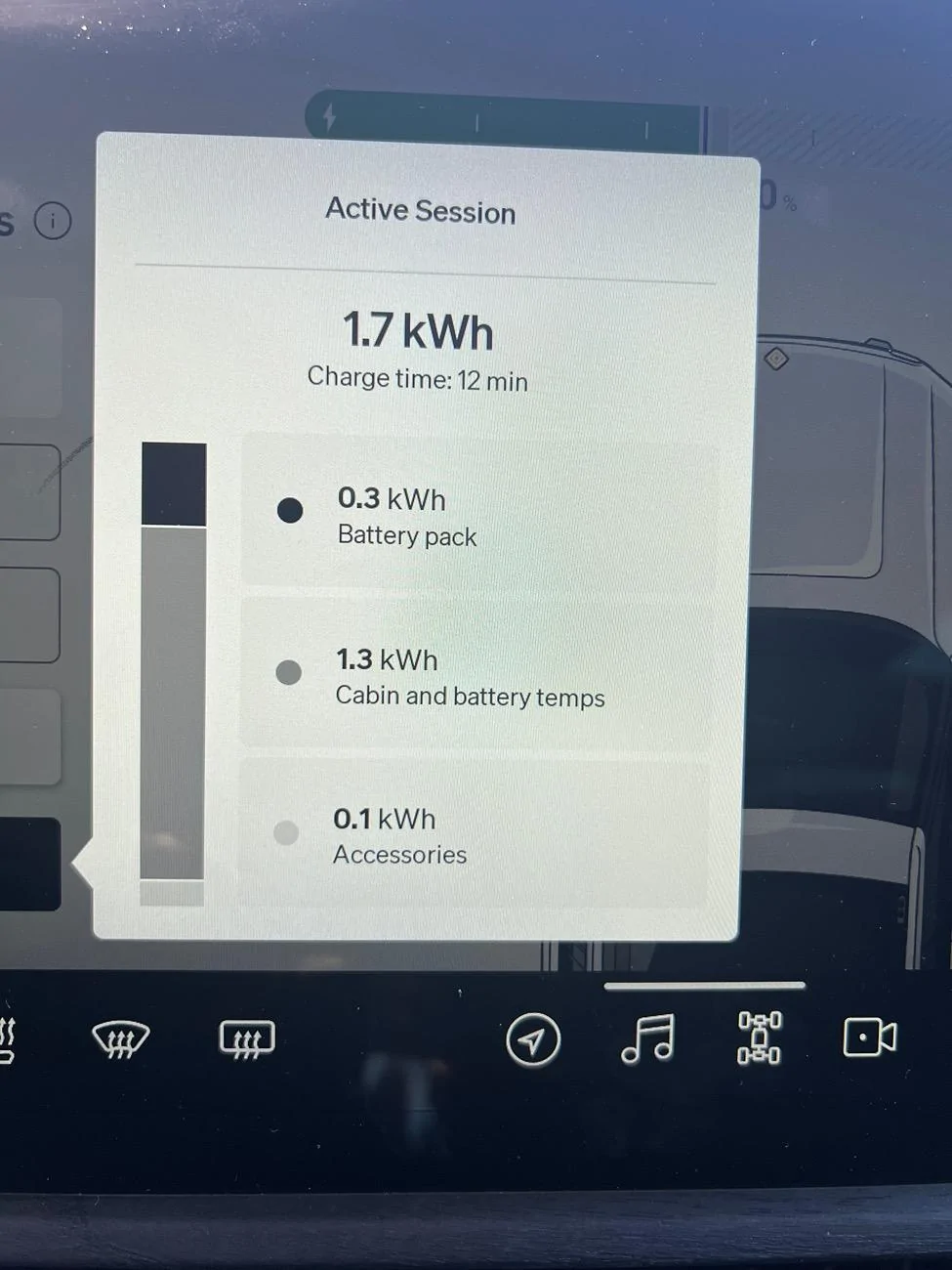
I did an experiment today, after a fairly cold night with temps in the 30’s. The T had been outside, plugged in all night, buy not charging. The motor temps were very low - probably around 50 degrees. The HV battery was sitting at 47 degrees. My battery percentage was at 47%. I manually set it charge only to 50%, as I just wanted to see what would happen. For the first 10+ minutes or so, pretty much all the juice seemed to be going into heating up the motors. They quickly shot up to as high as 230 degrees! Whoa! That was a surprise! Meanwhile, the HV battery remained unchanged at 47 degrees. As you can see from the screen shot, .1 kWh went in the accessories and 1.3 kWh went to ”Cabin and Battery Temps“ during this time. The cabin conditioning was not on. That “battery temps” was pretty much heating the 4 motors, I assume. During this period very little was going into the HV battery and its temp was staying at 47 degrees. After about 10+ minutes, the HV battery began to warm up. Once it hit 50 degrees, it was game on and all the power was going straight into it. The motor temps backed off to a more normal range. As you can see in the pic, at the 12 minute mark the main battery is just starting to take some juice, but had only received .3 kWh. It ramped up pretty quickly after this. End of experiment ?

Here’s my take away. If one wants to quickly precondition the HV battery, without having it on a set schedule, manually set the charge limit at least a couple of percentage points higher than the current battery percentage. Of course, this can be done remotely, if the rig is plugged in. Based on my experiment, it may take at 12-15 minutes to get it properly conditioned. Then away you go.

Rivian R1T R1S Cold weather battery conditioning vs driving efficiency IMG_0465
 

Kidentist

Well-Known Member
First Name
Carlitos way
Joined
Oct 28, 2021
Threads
2
Messages
271
Reaction score
324
Location
PNW
Vehicles
Audi A3, Cayenne E-Hybrid, R1T DM Std.+
Occupation
Mouth Janitor
Interesting thread!!!
I live in central WA so over the last couple of weeks the temps in the morning (usually I leave at 7:30 am) are in the low 30s, it will get much colder soon. My efficiency has been DRASTICALLY different.
The truck has averaged 2.4 mi/KwH since new (4300 miles and change), now I'm lucky if I see 1.6 on my morning drive. I guess that's the price I pay for leaving the truck outside (unplugged unless charging). I do pre-condition the cabin about 10 minutes before departing and to be fair, my morning commute is only 10-15 miles.
 

Lawrence-of-Blaine

Well-Known Member
First Name
Larry
Joined
Feb 26, 2022
Threads
21
Messages
200
Reaction score
263
Location
Blaine, Mn
Vehicles
Audi A6, GMC Envoy, Nissan 350Z
Occupation
Photographer/Artist
Clubs
 
I’ve also noticed that speed of charge has a direct, immediate effect on battery temps. Trickle charge on a 20-amp outlet, essentially zero effect on battery temps. Last night I charged outside here in Minnesota at about 20F, on my 48 amp Rivian charger, and over night the battery went from 47 to 59F. When I stop at a high-speed charger pumping out 250-300Kw, the battery temp will go up 30+ degrees in ten minutes.
So the faster you pump juice into the car, the higher the battery temps will go. Most people here probably already know that, but for the newbies, that little factoid might come in handy someday.
Sponsored


Top