Sponsored

Gen1 23 R1T Regen was Negative over 5,000ft drop

Tlohrenz

Well-Known Member
First Name
Tim
Joined
Jun 16, 2024
Threads
17
Messages
75
Reaction score
52
Location
Golden, CO
Vehicles
2023 Rivian R1T
Occupation
Retired
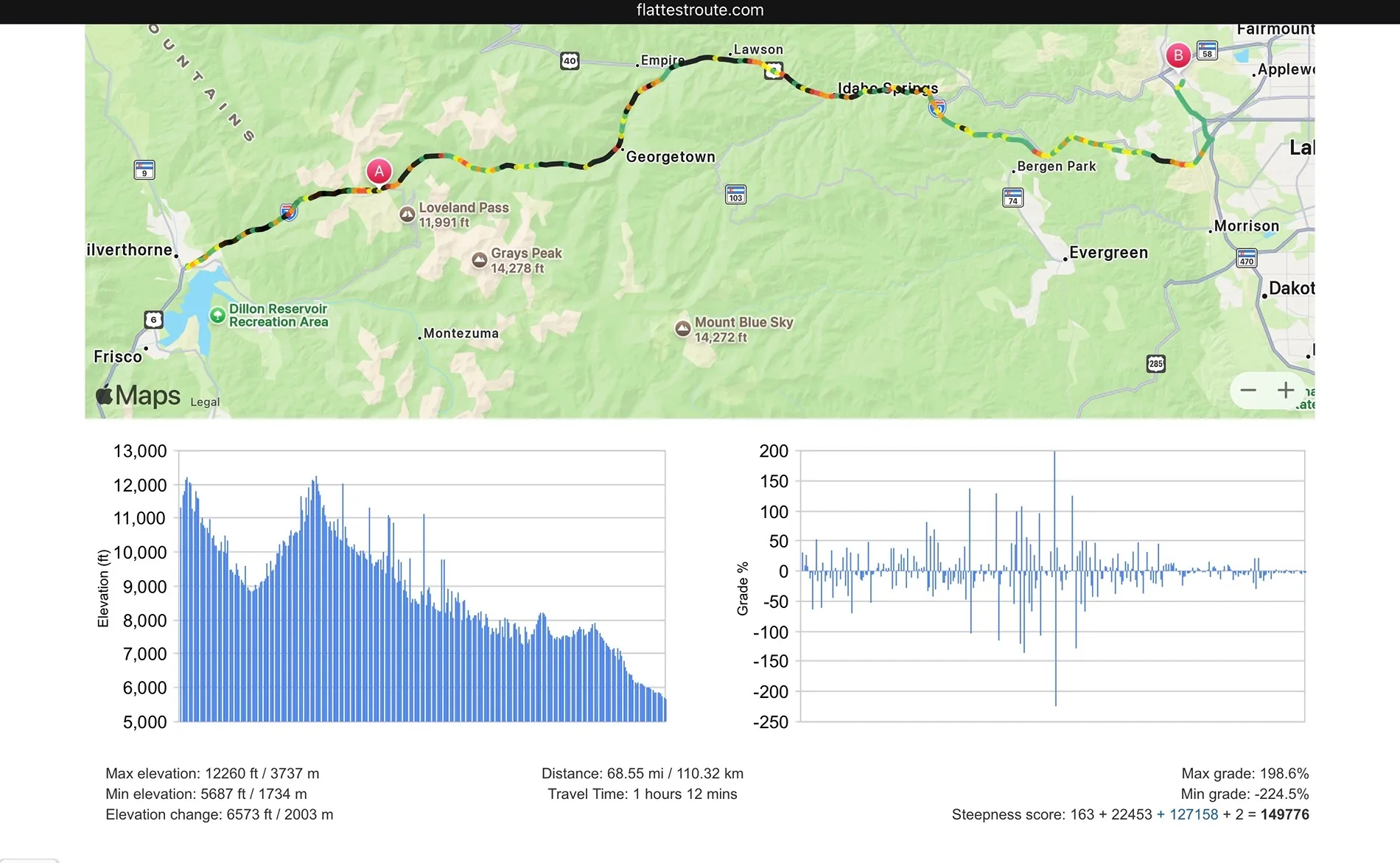
At the top of I-70 at Eisenhower (11,170ft) Tunnel in Colorado, I had 13% thinking I would gain 9-10% like my Tesla MY. After a drop to 6,120 ft to Golden, CO, I actually lost another 4% and ended up at 9% for on that 5,000ft elevation drop over 45 miles. For some reason, my R1T gave no increase in battery over that 45 mile downhill. Like I said, my '25 Tesla Model Y generated 9%

I'm curios if anyone with a Gen 2 in Colorado gets any positive regen going east from the tunnel to the I-70/I-470 interchange.

Thanks,

Tim
Sponsored

 

COdogman

Well-Known Member
First Name
Brian
Joined
Jan 21, 2022
Threads
33
Messages
11,641
Reaction score
34,494
Location
CO
Vehicles
2023 R1T
Occupation
Cyber defender
Clubs
 
I feel like that stretch is almost a wash. Yes, Golden is much lower, but there are still plenty of hills to climb on the way down and if you don’t watch your speed it seems to not amount to much range savings. Or at least not as much as you would think…I agree it is counterintuitive…

Rivian R1T R1S Gen1 23 R1T Regen was Negative over 5,000ft drop IMG_0264
 

Time2Roll

Well-Known Member
Joined
Jul 10, 2025
Threads
2
Messages
770
Reaction score
659
Location
SoCal
Vehicles
2026 R1S Quad - 2001 F150
Depending on the speed, much of the energy may have been absorbed into the wind resistance. Rivian is not quite as aerodynamic as the Y. Also any headwind hurts more than a tailwind helps.
 

zefram47

Well-Known Member
First Name
Aaron
Joined
Feb 6, 2022
Threads
18
Messages
2,749
Reaction score
4,511
Location
Denver, CO
Vehicles
Rivian R1T, Alfa Romeo 4C
Occupation
Software Engineer
Last time I did that drive was in May and I was at 37% exiting the tunnel. At the bottom of Floyd Hill I hit 39% and then getting off the highway near Red Rocks I was at 33%, but I also seem to recall it was pouring down rain for a fair bit of it. Going the other direction, I was at 59% exiting the tunnel and only managed to get to 62% exiting the highway in Silverthorne. I think someone else's comment about wind resistance being a big factor is probably correct considering we're largely driving a brick. Even though the Cd is pretty low for a truck, the frontal area is still huge.

I do have a Gen1 Quad with LT rated all-terrains, so kind of worst case. I also turn off brake-assist so I know when I'm limited on regen and manage it myself. Similarly, I'll regen more coming down from the mountains on a slower road than I will on the interstate...again suggesting that wind resistance is playing a big factor here.
 
Last edited:

VSG

Well-Known Member
Joined
Oct 3, 2022
Threads
4
Messages
3,197
Reaction score
5,982
Location
WA
Vehicles
R1T LE/RB/OC/20
Also, comparing battery percentage loss/gain between two different vehicles like this gives the wrong answer. A Rivian battery can be twice as big as a Tesla MY battery, so 2% on the Tesla is only 1% on the Rivian.

To understand more about how regen is working in your Rivian, watch the energy usage screen. I find the regen put a lot more energy back into the battery than I was assuming.

You should also play with your regen settings, esp. brake assist, and watch how those settings affect your energy gain under those conditions and with your driving style.

The R1 is boxier than a Tesla, which mean s a larger percentage of its energy usage is going into overcoming the drag. Energy usage due to aerodynamic drag increases with the square of the speed. If you're cruising down that hill at 10mph faster than you went up, then you could easily be using 30% more energy combating that drag on the way down. That would negate a lot of your regen.

I don't live near that section of highway, but around here I routinely increase my battery charge when coming down a few thousand feet off a hill.
 

Sponsored

zefram47

Well-Known Member
First Name
Aaron
Joined
Feb 6, 2022
Threads
18
Messages
2,749
Reaction score
4,511
Location
Denver, CO
Vehicles
Rivian R1T, Alfa Romeo 4C
Occupation
Software Engineer
I don't live near that section of highway, but around here I routinely increase my battery charge when coming down a few thousand feet off a hill.
The speed / wind resistance is likely making a large difference. I will regen a lot more on a slower road coming down a few thousand feet than I will on an interstate doing 70+ mph. The slower road also means less chance of getting a regen limitation, and I do drive with brake assist turned off since I want to know when I'm limited.
 

Scottm

Well-Known Member
First Name
Scott
Joined
Feb 22, 2023
Threads
3
Messages
134
Reaction score
210
Location
Eugene, OR
Vehicles
Toyota 4Runner, Tesla Model Y
Occupation
physician
So how much does battery temperature play in to this? I imagine at higher temperatures the battery will be able to take a lot more input from high regen during a downhill but inverter temp limits it at some point.

I have a steep hill down to my house but it’s only 1/4 miles long and my regen will be limited by the end when the battery is cold but not when it’s warm. I keep brake assist off so that I know when this is happening. It seems to me that the inverter temperature is not always the limiting factor for how much power we can recuperate on a long downhill. Would manually preconditioning the battery if it’s cold allow you to net more power regen than you spent to warm the battery?
 

jn bot

Well-Known Member
First Name
jan
Joined
Feb 12, 2025
Threads
18
Messages
59
Reaction score
28
Location
santa rosa ca
Vehicles
lotus ,z06,Subaru bolt
Occupation
lawyer
We went up the Tehachapi Mountains, which reduced our range considerably and caused us to worry that we would run out of energy. However, coming down the other side, we gained so much that our worries dissipated. I know or rather remember, no numbers on this, but it was pretty surprising in both directions for us.
 

Sponsored

GA_Rivian

Well-Known Member
Joined
Oct 31, 2021
Threads
54
Messages
214
Reaction score
92
Location
Ovando, MT
Vehicles
R1T
Clubs
 
I go over several passes here in MT fairly regularly, winter and summer, with a steady drop of around 2000' with virtually no uphill sections. We are almost always regen limited after about 90 seconds. I try to keep the descent at 55mph or so, primarily to limit regen cutoff. If we get up above 55 regen usually won't slow us down sufficiently before hairpin curves, and usually cuts out sooner. Battery temp doesn't seem to matter much, as long as it's high enough to avoid the snowflake limit and charge is low enough to avoid the too-high-to-regen limit. Based on a wide variety of circumstances (extreme cold, summer, battery cold, battery hot) I'm convinced (no data) the main thing limiting regen is the inverter temp, for which there is no data. I wish there was a way to dump inverter heat to heat the cabin and cool the inverter at the same time.

We just returned from a trip to Oregon and on Lookout Pass I had to touch the brakes a few times. We didn't gain a lot via regen, although I wasn't watching it closely.
 

Jonger1150

Well-Known Member
First Name
Jon
Joined
Jun 28, 2024
Threads
4
Messages
1,023
Reaction score
962
Location
Howell, MI
Vehicles
2024 R1T & 2024 Chevy Blazer EV
Occupation
Nerd
Clubs
 
I gained quite a bit going down Mt. Washington in NH.
 

VSG

Well-Known Member
Joined
Oct 3, 2022
Threads
4
Messages
3,197
Reaction score
5,982
Location
WA
Vehicles
R1T LE/RB/OC/20
Based on a wide variety of circumstances (extreme cold, summer, battery cold, battery hot) I'm convinced (no data) the main thing limiting regen is the inverter temp, for which there is no data.
You mean rectifier, right? A/C power from regen needs to be rectified to put it into the D/C high voltage battery.

Regardless, the reason for limited regen seems to be far simpler:
Regen can't force energy into the HV battery any faster than the DCFC charging curve.

A Rivian can only charge at a maximum rate of about 220kW. But that maximum rate is only available when your battery is less than about 40% full. Above that SoC the rate the battery can accept power decreases steadily. Charging curves are not unique to Rivian, and they depend on battery chemistry as well as other things. Rivian's charging curve is pretty similar to most EVs, I would rate it as above average. Others do better, most do worse.

The four motors on my R1T can each consume up to 325kW when driving.
And while I can't find published numbers on exactly how much each motor can generate from regenerative braking, it's probably at least half of that (similar systems with published specs claim 60% or more). So all four motors together can generate far more energy than the battery can possibly accept even under ideal circumstances. If you factor in SoC and temperature, then the HV battery can usually accept even less.

Regen therefore MUST be limited under a lot of circumstances. It seems unlikely that one component in the chain is the limiting factor, but if it were then simply replacing that component with a better one would still be limited by the charging curve. I'm going to assume that when you say inverter you're talking about the inverter in each drive unit. These inverters normal change the HV D/C into A/C to run the two motors in the drive unit. The inverter can also be run in rectifier mode to convert the regenerated A/C to D/C and feed it back into the HV battery. In rectifier mode, the device is less efficient, but I would be surprised if the same inverter that can handle 325x2=750kW (x2 because there is one inverter in the drive unit with two motors) in one direction can't handle 1/2 or even 1/4 of that in "reverse" rectifier mode. Even if it can only handle 1/4, that still quickly maxes out the battery's ability to accept the power.

Additionally, both the quad motor drive units (Bosch motors) and the dual motor drive units (Rivian Enduro motors) have entirely different inverters and entirely different cooling systems. I would surprised if the inverter was the limiting factor on regen in both different situations.

I wish there was a way to dump inverter heat to heat the cabin and cool the inverter at the same time.
The inverter is cooled through the drive unit's cooling system, which does exchange heat with the HVAC.

This is an interesting topic to me, and I don't think there's a clear answer, which is why I think attributing it to one component is a little misleading.
I don't really want to hijack this thread, so let me just point to the following and suggest further discussion should take place over there:
https://www.rivianforums.com/forum/threads/r1t-limited-regen-warning-whats-normal.16460/
which has a lot more data and more opinions, some of which support the drive unit inverter and some which don't. One guy who gathered good data (https://www.rivianforums.com/forum/...warning-whats-normal.16460/page-3#post-359758) attributes the regen limit to BMS software control.
 

GA_Rivian

Well-Known Member
Joined
Oct 31, 2021
Threads
54
Messages
214
Reaction score
92
Location
Ovando, MT
Vehicles
R1T
Clubs
 
You mean rectifier, right? A/C power from regen needs to be rectified to put it into the D/C high voltage battery.
I really don't know how they work. Thanks for the clarification.

Regen can't force energy into the HV battery any faster than the DCFC charging curve.

A Rivian can only charge at a maximum rate of about 220kW. But that maximum rate is only available when your battery is less than about 40% full. Above that SoC the rate the battery can accept power decreases steadily.
I noticed that steep drop-off on our last trip, way sooner than I thought.

The four motors on my R1T can each consume up to 325kW when driving.
And while I can't find published numbers on exactly how much each motor can generate from regenerative braking, it's probably at least half of that (similar systems with published specs claim 60% or more). So all four motors together can generate far more energy than the battery can possibly accept even under ideal circumstances. If you factor in SoC and temperature, then the HV battery can usually accept even less.
Ours is a dual motor, so I would assume max possible is a lot
less.

Regen therefore MUST be limited under a lot of circumstances. It seems unlikely that one component in the chain is the limiting factor, but if it were then simply replacing that component with a better one would still be limited by the charging curve... In rectifier mode, the device is less efficient, but I would be surprised if the same inverter that can handle 325x2=750kW (x2 because there is one inverter in the drive unit with two motors) in one direction can't handle 1/2 or even 1/4 of that in "reverse" rectifier mode. Even if it can only handle 1/4, that still quickly maxes out the battery's ability to accept the power.
...
The inverter is cooled through the drive unit's cooling system, which does exchange heat with the HVAC.
[/QUOTE]
Thanks for the info.

I don't really want to hijack this thread, so let me just point to the following and suggest further discussion should take place over there:
https://www.rivianforums.com/forum/threads/r1t-limited-regen-warning-whats-normal.16460/
which has a lot more data and more opinions, some of which support the drive unit inverter and some which don't.
Thanks

Normal mode mostly just uses the front wheels for regen, but snow mode uses all 4; that would split the regen between the two inverters. I'm going to try that next time and see if it changes anything.
Sponsored


Top