Sponsored

scr5008

Active Member
Joined
Mar 13, 2023
Threads
6
Messages
28
Reaction score
64
Location
Austin Area
Vehicles
R1T
Occupation
Operations
Hi everyone - Looking for an analysis review on my math below. Overall I’m just logging my charging/cost of my R1T just for fun and to highlight any hidden costs or savings vs my old ICE.

Method - I created an iPhone shortcut to log every single charge session and cost associated w/ it. Logging kWh & price. I then sum up my total kWh used and look at my total mileage, giving me a calculated Mile/kWh. What I’m stuck on is how to calc any associated vampiric drain.

Total kWh consumed (cumulative) = 2239
Total Mileage = 3898
Calculated Mile/kWh = 0.18
Truck reported Mile/kWh = 2 (placeholder as I’m not at the truck right now to verify)
Delta = 0.2 —— Is this accurate to say this is the vampiric drain?

To calc the cumulative drain of the truck, I can take that .2 and multiply it by my cumulative kWh consumed. (0.18 * 2239 = 403). Is my analysis correct on that?

Some fun facts about my analysis so far:
- I charge for free as much as possible at work
- I live in Tx so my home electric cost is very low compared to others I’ve seen here (0.096/kWh)
- Over my total mileage above, I’ve only spent $105 to juice up the truck
- My cost per mile is about $0.027, compared to my ICE which was about $0.16

Does anyone else do any of this? I’m happy to share my spreadsheet if there’s interest (once I clean it up fully)
Sponsored


 

COdogman

Well-Known Member
First Name
Brian
Joined
Jan 21, 2022
Threads
33
Messages
11,641
Reaction score
34,494
Location
CO
Vehicles
2023 R1T
Occupation
Cyber defender
Clubs


Hankenstein

Well-Known Member
First Name
Hank
Joined
Feb 23, 2022
Threads
2
Messages
97
Reaction score
134
Location
Colorado
Vehicles
2012 Prius, 2023 R1T
Clubs
 
I am hoping your measured/actual mile/kWh is 1.8 and not .18 The difference between what Rivian is reporting and what you are measuring is a combo (I think) of energy loss during the transfer+vampire drain. I think chargers just report what they tried to dump into the truck and not exactly what was stored in the cells.
 

Andystroh

Well-Known Member
First Name
Andrew
Joined
Mar 18, 2021
Threads
25
Messages
551
Reaction score
1,168
Location
Colorado
Vehicles
R1T
Clubs
 
One thing to be aware of is that the truck will include vampire drain as energy consumed in the calculation when it is unplugged, but will not include vampire drain when its plugged in; e.g.:

Scenario 1: you leave truck unplugged for 2 weeks. The measured mi/kWh in your trip will drop reflecting the energy consumed while idle.

Scenario 2: You leave the truck plugged in or 2 two weeks. The measured mi/kWh in your trip will not change. You charge back up, and since your mi/kWh is the same, you do not calculate any vampire drain.

If you do any sort of long term measurements, they'll be impacted by how often the truck is plugged in, so using the truck as your baseline for energy used while moving will not be reliable.
 

usofrob

Well-Known Member
First Name
Robert
Joined
Apr 9, 2022
Threads
5
Messages
671
Reaction score
583
Location
Michigan
Vehicles
Tesla 3, lotus Elise
Occupation
MBSE
I wonder if the vampire drain is approximately consistent enough to just use a standard value for each day/week/time period. So, your cost per mile will go down when you drive it more.

What about other direct expenses, like taxes, insurance?
And indirect expenses like depreciation (increases per mile and age), tire wear?

I've been keeping track of my gas tank refill for my ICE cars for a long time, but I haven't done it in the Tesla, in part because it's just harder to keep track, but also because there are the other losses that are hard to measure. I'd like to have that information, but not enough to pay for TeslaTap yet. I just don't find the expense of energy for my Tesla (and probably similar for the Rivian) to be enough for me to worry about.
 

Sponsored

Mathme

Well-Known Member
First Name
Matt
Joined
Jul 25, 2022
Threads
3
Messages
1,375
Reaction score
1,808
Location
Los Altos, CA
Vehicles
R1T: El Cap, OC, 20AT, Off road package
Occupation
High Tech
My vampire drain has been <1% per day. On the App it shows a reduction in a couple of miles. In 3 days of sitting in the driveway (with a few random lock/unlocks, it's lost about 2-3%.
 

SANZC02

Well-Known Member
First Name
Bob
Joined
Feb 11, 2021
Threads
50
Messages
7,396
Reaction score
12,676
Location
California
Vehicles
Tesla Model S, LE - R1S
Occupation
Retired
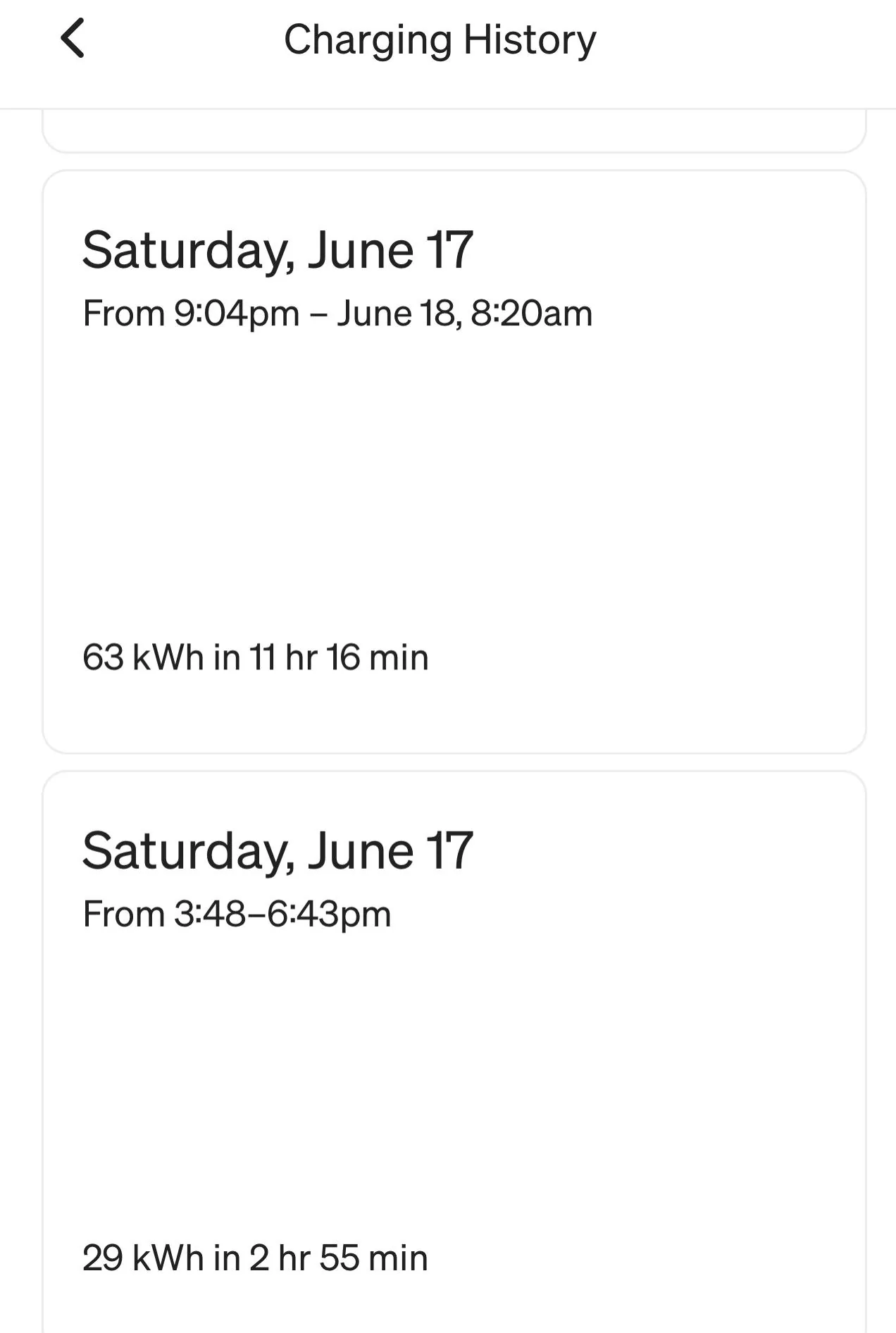
If you just monitor kW delivered to the vehicle from the chargers you should have both vampire drain as well as charging efficiency loss. The charger tells what it is sending not what the truck is accepting.

Here is an example from June 17th, you can see on the overnight charge I lost 3 kW in charging inefficiency Just under 5%.

Sent from my charger
Rivian R1T R1S NERD ALERT - Need some analysis review - Tracking my ROI one charge at a time IMG_3373


Received by the R1S
Rivian R1T R1S NERD ALERT - Need some analysis review - Tracking my ROI one charge at a time IMG_9122
 

MoreTrout

Well-Known Member
First Name
Jay
Joined
Sep 12, 2021
Threads
19
Messages
551
Reaction score
840
Location
PA
Vehicles
Ford Fusion Hybrid, Rivian R1T
Occupation
Retired USN
If your goal is to calculate how much you actually spend then don't even bother worrying about the exact amount of vampire drain. At the end of the day, you spent $X and drove Y miles. It looks like you are just trying to track your $/mile, and you have that. Anything after that is just nerding out trying to figure out exact vampire drain and what you coulda/woulda/shoulda got without it.
 

Guy

Well-Known Member
First Name
Guy
Joined
Nov 6, 2021
Threads
12
Messages
1,607
Reaction score
1,518
Location
Philadelphia suburbs
Vehicles
Mazda 6, Toyota Sienna
Occupation
Scientist
Clubs
 
What shortcut do you set up? Is this to a spreadsheet or another app?
 

lefkonj

Well-Known Member
First Name
Jeff
Joined
Feb 6, 2021
Threads
37
Messages
1,445
Reaction score
2,594
Location
New Jersey
Vehicles
Gen2 R1S Tri, I4-m50
Clubs
 
I took the easier path. A year ago my electric bill was X. Now with my rivian it is Y. Y-X=Z is how much I pay to charge my R1S a month. Since getting my vehicle in February I have driven 5500 miles, so that is 1375 miles a month, 1375/Z is what I pay per mile. It worked out to $1 for every 68 miles or about $5 for a full charge.

I could have also done the really simple math of what I pay per KW ($0.085) multiplied by 135KW (the battery capacity) which would be $11.48 for a full charge. I never am down to 0 and I rarely change to 100%, so it is about $6 to charge once a week or so.

I tracked this over the months and the math just works. We don't pay peak charges or anything like that in NJ so it is all good. There is no ICE vehicle that you could fill the tank for $10 and get very far.
 

Sponsored

Riviot

Well-Known Member
Joined
Mar 29, 2021
Threads
121
Messages
6,430
Reaction score
10,804
Location
Kitsap, WA
Vehicles
R1T
Clubs
 
I am hoping your measured/actual mile/kWh is 1.8 and not .18 The difference between what Rivian is reporting and what you are measuring is a combo (I think) of energy loss during the transfer+vampire drain. I think chargers just report what they tried to dump into the truck and not exactly what was stored in the cells.
Transfer loss and "vampire" drain should still be tracked as part of the cost per mile. If you spilled gas at the station, you're still paying for it. If you run your ICE to cool down the interior or warm up the engine before jumping in, you're still using that fuel.

Vampire drain isn't lost to the ether, it's used in BMS and other functions that (hopefully) extend the useful life of the battery. So while we're using more energy, our batteries should last longer than some competitors. Anecdotally, I'm nearing 30k and haven't lost any miles on my guessometer. Hopefully in a year @jjswan33 and some other crazy road trippers hit 100k miles and we see long-term battery health in the wild.
 

jjswan33

Well-Known Member
First Name
Joshua
Joined
Sep 17, 2021
Threads
135
Messages
4,455
Reaction score
9,876
Location
Sandy, OR
Vehicles
Rivian R1T LE, Hyundai Ioniq 5 Limited
Occupation
Engineer
Clubs
 
Hopefully in a year @jjswan33 and some other crazy road trippers hit 100k miles and we see long-term battery health in the wild.
I think am going to sell my truck. I have been trying to make financial sense of it but the one video on my YouTube channel isn't bringing in enough revenue to justify the cost of the truck. :facepalm: :CWL:
 

virgnia_rivian

Well-Known Member
First Name
Ryan
Joined
Dec 13, 2021
Threads
4
Messages
640
Reaction score
866
Location
Alexandria, VA
Vehicles
R1T, Mazda Miata
Does anyone else do any of this? I’m happy to share my spreadsheet if there’s interest (once I clean it up fully)
Spreadsheet? No. We built a website to track efficiency, drain, charging. :)
Overall our focus has been on the efficiency (not the cost per-se) and drain, which in our 7mo of ownership has been averaging around 1% or less.
 
OP
OP

scr5008

Active Member
Joined
Mar 13, 2023
Threads
6
Messages
28
Reaction score
64
Location
Austin Area
Vehicles
R1T
Occupation
Operations
I wonder if the vampire drain is approximately consistent enough to just use a standard value for each day/week/time period. So, your cost per mile will go down when you drive it more.

What about other direct expenses, like taxes, insurance?
And indirect expenses like depreciation (increases per mile and age), tire wear?
Yeah great point. Based on other feedback here it's not as straight forward. My goal isn't to fixate on vampire drain, but I was curious if I could measure it in a different way than just observing.

If your goal is to calculate how much you actually spend then don't even bother worrying about the exact amount of vampire drain. At the end of the day, you spent $X and drove Y miles. It looks like you are just trying to track your $/mile, and you have that. Anything after that is just nerding out trying to figure out exact vampire drain and what you coulda/woulda/shoulda got without it.
Yeah agreed. As I was building out my simple math I realized I may have enough insight to calc some form of vampire drain. I honestly don't care about vampire drain, was just curious if I could calc it. This is just a "fun" exercise to play with data, so yeah, just needing out. My intention is not to make any changes or hyper fixate on cost, drain, etc.

What shortcut do you set up? Is this to a spreadsheet or another app?
I use an iPhone shortcut (shortcut app) to ask for input on kWh & cost & location, then it populates a numbers spreadsheet.

I took the easier path. A year ago my electric bill was X. Now with my rivian it is Y. Y-X=Z is how much I pay to charge my R1S a month. Since getting my vehicle in February I have driven 5500 miles, so that is 1375 miles a month, 1375/Z is what I pay per mile. It worked out to $1 for every 68 miles or about $5 for a full charge.

I could have also done the really simple math of what I pay per KW ($0.085) multiplied by 135KW (the battery capacity) which would be $11.48 for a full charge. I never am down to 0 and I rarely change to 100%, so it is about $6 to charge once a week or so.

I tracked this over the months and the math just works. We don't pay peak charges or anything like that in NJ so it is all good. There is no ICE vehicle that you could fill the tank for $10 and get very far.
Yeah that's a simplified approach. I was leaning away from that because there are many other variables in your electricity bill, at least for me since that's my only public utility (electric heat, appliances etc). I didn't want to go down the stats route of limits and bounds of significance.

Transfer loss and "vampire" drain should still be tracked as part of the cost per mile. If you spilled gas at the station, you're still paying for it. If you run your ICE to cool down the interior or warm up the engine before jumping in, you're still using that fuel.

Vampire drain isn't lost to the ether, it's used in BMS and other functions that (hopefully) extend the useful life of the battery. So while we're using more energy, our batteries should last longer than some competitors. Anecdotally, I'm nearing 30k and haven't lost any miles on my guessometer. Hopefully in a year @jjswan33 and some other crazy road trippers hit 100k miles and we see long-term battery health in the wild.
Yep, great points. Definitely more complex and just shows that it's not a simple math exercise. Thanks for your input.

Spreadsheet? No. We built a website to track efficiency, drain, charging. :)
Overall our focus has been on the efficiency (not the cost per-se) and drain, which in our 7mo of ownership has been averaging around 1% or less.
Haha, awesome, I'm not tech literate, so this is way beyond me.
 
  • Like
Reactions: Guy

H2Onu

Member
First Name
Brian
Joined
May 28, 2023
Threads
1
Messages
6
Reaction score
25
Location
Santa Cruz
Vehicles
Rivian R1T
Occupation
Semi-retired
Hail fellow nerd!
I built a spreadsheet to compare to an equivalent ICE pickup. Now equivalent isn’t a barebones F-150…the R1T is more of a luxury vehicle, so you need to compare costs of something like an F-150 Limited…with all the expenses (like taxes and registration), you are looking at around $90K for one of those. So the initial capital cost is close.
I am in CA, so electricity is higher (my average is $0.21/kWh) and so is fuel ($4.75).
Need to take into account no maintenance costs. For example, on my 2018 Tesla Model S, I have 80K mi and the only service has been 2 tire changes and 2 wiper blade changes. :) In comparison an ICE will cost an average of $1K/yr for maintenance (labor).
My efficiency is running about 2.1 mi/kW (BTW, in your numbers… you said 0.18 but it looks like 1.8).
With all that said, my annual operating cost on the R1T is 47% lower than a F-150 Limited and I reach breakeven in 2 years on the relatively small initial cost differential differential. And when gas is running at $5 around here it’s even quicker.
Of course this will be different with Tex-economics, but as they say..mileage may vary.
Sponsored


Top