
Sponsored

Quad motor vs locking diff

Zybane

Banned
Well-Known Member
Joined
Aug 9, 2021
Threads
9
Messages
294
Reaction score
434
Location
Crestone Colorado
Vehicles
Ford Raptor 37
Occupation
Military Pilot
GM's regular on-road traction control in the Hummer is horrible compared to what Rivian does. I don't trust them to have their shit together for their virtual locker either.
Ya but this particular issue is manufacturer independent and will affect all off-road EV's that don't have mechanically locking diffs.

The easiest way for me to boil down is; when you have three locking diffs, the entire driveline is working in unison independent of traction. Therefore, any tire that contacts the ground will have forward force to propel the vehicle forward, no matter the traction.

With an "E-locker" setup that the Hummer EV has and that could be implemented in the Rivian, the driveline is not working in unison as each motor to maximize traction has to react to the traction.

The proposed "solution" mentioned in this thread is to just tell each motor to spin at the same RPM. Except that's not how it works in reality. It may take 1 Amp of current to one motor to spin "X" wheel at 10 RPM, but it may take 80 Amps of current to another motor to spin "Y" wheel at 10 RPM. So the system is still trying to react to ever changing current demand to each of the four motors, which carries a delay as the computers are constantly trying to adjust the current stepping up and down to match that wheel RPM as traction is ever changing.

And that's not even talking about the current limits of each motor and stalling/lugging under great demand as they proceed through transient envelopes.
Sponsored

 

Dark-Fx

Well-Known Member
First Name
Brian
Joined
Jul 15, 2020
Threads
147
Messages
13,517
Reaction score
27,280
Location
Michigan
Vehicles
R1T, R1S, Livewire One, Sierra EV, R1S
Occupation
Engineering
Clubs
 
Ya but this particular issue is manufacturer independent and will affect all off-road EV's that don't have mechanically locking diffs.

The easiest way for me to boil down is; when you have three locking diffs, the entire driveline is working in unison independent of traction. Therefore, any tire that contacts the ground will have forward force to propel the vehicle forward, no matter the traction.

With an "E-locker" setup that the Hummer EV has and that could be implemented in the Rivian, the driveline is not working in unison as each motor to maximize traction has to react to the traction.

The proposed "solution" mentioned in this thread is to just tell each motor to spin at the same RPM. Except that's not how it works in reality. It may take 1 Amp of current to one motor to spin "X" wheel at 10 RPM, but it may take 80 Amps of current to another motor to spin "Y" wheel at 10 RPM. So the system is still trying to react to ever changing current demand to each of the four motors, which carries a delay as the computer are constantly trying to adjust the current stepping up and down to match that wheel RPM as traction is ever changing.

And that's not even talking about the current limits of each motor and stalling/lugging under great demand as they proceed through transient envelopes.
You're talking about a delay of tenths of milliseconds if it's baked into the design of the inverter.
 

Zybane

Banned
Well-Known Member
Joined
Aug 9, 2021
Threads
9
Messages
294
Reaction score
434
Location
Crestone Colorado
Vehicles
Ford Raptor 37
Occupation
Military Pilot
You're talking about a delay of tenths of milliseconds if it's baked into the design of the inverter.
Not when you have 300+ lbs of motor rotor, gears inside the gearbox, driveshaft, CV's, bearings, brake disc, wheel and tire inertial mass to move per corner. Nothing is super quick accelerating and decelerating that mass.
 

madgrey

Well-Known Member
First Name
Allan
Joined
Feb 26, 2022
Threads
4
Messages
903
Reaction score
1,241
Location
Fidalgo Island, WA
Vehicles
2022 R1T, 2016 Miata, 2015 Viper
Occupation
Hardware Design Verification
Is there a different way I should be trying to explain this? I feel like I am not using the right words to convey why this is a problem.
It makes sense to me. Thanks for all the explanations. This has been quite a mental exercise for me.

My first engineering job was writing firmware for stepper motors. I later moved on to designing hardware for AC motor controllers, among other things. This was an engineering lifetime ago, so I decided to call a buddy of mine that has much more experience in this sort of thing, and as an added bonus, he is a huge EV enthusiast.

Initially, he was pretty keen on the idea of being able to exactly emulate a locking differential in an EV application like Rivian. However, as we continued the discussion, there were a few caveats, mainly questions about precision of the hardware control and feedback, which we can only speculate about. In the end, we thought it may be doable, but it clearly isn't now.
 
OP
OP
R.I.P.

R.I.P.

Well-Known Member
First Name
Sean
Joined
Jan 2, 2023
Threads
13
Messages
1,217
Reaction score
1,681
Location
San Carlos, Mexico
Vehicles
Tesla Y, Cadillac ELR, Rivian R1T, Jeep TJ, F250
Occupation
Electrical Engineer
Not when you have 300+ lbs of motor rotor, gears inside the gearbox, driveshaft, bearings, brake disc, wheel and tire inertial mass to move per corner. Nothing is super quick accelerating and decelerating that mass.
Yep... paper & drafting pen shredding when the rubber meets the ice. It all sounds so nice when they are selling it to you, but the reality is lacking.
 

Sponsored

Dark-Fx

Well-Known Member
First Name
Brian
Joined
Jul 15, 2020
Threads
147
Messages
13,517
Reaction score
27,280
Location
Michigan
Vehicles
R1T, R1S, Livewire One, Sierra EV, R1S
Occupation
Engineering
Clubs
 
Not when you have 300+ lbs of motor rotor, gears inside the gearbox, driveshaft, CV's, bearings, brake disc, wheel and tire inertial mass to move per corner. Nothing is super quick accelerating and decelerating that mass.
Wind up is the bigger problem than the mass.
 

Sportute

Member
Joined
Dec 25, 2022
Threads
0
Messages
7
Reaction score
6
Location
MI
Vehicles
R1S Limestone, C63S, Expedition Platinum
On the locking diffs, the tech is old and well known. It’s not going to further evolve.

When vehicles started introducing active torque vectoring - overdrive the outside wheels - requires electronic motors / actuators and sensors to make the system more effective than a limited slip.

Looking at this thread, there’s so much vitriol in what technology is better, it’s tough to see the actual useful information.

From my view, mechanical drivetrain benefits and drawbacks are known for a long time, and this isn’t going to change unless someone creates a new magical mechanical differential.
Locking diffs have strengths that are specific to some drive conditions - straight rock crawl is one. introduce a turning radius, there’s scrubbing that occurs on a side - a forced loss of traction. For each condition locking diffs are great, there’s multiple conditions where it’s not ideal.

Electrical drivetrain performance we are not even close to exploring the potential applications in off-road. Some in this thread are taking the current state of electric motor applications, and are making broad conclusions that it’ll never beat locking diffs in a few particular conditions.

No company has yet attempted to utilize electric motors and suspension in this off road capacity and have the resourcing to program in different drive conditions till now. Give it more time. When combined with independent controllable suspension, and control of each corner’s torque and speed, imagine distributing power based on corner load and the ability to adjust weight distribution using suspension heights. The implementation might not be there yet, but the potential is there….
 
OP
OP
R.I.P.

R.I.P.

Well-Known Member
First Name
Sean
Joined
Jan 2, 2023
Threads
13
Messages
1,217
Reaction score
1,681
Location
San Carlos, Mexico
Vehicles
Tesla Y, Cadillac ELR, Rivian R1T, Jeep TJ, F250
Occupation
Electrical Engineer
It makes sense to me. Thanks for all the explanations. This has been quite a mental exercise for me.

My first engineering job was writing firmware for stepper motors. I later moved on to designing hardware for AC motor controllers, among other things. This was an engineering lifetime ago, so I decided to call a buddy of mine that has much more experience in this sort of thing, and as an added bonus, he is a huge EV enthusiast.

Initially, he was pretty keen on the idea of being able to exactly emulate a locking differential in an EV application like Rivian. However, as we continued the discussion, there were a few caveats, mainly questions about precision of the hardware control and feedback, which we can only speculate about. In the end, we thought it may be doable, but it clearly isn't now.
OK, good... somebody gets it lol. Over the course of the last few months, I have gone from 100% fan of the quad motor design, to trying to figure out what is wrong with it and what it would take to fix it, to finally coming to the conclusion that it is the very concept that is wrong. They broke it when they took the differential out. Not only is it not as capable in low traction situations, it is heavier and more complex than it needs to be.

Put the differential back in and be done with it. Design fixed. Unless your purpose is to drag race people on tarmac, quad motors work great for that. :cool:
 

Zoidz

Well-Known Member
First Name
Gil
Joined
Feb 28, 2021
Threads
226
Messages
5,185
Reaction score
11,685
Location
PA
Vehicles
23 R1S Adv, Avalanche, BMWs-X3,330cic,K1200RS bike
Occupation
Engineer
On the locking diffs, the tech is old and well known. It’s not going to further evolve.

When vehicles started introducing active torque vectoring - overdrive the outside wheels - requires electronic motors / actuators and sensors to make the system more effective than a limited slip.

Looking at this thread, there’s so much vitriol in what technology is better, it’s tough to see the actual useful information.

From my view, mechanical drivetrain benefits and drawbacks are known for a long time, and this isn’t going to change unless someone creates a new magical mechanical differential.
Locking diffs have strengths that are specific to some drive conditions - straight rock crawl is one. introduce a turning radius, there’s scrubbing that occurs on a side - a forced loss of traction. For each condition locking diffs are great, there’s multiple conditions where it’s not ideal.

Electrical drivetrain performance we are not even close to exploring the potential applications in off-road. Some in this thread are taking the current state of electric motor applications, and are making broad conclusions that it’ll never beat locking diffs in a few particular conditions.

No company has yet attempted to utilize electric motors and suspension in this off road capacity and have the resourcing to program in different drive conditions till now. Give it more time. When combined with independent controllable suspension, and control of each corner’s torque and speed, imagine distributing power based on corner load and the ability to adjust weight distribution using suspension heights. The implementation might not be there yet, but the potential is there….
Agree, but give it more time and $$$$$$$$$$$$$$$$$$$$$$$$$$$$$$$, lol.
 

Zybane

Banned
Well-Known Member
Joined
Aug 9, 2021
Threads
9
Messages
294
Reaction score
434
Location
Crestone Colorado
Vehicles
Ford Raptor 37
Occupation
Military Pilot
Locking diffs have strengths that are specific to some drive conditions - straight rock crawl is one.
Except the difference is one may get you from point A to B and the other may not. A vehicle with three locking diffs will still get you anywhere a Rivian can on the road. But a Rivian most certainly cannot go some places the three locking diff vehicle can go. Yes, of course the Rivian is going to ride and drive a whole heck of a lot better than the three locking diff off-road vehicle. It just depends on where your priorities are.

Same thing with a winch. Do you "need" a winch? A tool that can make or break you getting from point A to point B.

I simply prioritize the "go anywhere" aspect of "Adventure vehicle" over comfort and speed. So the Rivian may not be for me... although I still want one (not like Rivian is going to fulfill my pre-order anyway since I don't live near a SC).

Put the differential back in and be done with it. Design fixed. Unless your purpose is to drag race people on tarmac, quad motors work great for that. :cool:
When I first heard about the dual motor Rivian, I was like "oh crap I'm gonna get that, it will def have locking diffs". Then I found out they went out of their way to not put them in, and I got deflated.
 

Sponsored

OP
OP
R.I.P.

R.I.P.

Well-Known Member
First Name
Sean
Joined
Jan 2, 2023
Threads
13
Messages
1,217
Reaction score
1,681
Location
San Carlos, Mexico
Vehicles
Tesla Y, Cadillac ELR, Rivian R1T, Jeep TJ, F250
Occupation
Electrical Engineer
When I first heard about the dual motor Rivian, I was like "oh crap I'm gonna get that, it will def have locking diffs". Then I found out they went out of their way to not put them in, and I got deflated.
Locking diffs on the dual motor would make for an amazing vehicle, but I will take dual-motor + traction control over the quad-motor mess no question. The diffs + traction control leaves me the anchor wheels I need on the trails or slippery road that I do not have now.
 

zefram47

Well-Known Member
First Name
Aaron
Joined
Feb 6, 2022
Threads
18
Messages
2,749
Reaction score
4,511
Location
Denver, CO
Vehicles
Rivian R1T, Alfa Romeo 4C
Occupation
Software Engineer
You are correct that a DC motor develops maximum torque at 0 rpm or stall speed.
Just for clarification, Rivian is using permanent magnet AC motors, not DC.
 

OrthoBlock

Well-Known Member
Joined
Mar 19, 2021
Threads
8
Messages
133
Reaction score
224
Location
Philly Area
Vehicles
R1T, X5 PHEV
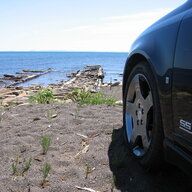
My biggest fear around our current 4 motors system is that the lack of wheel spin we see in the videos may in fact be a real limitation of the total torque potential of the respective motors.

I ran some numbers to get a sense. You can check my math on the image to keep me honest.

Full disclaimer: I'm not a scientist, or a mathematician, or a magician, etc. although I did graduate from high-school.

The bottom line from my analysis (assuming I didn't screw up that math, and I'm sure someone here will correct me if I did) the problem may really be that the motors just arent' powerful enough (especially once you start loading up vehicle with weight and introducing other factors like mud/rolling resistence, etc.) to spin the tires in some situations.

This is not the answer I wanted to see, as it would diminish the hope for clever software fixes (unless they can increase the total torque.)

(Incidentally, the smaller radius, non-AT tires would have a small advantage in having more available force due to the smaller torque arm.)

Rivian R1T R1S Quad motor vs locking diff Screenshot 2023-01-24 221240
 

White Shadow

Well-Known Member
First Name
Thomas
Joined
Nov 11, 2021
Threads
13
Messages
1,406
Reaction score
1,159
Location
NJ
Vehicles
Jeep & Audi
Occupation
SP
No you cannot. Exact same power to each wheel would make each wheel spin the same speed if the truck was on a lift....
And oh so easy to fix....make it speed based, not power based. ECU will adapt power instantaneously to keep all wheels spinning the same speed. Problem solved. And actually, I meant to say speed and bot power. You can see that in my other posts.
 

Nix

Well-Known Member
Joined
Dec 18, 2022
Threads
1
Messages
68
Reaction score
99
Location
United States
Vehicles
No Dox
...The easiest way for me to boil down is; when you have three locking diffs, the entire driveline is working in unison independent of traction. Therefore, any tire that contacts the ground will have forward force to propel the vehicle forward, no matter the traction....
Not only are the 3 locking members turning in unison, the entire mass of the drivetrain has a flywheel effect. Axles, driveshafts, gears, the actual flywheel, the crankshaft, it all has weight and momentum acting in unison. That weight is multiplied by the gear ratios in the transmission, transfer case, and axles.

This flywheel effect moderates the rpm's so the ICE motor doesn't have to react instantaneously to changing torque demand. The flywheel effect keeps the ICE motor from either speeding up or slowing down instantly. As long as the driver can keep the tires turning, the wheels and tires add to the flywheel effect too.

The guys who make every obstacle look easy are using small throttle inputs and gearing to keep the wheels slowly churning as a steady pace, clawing for traction. No big changes in RPM, no big spins. As long as the driver doesn't get too ham-fisted on the throttle, 2, 3, even all 4 tires can all take turns chirping and slipping and still maintain forward progress. Gear backlash, drivetrain wind-up, and tire/tread block flex will keep giving the tires chances to hook up again. It also maintains that anchor effect even with all 4 tires locked.


...The proposed "solution" mentioned in this thread is to just tell each motor to spin at the same RPM. Except that's not how it works in reality....
One of the efficiencies of an electric motor and quad motors is how light the rotating mass is throughout the drivetrain and motor. This is good for efficiency, but the moment a tire loses traction there is much less physical with that flywheel and gearing effect to keep the tire from quickly spinning very fast. Much faster than would give the tires any chance to hook up again without cutting the power. Cutting the power ends the momentum, putting forward progress back to zero.

I don't know how to program EV motors. But something would need to be programmed in to simulate those gearing and flywheel effects, and to keep the RPM's from either speeding up or slowing down too quickly without actually ever completely cutting power and losing that all-important constant forward momentum.
Sponsored


Top