Sponsored

Tesla chargers and everyone else

JoeGiul

Well-Known Member
First Name
Joseph
Joined
Feb 27, 2024
Threads
10
Messages
55
Reaction score
35
Location
Florida
Vehicles
R1S
Occupation
Investor
Rivals largely still can’t use Tesla chargers due to delays
Rows of fast-charging plugs await electric vehicles March 11 at a Tesla Supercharger station in California. Tesla’s plug is becoming standard. Lauren Justice/The New York Times
By Jack Ewing The New York Times
Scarce and finicky public chargers are among the biggest reasons people hesitate to buy electric cars. So when Elon Musk, the CEO of Tesla, agreed last year to open the company’s well-regarded Supercharger network to vehicles from other carmakers, many drivers and industry experts celebrated the decision.
But more than 12 months later, Tesla’s network, with nearly 30,000 fast-charging plugs in the United States and Canada, remains largely inaccessible to most people who don’t drive Teslas. Why? Software delays and hardware shortages.
The delays have fueled speculation that Musk was having second thoughts about opening up Tesla’s network, possibly because he was worried that access would help other automakers sell battery-powered models and lure customers from Tesla, which has suffered from declining sales.
Tesla eased those fears a bit last week when the company’s charging unit posted on the social platform X that it had stepped up production of a crucial piece of hardware: adapters that drivers of Ford, Rivian and other car brands need to connect to Tesla chargers.
A Tesla factory in Buffalo, New York, is producing 8,000 of the adapters each week, the company said, noting that outside suppliers are also producing the part. Still, it is unclear how fast those adapters would reach electric vehicle owners.
Tesla did not respond to a request for comment, and the other automakers have been reluctant to speak in detail, apparently because they do not want to antagonize Tesla and Musk.
The slow rollout raises questions about the decision that almost all major carmakers operating in the United States made to abandon the Combined Charging System, the standard that most of them used previously, and adopt the North American Charging Standard developed by Tesla. The switch made them vulnerable to the whims of Musk, who frequently changes corporate strategy and tactics in ways that can surprise even his employees and supporters.
Tesla built the Supercharger network to encourage sales of its own vehicles. By opening up the network, Tesla can make money from drivers of other car brands, who pay per kilowatt-hour to charge. The electric car company also makes money from selling adapters to other automakers.
But Tesla risks alienating its own customers, who will lose exclusive access to the chargers.
Tesla’s opening up of its chargers to other automakers was meant to be a three-stage process.
First, Tesla and each automaker would update the software on Tesla’s chargers and the other company’s cars so they could work with each other. Second, Tesla would make and supply adapters to allow other cars to connect to its chargers. The final step is supposed to happen next year, when most automakers plan to start installing Tesla plugs on the new cars they assemble, eliminating the need for an adapter.
So far only two car companies have advanced past the first stage with Tesla — Ford Motor Co. and Rivian. General Motors had said it expected to complete the software coordination with Tesla this spring but now says it will happen later this year.
Other automakers are expected to follow GM.
Behind the scenes, technical experts from automakers and other interested parties have been working to adapt Tesla’s proprietary technology so it works flawlessly with other electric vehicles.
That process is often fraught, acknowledged Oleg Logvinov, chair of the Charging Interface Initiative North America, an industry group whose members include Ford and Tesla.
“Transition is painful,” Logvinov said. But once the problems are worked out, “it’s hugely beneficial because it leads to a much higher adoption rate.”
He noted that there had been competing technical standards in the early days of mobile phones, but sales took off after the industry whittled them down.
Sponsored

 

RivianRunner

Banned
Well-Known Member
First Name
Marcus
Joined
Sep 14, 2021
Threads
0
Messages
732
Reaction score
629
Location
Bellingham, WA
Vehicles
Cybertruck DM, F-150, Suzuki DR650
Occupation
Tester
Rivals largely still can’t use Tesla chargers due to delays
Rows of fast-charging plugs await electric vehicles March 11 at a Tesla Supercharger station in California. Tesla’s plug is becoming standard. Lauren Justice/The New York Times
By Jack Ewing The New York Times
Scarce and finicky public chargers are among the biggest reasons people hesitate to buy electric cars. So when Elon Musk, the CEO of Tesla, agreed last year to open the company’s well-regarded Supercharger network to vehicles from other carmakers, many drivers and industry experts celebrated the decision.
But more than 12 months later, Tesla’s network, with nearly 30,000 fast-charging plugs in the United States and Canada, remains largely inaccessible to most people who don’t drive Teslas. Why? Software delays and hardware shortages.
The delays have fueled speculation that Musk was having second thoughts about opening up Tesla’s network, possibly because he was worried that access would help other automakers sell battery-powered models and lure customers from Tesla, which has suffered from declining sales.
Tesla eased those fears a bit last week when the company’s charging unit posted on the social platform X that it had stepped up production of a crucial piece of hardware: adapters that drivers of Ford, Rivian and other car brands need to connect to Tesla chargers.
A Tesla factory in Buffalo, New York, is producing 8,000 of the adapters each week, the company said, noting that outside suppliers are also producing the part. Still, it is unclear how fast those adapters would reach electric vehicle owners.
Tesla did not respond to a request for comment, and the other automakers have been reluctant to speak in detail, apparently because they do not want to antagonize Tesla and Musk.
The slow rollout raises questions about the decision that almost all major carmakers operating in the United States made to abandon the Combined Charging System, the standard that most of them used previously, and adopt the North American Charging Standard developed by Tesla. The switch made them vulnerable to the whims of Musk, who frequently changes corporate strategy and tactics in ways that can surprise even his employees and supporters.
Tesla built the Supercharger network to encourage sales of its own vehicles. By opening up the network, Tesla can make money from drivers of other car brands, who pay per kilowatt-hour to charge. The electric car company also makes money from selling adapters to other automakers.
But Tesla risks alienating its own customers, who will lose exclusive access to the chargers.
Tesla’s opening up of its chargers to other automakers was meant to be a three-stage process.
First, Tesla and each automaker would update the software on Tesla’s chargers and the other company’s cars so they could work with each other. Second, Tesla would make and supply adapters to allow other cars to connect to its chargers. The final step is supposed to happen next year, when most automakers plan to start installing Tesla plugs on the new cars they assemble, eliminating the need for an adapter.
So far only two car companies have advanced past the first stage with Tesla — Ford Motor Co. and Rivian. General Motors had said it expected to complete the software coordination with Tesla this spring but now says it will happen later this year.
Other automakers are expected to follow GM.
Behind the scenes, technical experts from automakers and other interested parties have been working to adapt Tesla’s proprietary technology so it works flawlessly with other electric vehicles.
That process is often fraught, acknowledged Oleg Logvinov, chair of the Charging Interface Initiative North America, an industry group whose members include Ford and Tesla.
“Transition is painful,” Logvinov said. But once the problems are worked out, “it’s hugely beneficial because it leads to a much higher adoption rate.”
He noted that there had been competing technical standards in the early days of mobile phones, but sales took off after the industry whittled them down.
Wow! What a hit piece. I quit reading when I came to this:

"The electric car company also makes money from selling adapters to other automakers."

The agreements Tesla signed with other automakers include Tesla agreeing to manufacture and sell the adapters at cost (zero profit margin) to each manufacturer. When I see basic facts like that misrepresented, with no source listed as to how they know that, I immediately know I can't trust anything the article says.
 
OP
OP

JoeGiul

Well-Known Member
First Name
Joseph
Joined
Feb 27, 2024
Threads
10
Messages
55
Reaction score
35
Location
Florida
Vehicles
R1S
Occupation
Investor
Wow! What a hit piece. I quit reading when I came to this:

"The electric car company also makes money from selling adapters to other automakers."

The agreements Tesla signed with other automakers include Tesla agreeing to manufacture and sell the adapters at cost (zero profit margin) to each manufacturer. When I see basic facts like that misrepresented, with no source listed as to how they know that, I immediately know I can't trust anything the article says.
But it is the NYT. Totally unbiased.
 

COdogman

Well-Known Member
First Name
Brian
Joined
Jan 21, 2022
Threads
33
Messages
11,641
Reaction score
34,494
Location
CO
Vehicles
2023 R1T
Occupation
Cyber defender
Clubs
 
The article doesn’t seem to understand not every Tesla charger will be available to those other automakers. Only 5000 of those 30000 will be open. It isn’t Tesla’s job to save the charging industry.
 

emoore

Well-Known Member
Joined
Nov 29, 2020
Threads
4
Messages
3,815
Reaction score
4,240
Location
Colorado
Vehicles
2022 R1T
Didn’t help that Musk fired the entire supercharger team. I, guessing other companies would have access by now if he didn’t do that.
 

Sponsored

zsherry

Active Member
First Name
Zach
Joined
Aug 11, 2024
Threads
7
Messages
38
Reaction score
68
Location
CA
Vehicles
R1T, MYLR
Occupation
Engineer
I'm on my 4th electric vehicle, a new to me 2023 R1T Quad motor. Amazing vehicle, save for a few quirks (which I'm used to being an early adopter in EV tech). I also tried out the H2 market with a Mirai, and honestly after a year with that vehicle I can firmly state that the H2 passenger vehicle market is dead in the water unless the H2 infrastructure issues are addressed.

Starting in a Fiat 500e, then a Mercedes 300b, then a Tesla Model Y. My journey started with setting expectations at just driving locally and charging at home as the first 2 vehicles had about 100 miles of range. This worked fine as we had a second ICE vehicle for longer trips. When I began using the second EV for an occasional longer commute (50 miles in each direction) I started to hit the challenging issue of destination charging. This was 5 years back and L2 charging stations with the J1772 connection were sparse and reliability iffy at best.

We then moved into the Model Y and quickly completely forgot about the charging hassles either destination or mid trip top offs. We regulary used the Y for trips both long and short, but primarily charge at home.

Going "back" to the Rivian I was abrupty re-introduced to the challenging charing issues with the non-Tesla network in the first 2 weeks while waiting for the account to get transferred and my NACS to J1772 home adapter to arrive. It's crowded, clunky to use, and unreliable. This is the only option for the growing non-tesla EV market (save for Rivian with the sparse RAN network). It's a horrifically bad introduction to an EV for anyone that: 1. Did not start early and set expectations around charging availability and vehicle use. and 2. Has anything close to expectations that an EV work like an ICE around convenience and speed of "refueling" times.

IMHO this will meet in the middle once 2 things are solved:

1. Standardization and widespread availability of reliable "L3" high speed travel AND low speed destination charging infrastructure. (We all know this)
2. Clear and standardized advertising of charging rates at both stations AND in apps.

On the other end, ICE drivers mindsets will need to shift around charging time expectations as it does take a little longer than an ICE today. Save for extreme edge cases, how much of an issue is this really? Do we really need 5 minute refueling capability to "match" ICE experiences? I dont know the numbers here, but to me this is a mindset shift that will become less of an issue if the charging issues dissapear.

Standardized price advertising IMHO is very important as this IS something that ICE drivers are keenly aware of when driving. You can easily compare prices between the 2 gas stations across the street from one another and so many apps provide fuel pricing on a map today. It is exceedingly difficult to do this with charging and the pricing can be more than double in some cases! (Rivian RAN network: 35 cents vs. Tesla super charger .70 cents in the same area). This was not impossible, but very difficult to find and compare in apps.
 

mikehmb

Well-Known Member
First Name
Mike
Joined
Jan 12, 2022
Threads
154
Messages
2,303
Reaction score
5,224
Location
SF Bay Area
Vehicles
My name is Mike, and I have a (car) problem
I think your point about expectations shifting is key.

Bumped into a local contractor at the lumberyard recently (10 sheets ply, to many 8' 2x4s, many 2x6s). I was laughing about watching the suspension adjust itself to the load, and he got super curious - told me he'd never seen an EV truck do actual work before (I'm not a contractor, so this isn't a daily event)

He asked me how much of a pain it was to recharge. I was honest - it takes an "average time it takes a family of 3-4 and a dog to pee" to charge for most of our road trips, which he laughed at. But then I told him about how you simply -do not need to do that 99% of the time if your daily driving is under 300 miles- and he was genuinely, and pleasantly, surprised.

When I told him that it costs me 60-80% less to drive than fueling my Tundra, he was visibly stunned. No clue if he followed through, but he told me he was going to check out a Lightning after our conversation.

Helped me realize that a lot of people haven't internalized the upsides of EV ownership.
 

ndmiller

Well-Known Member
First Name
Noah
Joined
Nov 19, 2023
Threads
15
Messages
1,393
Reaction score
1,751
Location
Atlanta
Vehicles
23 R1T Silver (The AG)
Occupation
Retailler
Clubs
 
Scarce and finicky public chargers are among the biggest reasons people hesitate to buy electric cars.
it's one reason, but not even close to the biggest. The biggest are still price of entry and the poor design of the current crop of EV's. People don't want expensive spaceships. The top selling EV's (and Ice and Hybrid) are still recognizable as Cars, SUV's or Trucks. The ugly stuff isn't selling as an EV, ICE or Hybrid.

When the VW Buzz finally gets delivered in 24....game on. Not even sure if it's a good EV, but retro sells like hotcakes in the US market and they'll sell a ton. All of a sudden the press will report EV sales are back and that won't be true either. They should report sales of good looking ICE/EV that customers want are strong...same as now.
 

Miketz

Well-Known Member
Joined
Apr 17, 2023
Threads
0
Messages
50
Reaction score
53
Location
Florida
Vehicles
R1T, Lucid Air, BMW IX
Since when is opening thousands of charging stations to competitors is doing a bad thing?
 

bigsky

Banned
Well-Known Member
Joined
Jan 8, 2024
Threads
12
Messages
1,098
Reaction score
740
Location
MUM
Vehicles
MUM
Huh!!!?
Just came from a long trip in my Model Y. Saw Rivians, Subarus, and Audis charging at 250 kW Tesla superchargers just fine.
Not waiting for freebie my NACS adapter for my R1S. My A2Z Typhoon PRO adapter arrived last Friday!!
Compared to what I paid for my R1S, cost of my A2Z adapter is even less than chump change.
 

Sponsored

emoore

Well-Known Member
Joined
Nov 29, 2020
Threads
4
Messages
3,815
Reaction score
4,240
Location
Colorado
Vehicles
2022 R1T
Huh!!!?
Just came from a long trip in my Model Y. Saw Rivians, Subarus, and Audis charging at 250 kW Tesla superchargers just fine.
Not waiting for freebie my NACS adapter for my R1S. My A2Z Typhoon PRO adapter arrived last Friday!!
Compared to what I paid for my R1S, cost of my A2Z adapter is even less than chump change.
Ummm ok. The only superchargers Audis and Subarus can charge at are the magic dock ones. Which is a very small percentage of the total superchargers
 

bigsky

Banned
Well-Known Member
Joined
Jan 8, 2024
Threads
12
Messages
1,098
Reaction score
740
Location
MUM
Vehicles
MUM
Ummm ok. The only superchargers Audis and Subarus can charge at are the magic dock ones. Which is a very small percentage of the total superchargers
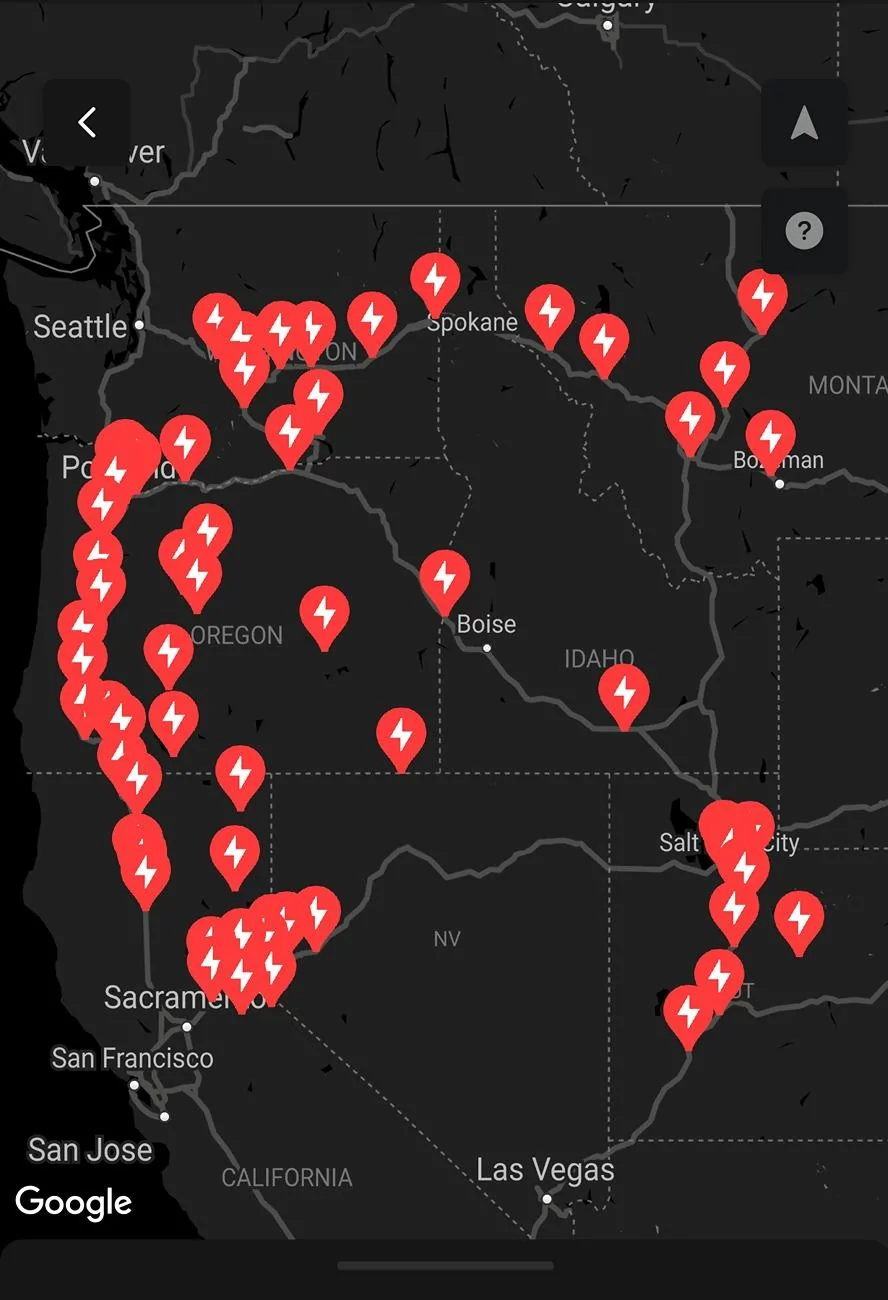
Audis, Subarus, Fords, Rivians can charge at both Tesla superchargers that have a Magic Dock AND at any and all Tesla superchargers that are 250 kW even without Magic Dock. The latter name is just a euphemism for NACS adapter.
Reason why I purchased and just got my A2Z Typhoon PRO NACS adapter for my Rivian, which I will use in my upcoming trip with my R1S. Already mapped out the Tesla superchargers I may use with my adapter. Indeed, the Rivian app shows you the Tesla chargers available to Rivian and will also tell you whether or not you will need your own adapter. So will my Tesla app tell me if my Rivian will need an adapter at a given supercharger.
Sure, not all Teslas SCs are NACS-enabled, but the quite a few that Rivians can use is a game cha nger.

From my Tesla app. selecting "Charge my other EV," then zooming out to the the Wester U.S. to see what is available. These are the Tesla chargers open to NACS.

Rivian R1T R1S Tesla chargers and everyone else Screenshot_20240902_140330_Tesla
 
Last edited:

emoore

Well-Known Member
Joined
Nov 29, 2020
Threads
4
Messages
3,815
Reaction score
4,240
Location
Colorado
Vehicles
2022 R1T
Audis, Subarus, Fords, Rivians can charge at both Tesla superchargers that have a Magic Dock AND at any and all Tesla superchargers that are 250 kW even without Magic Dock. The latter name is just a euphemism for NACS adapter.
Reason why I purchased and just got my A2Z Typhoon PRO NACS adapter for my Rivian, which I will use in my upcoming trip with my R1S. Already mapped out the Tesla superchargers I may use with my adapter. Indeed, the Rivian app shows you the Tesla chargers available to Rivian and will also tell you whether or not you will need your own adapter. So will my Tesla app tell me if my Rivian will need an adapter at a given supercharger.
Sure, not all Teslas SCs are NACS-enabled, but the quite a few that Rivians can use is a game cha nger.
Haven’t heard of any VW or Subaru being able to charge at any v3 superchargers. Only Rivian and Ford.
 

SPITmadFIRE

Well-Known Member
Joined
Jul 27, 2021
Threads
10
Messages
842
Reaction score
1,388
Location
CA
Vehicles
2024 R1S PDM Max Pack 20" AT
Are we just copy-pasting articles directly into the forum now? Without even posing questions about it or linking to the original article? What's happening?
Sponsored


Top