
Sponsored
Video: Charging Two Rivians on 200A Service
- Thread starter Electrified Outdoors
- Start date
- Watchers 2
NineElectrics
Well-Known Member
I have three chargers on 400A service.
NineElectrics
Well-Known Member
The video gave me one tidbit, at least: the Tesla solution is lame and requires two circuits and two breakers. Sometimes the panel is full and that extra breaker matters.Just network two Tesla chargers together at the max the electrician says your house load calculation allows. No video needed.
pc500
Well-Known Member
A small subpanel can solve this; although if you only needed 2 and you can mount it in the same spot, you can also just get a clipper creek 2-headed unit.The video gave me one tidbit, at least: the Tesla solution is lame and requires two circuits and two breakers. Sometimes the panel is full and that extra breaker matters.
OP
OP

Electrified Outdoors
Well-Known Member
- First Name
- Ken
- Joined
- Jan 30, 2023
- Threads
- 63
- Messages
- 3,683
- Reaction score
- 3,982
- Location
- Mount Airy, Maryland
- Website
- EVoutdoors.org
- Vehicles
- 2024 Rivian R1S Quad, 2024 Silverado EV RST First Edition
- Occupation
- Real Estate
- Thread starter
- #20
Yeah good point. 400amp is nice. Our next home will probably be 400 amp (we plan to build).The video gave me one tidbit, at least: the Tesla solution is lame and requires two circuits and two breakers. Sometimes the panel is full and that extra breaker matters.
In the case of a full panel one would need to run a sub panel for the loads to install it to code.
I'm lucky bc we have several appliances that run off propane here.
Sponsored
OP
OP
Electrified Outdoors
Well-Known Member
- First Name
- Ken
- Joined
- Jan 30, 2023
- Threads
- 63
- Messages
- 3,683
- Reaction score
- 3,982
- Location
- Mount Airy, Maryland
- Website
- EVoutdoors.org
- Vehicles
- 2024 Rivian R1S Quad, 2024 Silverado EV RST First Edition
- Occupation
- Real Estate
- Thread starter
- #21
But no video is no fun ?Just network two Tesla chargers together at the max the electrician says your house load calculation allows. No video needed.

BrentInCO
Well-Known Member
I have a similar setup, though Clipper Creek. I control the amps going to each vehicle with the Tesla and Rivian apps, though the max is 50% of the line’s capacity to each vehicle when both are requesting juice.I use the Grizzl-e Duo plugged into a 14-50 with a 40A breaker. The unit has a set of dip switches to configure the max amps. I set mine at 32A and it splits that power evenly across both EVs until one says "full" then gives all 32A to the remaining EV. Working great so far.
Only thing that would make it better: some onboard smarts that would feed a little more power to the EV that had the biggest delta between current state-of-charge and target "full" state, so they would both arrive at "full" at the same time, or if power were interrupted, then the emptier one got more power to get it closer to a useful range.
Last edited:
lostinafog
Active Member
We're lucky to have 200amp service (my woodshop is thankful for the headroom) and a Model 3 and R1T. Put the charger on the garage wall in front of both cars and charge them as needed. Haven;t had any issues. 30 mile RT commute for both cars, charge them every 3-5 days generally. If you can share the charger (e.g. a 2-car garage) seems no reason to put in multiple ones.
NineElectrics
Well-Known Member
I'm a big fan of 400A. In addition to EVSEs, induction cooktops have less indoor pollutants than gas, and there are health benefits to saunas (and maybe hot tubs). Heat pumps are amazing too, and it all adds up. Some cities have banned gas for new construction, so even the water heater becomes electric.Yeah good point. 400amp is nice. Our next home will probably be 400 amp (we plan to build).

pricedm
Well-Known Member
Exactly! Five Tesla chargers on a 100A circuit. Configure load share on the wall connectors . All five in use = 80A/5 = 16A = 10 miles of range added per hour, each of the five EVs. One in use = 30-44 miles of range added per hour, depending on vehicle.Just network two Tesla chargers together at the max the electrician says your house load calculation allows. No video needed.
Sponsored

HighVoltOverland
Well-Known Member
- Joined
- Jul 6, 2021
- Threads
- 21
- Messages
- 752
- Reaction score
- 1,564
- Location
- Laguna Beach
- Vehicles
- GW/OC R1T | Tesla MY
- Occupation
- Retired-ish
The charge rate is woeful.You got my attention. What's the charge rate? Must not have much other usage? ?
I only run them one at a time, limiting the circuit (electric dryer not used due to gas) to 22A, which is good for about 8mi/hr
Annoyance is Tesla doesn't let you set a start and stop window, so if my wife plugs her Y in too late when my Rivian schedule hits it will trip the breaker
NineElectrics
Well-Known Member
I hate to ask but... is this to code? Madlad!The charge rate is woeful.
I only run them one at a time, limiting the circuit (electric dryer not used due to gas) to 22A, which is good for about 8mi/hr
Annoyance is Tesla doesn't let you set a start and stop window, so if my wife plugs her Y in too late when my Rivian schedule hits it will trip the breaker
HaveBlue
Well-Known Member
You'd be better off putting each charger on their own 30A circuit instead of two 24A draws on one 30A breaker. Depending on the panel, you could replace two full sized breakers with one quad 20-30-20 (or 15-30-15) to get the space for the additional circuit. You could adjust down if needed as 48A draw is getting pretty far into the 60A main. Overnight when little else is running, you would be ok.The charge rate is woeful.
I only run them one at a time, limiting the circuit (electric dryer not used due to gas) to 22A, which is good for about 8mi/hr
Annoyance is Tesla doesn't let you set a start and stop window, so if my wife plugs her Y in too late when my Rivian schedule hits it will trip the breaker
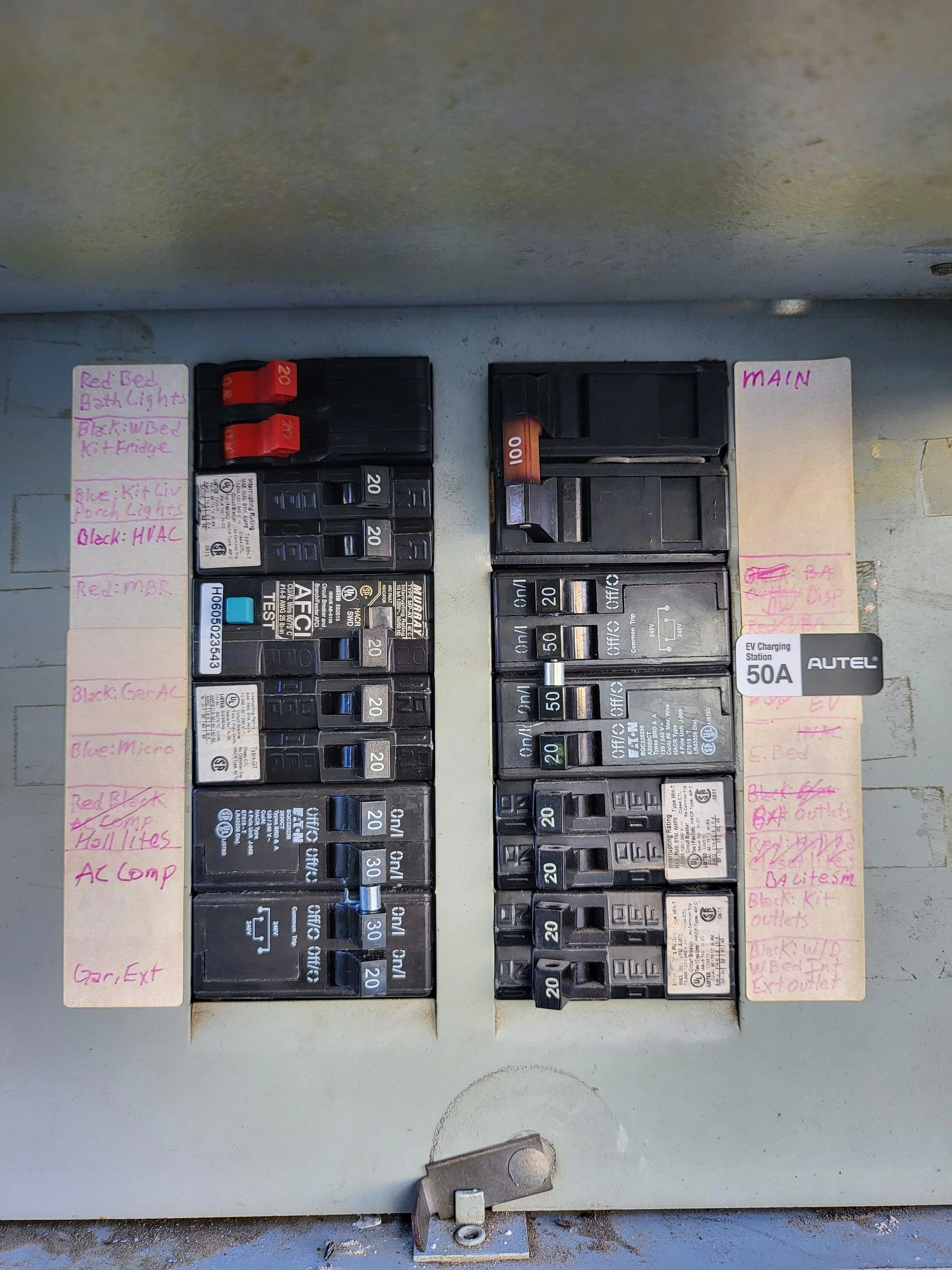
Amazingly my 100A panel load calc comes out to 80A with the EVSE and two AC units but it is seriously over subscribed. I have a welder outlet piggybacked off the Air-Con so technically I could charge a second car if the Air-Con is not in use. It's a 100 year old house that got a new panel in the 1980s and extensive rewiring about ten years ago. There's still some knob and tube in the attic though supplying lights which are all LED now. I try to be kind to the panel as even drawing 40A for the car gets things warm. It's also not marked with a name. It think it's a Crouse and Hinds from the oldest breakers hence Eaton ones seem to work the best in it.
Last edited:
HaveBlue
Well-Known Member
So let me get this straight? You "only" have a 200A panel and you "only" see 115A max load and you are load balancing two EVSE units so you'll only use half your panel capacity? ok..... Feels like 80% of 200A is 160A - 115A = 45A unused.My home charging setup . Don't let anyone tell you that you can't charge 2EVs on 200A service.
OP
OP
Electrified Outdoors
Well-Known Member
- First Name
- Ken
- Joined
- Jan 30, 2023
- Threads
- 63
- Messages
- 3,683
- Reaction score
- 3,982
- Location
- Mount Airy, Maryland
- Website
- EVoutdoors.org
- Vehicles
- 2024 Rivian R1S Quad, 2024 Silverado EV RST First Edition
- Occupation
- Real Estate
- Thread starter
- #30
There is the potential to use more though. We have a 90 amp sub panel in the basement that runs well pump, ejector, sump, and sprinkler (fire suppression) pumps. The 2nd floor heat pump also has 60 amp for the electric emergency backup heat.So let me get this straight? You "only" have a 200A panel and you "only" see 115A max load and you are load balancing two EVSE units so you'll only use half your panel capacity? ok..... Feels like 80% of 200A is 160A - 115A = 45A unused.
Actually I was mistaken, I just checked again and I hit a new usage peak on Jan 15th 2024. This equates to about 133 amps. 31,935/240 = 133.0625

Sponsored
Similar threads
- Replies
- 2,291
- Views
- 631,274

- Replies
- 95
- Views
- 10,549


- Replies
- 21
- Views
- 1,024
