

NineElectrics
Well-Known Member
Unlike the e-tron, Rivian doesn’t have the tech. to significantly cool the battery at high state of charge. Therefore, DC charging at above 80% is painfully slow.
Sponsored


Yes, but be honest with yourself….the answer is that the vehicle is receiving the same amount of electricity at approximately the same speed, but due to “efficiency” of the vehicle it translates to less MPH for charging. That’s just physics….From a road tripping standpoint, miles per hour is apples to apples. Time to get to the next charging stop. I actually like the comparison of time to add 100 miles.
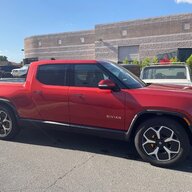
I understand physics, I have an EE degree. Let me provide my real world experience, since I have a Mach E and a Rivian. I have taken both on a few identical trips, and they both provide me with about 300 miles of highway range at 70-75mph. My Mach E is actually 50% more efficient than the Rivian, but charges slower (150kw peak versus 220kw peak). But both can provide me with 120-140 miles in 20 minutes. In the end I spend nearly the exact time at each charger to get to the next one. The fact that the Rivian has a higher kw charge rate does not provide me any benefit, but it costs me more $ to go the same number of miles.Yes, but be honest with yourself….the answer is that the vehicle is receiving the same amount of electricity at approximately the same speed, but due to “efficiency” of the vehicle it translates to less MPH for charging. That’s just physics….
Super useful stats. Thank you.I understand physics, I have an EE degree. Let me provide my real world experience, since I have a Mach E and a Rivian. I have taken both on a few identical trips, and they both provide me with about 300 miles of highway range at 70-75mph. My Mach E is actually 50% more efficient than the Rivian, but charges slower (150kw peak versus 220kw peak). But both can provide me with 120-140 miles in 20 minutes. In the end I spend nearly the exact time at each charger to get to the next one. The fact that the Rivian has a higher kw charge rate does not provide me any benefit, but it costs me more $ to go the same number of miles.
I am measuring charge rate in terms of time, not in terms of power. Also, the Mach E actualy has a much flatter charge curve, so if I start charging at a higher SoC, let's say 40%, it out performs the Rivian in terms of MPH.
On road trips I try to plan on 20 minute stops and have found the shortest charge times occur if I stay within 15-60% SoC, which is normally the charging sweet spot. It is only when I absolutely need more range that I would go to 80% or more.
Kw is the same as kWhr/hr. My T charges at about 11.1 kWh/h or 11.1 kW for level 2. So I agree that is the way to compare vehicles with different battery sizes and efficiencies.Larger battery and more power hungry truck makes for a slower charge rate when you use miles per hour. If you want to compare apples to apples on charging speed use kw and not miles per hour.

Want slooooow? Go look at the Cybertruck charging curves… ?Recently I've noticed a study done by Edmunds. It rates EV's according to charging speed. The fastest was a Hyundai Ioniq 6 at 868 miles per hour. Rivian R1T was number 37 at 316 miles per hour. That's less than half as fast. That is a significant difference. Why is that? I'd like to point out that the rating number can depend on minor differences that you wouldn't think would affect charging, like tire size. 20- and 21-inch Rivians have separate ratings (37 and 38). If you eliminated these things, the list would be way shorter.

Because Rivians are large vehicles. They're inefficient. An Ioniq 6 is a super-efficient sedan. Compare the MPG of a Honda Civic to a Honda Ridgeline.Recently I've noticed a study done by Edmunds. It rates EV's according to charging speed. The fastest was a Hyundai Ioniq 6 at 868 miles per hour. Rivian R1T was number 37 at 316 miles per hour. That's less than half as fast. That is a significant difference. Why is that? I'd like to point out that the rating number can depend on minor differences that you wouldn't think would affect charging, like tire size. 20- and 21-inch Rivians have separate ratings (37 and 38). If you eliminated these things, the list would be way shorter.
I owned a Ioniq 5 Limited before the Rivian and it easily charged at 3C for 40% of the range (say 30-70%).Because in miles/hour the least efficient cars are going to rate the slowest.
I also have an Ioniq 5 and it doesn’t receive much higher power in kW, the technology isn’t much different. The Hyundai is an 800V class vehicle but still only really charges faster because it has a smaller battery. Both vehicles can charge at >200kW.


