Sponsored

hroussel

Well-Known Member
First Name
Harold
Joined
Aug 19, 2021
Threads
26
Messages
182
Reaction score
114
Location
Montreal, Canada
Vehicles
Tesla model 3 perf, R1T DM El Cap with OC
I need to watch that, but that seems.... inconsistent with our charging infrastructure at least (at least the stuff we use the most). I could be wrong, but it seems like most of the DCFC chargers you encounter are rated for 800v systems. And the ones that aren't, there are some ways to adjust the voltage from the charger to the car. Porsche and Hyundai each have done it differently. Bjorn has a good discussion on it.

They definitely don't have as many suppliers available to them for an 800v system, which would probably make it more expensive...
From what I have seen so far, 150kw chargers are 400V based. But 200kw and 350kw chargers appear to support 800V (and in fact up to 1000V most of the time).

W/R to the conversion process, there was an article recently on Insideevs I believe showing the charge curve of a Lucid on a 350kw charger vs a 150kw.

Basically on the 150kw charger the curve was flat at 150kw until the same point where the battery pack was throttling the speed for the 350kw one. In other words there didn't seem to be a penalty due to the conversion, other than the fact that the power was limited to 150kw at low SoC. So I guess it all depends on the implementation.
Sponsored

 

SANZC02

Well-Known Member
First Name
Bob
Joined
Feb 11, 2021
Threads
50
Messages
7,445
Reaction score
12,750
Location
California
Vehicles
Tesla Model S, LE - R1S
Occupation
Retired
I need to watch that, but that seems.... inconsistent with our charging infrastructure at least (at least the stuff we use the most). I could be wrong, but it seems like most of the DCFC chargers you encounter are rated for 800v systems. And the ones that aren't, there are some ways to adjust the voltage from the charger to the car. Porsche and Hyundai each have done it differently. Bjorn has a good discussion on it.


They definitely don't have as many suppliers available to them for an 800v system, which would probably make it more expensive...
I think his reference was more global than US, I would be interested on your take for what he was saying.
 

SeaGeo

Well-Known Member
First Name
Brice
Joined
Jan 12, 2021
Threads
50
Messages
5,673
Reaction score
10,212
Location
Seattle
Vehicles
Xc60 T8
Occupation
Engineer
From what I have seen so far, 150kw chargers are 400V based. But 200kw and 350kw chargers appear to support 800V (and in fact up to 1000V most of the time).
Coincidentally, I was looking at the specs on a signet EA charger 150kw charger the other day when I was looking at it. It's still rated to 920v, and 500amps, it's just limited in the total power output. It seems like you have to start looking at older hardware to find stuff that's limited to 400v.

Even the chargepoint 250s that are paired 62kw chargers to 1000v. They just have limited amperage. Which is apparently part of the reason nobody can ever get their claimed 125kw when you use one of the two shared pedestals.
https://chargepoint.ent.box.com/v/CPE250-DS-EN-US

For another example, look at the current ABB charger lineup.
https://search.abb.com/library/Down...LanguageCode=en&DocumentPartId=&Action=Launch
 

rraj2k81

Well-Known Member
Joined
Apr 25, 2021
Threads
68
Messages
786
Reaction score
1,163
Location
Burlington, Ontario.
Vehicles
2022 Tesla Model S LR
I’m just curious what that does to the battery long term. Looks very aggressive, has anyone seen any long term data on the Audi battery degradation?
Audi has been blocking a big chunk of the battery in the eTron to achieve this.
When the eTron was first announced, out of 95kwh battery back they made 83kwh available.
Over time they have increased it to about 88kwh.
 

rraj2k81

Well-Known Member
Joined
Apr 25, 2021
Threads
68
Messages
786
Reaction score
1,163
Location
Burlington, Ontario.
Vehicles
2022 Tesla Model S LR
Nice! Thanks! It looks like the truck was probably maxing out the charger current up till ~60%, with the linear increase in pack voltage.

That is an absurdly aggressive drop in rate starting at ~60%. What happens after the 70% or 80%+ range is where I've been a little confused by the employee owner reports, because I've seen reports of maintaining ~180kw at 50%, and then pulling 120kw up to around 70 or 80%. Which would imply 27 minutes from say 10 to 70% or something (or their 140 miles in 20 minutes... aka ~10 to 55% in 20 minutes). But then I've also seen what seems like really long charging times to get to 85 or 100%.
That curve looks like the output was throttled at 150KW.
Maybe, an issue with the charger?
 

Sponsored

SeaGeo

Well-Known Member
First Name
Brice
Joined
Jan 12, 2021
Threads
50
Messages
5,673
Reaction score
10,212
Location
Seattle
Vehicles
Xc60 T8
Occupation
Engineer
That curve looks like the output was throttled at 150KW.
Maybe, an issue with the charger?
Yeah. Pretty sure it's the 350 to 380 amp issue. Thst why I was saying the power looks like it was linearly increasing w pack voltage.
 

SeaGeo

Well-Known Member
First Name
Brice
Joined
Jan 12, 2021
Threads
50
Messages
5,673
Reaction score
10,212
Location
Seattle
Vehicles
Xc60 T8
Occupation
Engineer
I think his reference was more global than US, I would be interested on your take for what he was saying.
Yeah, he was referring to other parts of the world having a lot of 400v chargers apparently.

He also tried to make a claim that the charging curve is better on 400v because it is relatively flat. Which is just a bad excuse. It basically just chops to top off the off the curve. ?
 

rraj2k81

Well-Known Member
Joined
Apr 25, 2021
Threads
68
Messages
786
Reaction score
1,163
Location
Burlington, Ontario.
Vehicles
2022 Tesla Model S LR
Yeah. Pretty sure it's the 350 to 380 amp issue. Thst why I was saying the power looks like it was linearly increasing w pack voltage.
This makes me wonder if this is a true 350KW charger. I don't know who the maker of this charger is, but ABB has two 350KW chargers, 'Terra HP' and 'Terra 360'. If this is the Terra HP charger, then it's a shared 350KW.

Terra HP: High Power Charging | High Power Fast Chargers | ABB

'With ABB Dynamic DC power sharing technology, power cabinets can be connected to charge one vehicle at up to 350 kW and 500 A or two vehicles simultaneously at up to 175 kW and 375 A '
 

zefram47

Well-Known Member
First Name
Aaron
Joined
Feb 6, 2022
Threads
18
Messages
2,753
Reaction score
4,516
Location
Denver, CO
Vehicles
Rivian R1T, Alfa Romeo 4C
Occupation
Software Engineer
This makes me wonder if this is a true 350KW charger. I don't know who the maker of this charger is, but ABB has two 350KW chargers, 'Terra HP' and 'Terra 360'. If this is the Terra HP charger, then it's a shared 350KW.

Terra HP: High Power Charging | High Power Fast Chargers | ABB

'With ABB Dynamic DC power sharing technology, power cabinets can be connected to charge one vehicle at up to 350 kW and 500 A or two vehicles simultaneously at up to 175 kW and 375 A '
With an 800V architecture car it is 350 kW capable. As we've said a ton of times on here at 400V they're limited to 500A which would be 200 kW. But many older chargers are limited to 350A instead of 500A, which means at 400V you're only getting 140-150 kW. At 800-1000V you're getting 280-350 kW capability.
 

sub

Well-Known Member
Joined
Jul 23, 2021
Threads
34
Messages
1,873
Reaction score
3,306
Location
USA
Vehicles
Rivian R1S, Tesla Model 3
The R1 battery is massive in comparison to most at 135 kWh. Charging at 150 kW sustained is only 1.1C and should be totally reasonable. I'm starting to get a bit concerned they have a thermal problem.
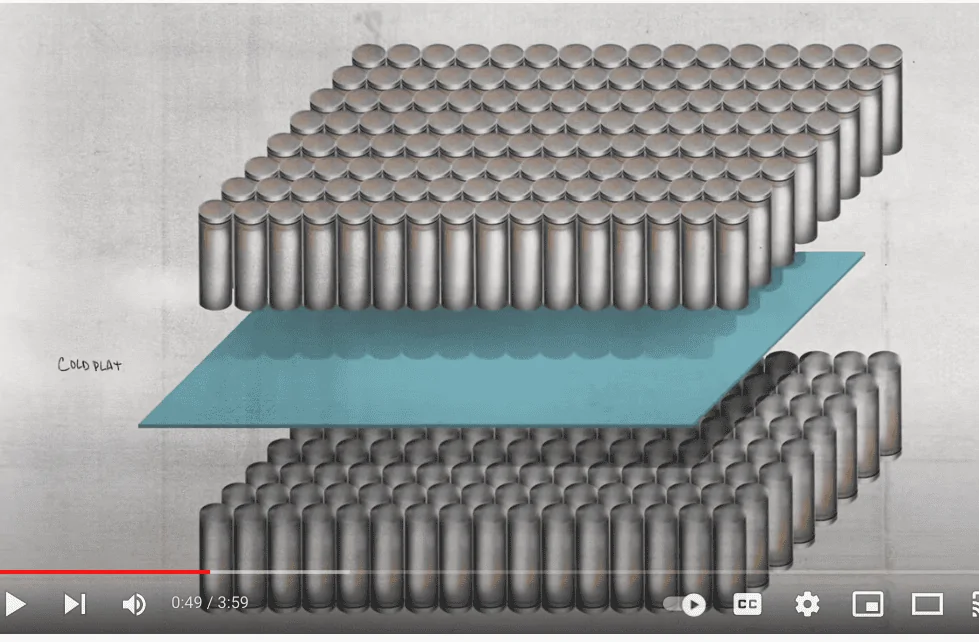
I think this is likely to be the case. From this video Rivian published, they appear to have much less cooling on the battery than Tesla.


Rivian: cooling plate only touches the cells on 1 short end.

https://www.youtube .com/watch?v=sdaUnjn1Da0
Rivian R1T R1S My R1T Charging Session Data - From 25% SOC to 85% 1647442507807


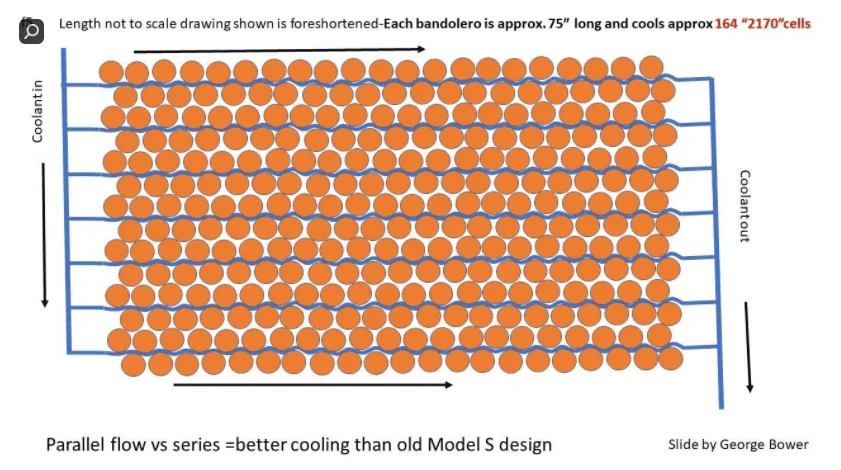
Tesla: Cooling plate snakes it's way around touching each battery on the long end. Much more contact with coolant.

https://insideevs.com/news/338711/tesla-model-3-battery-cooling-much-improved-track-mode/
Rivian R1T R1S My R1T Charging Session Data - From 25% SOC to 85% 1647443046871
 

Sponsored

r1t_kev

Well-Known Member
Joined
Jan 2, 2022
Threads
0
Messages
236
Reaction score
748
Location
PA, USA
Vehicles
Subaru Crosstrek
I think this is likely to be the case. From this video Rivian published, they appear to have much less cooling on the battery than Tesla.


Rivian: cooling plate only touches the cells on 1 short end.

https://www.youtube .com/watch?v=sdaUnjn1Da0
1647442507807.webp


Tesla: Cooling plate snakes it's way around touching each battery on the long end. Much more contact with coolant.

https://insideevs.com/news/338711/tesla-model-3-battery-cooling-much-improved-track-mode/
1647443046871.webp

Watch this video if you haven't already. Lucid uses the end cooling method and Peter explains why it's better than side cooling in general. Also a lot more interesting bits, but this point was one that struck me.


manitou202

Well-Known Member
Joined
Nov 21, 2020
Threads
22
Messages
801
Reaction score
2,204
Location
Manitou Springs, CO
Vehicles
R1S, i4 M50, Spyder RS, Bronco HE 7sp
I think this is likely to be the case. From this video Rivian published, they appear to have much less cooling on the battery than Tesla.


Rivian: cooling plate only touches the cells on 1 short end.

https://www.youtube .com/watch?v=sdaUnjn1Da0
1647442507807.png


Tesla: Cooling plate snakes it's way around touching each battery on the long end. Much more contact with coolant.

https://insideevs.com/news/338711/tesla-model-3-battery-cooling-much-improved-track-mode/
1647443046871.png
Watch this video from Lucid. It’s better to cool the batteries from the end. Tesla is also moving to this approach with their new battery cell format.


rraj2k81

Well-Known Member
Joined
Apr 25, 2021
Threads
68
Messages
786
Reaction score
1,163
Location
Burlington, Ontario.
Vehicles
2022 Tesla Model S LR
With an 800V architecture car it is 350 kW capable. As we've said a ton of times on here at 400V they're limited to 500A which would be 200 kW. But many older chargers are limited to 350A instead of 500A, which means at 400V you're only getting 140-150 kW. At 800-1000V you're getting 280-350 kW capability.
I am familiar with 800V/400V and how it relates to Electrical Energy (P=VI) and all of that.

But it all comes down to the charger itself and its specifications. If the charger is the Terra HP ABB charger, then as per its specs, it's capped at a max of 500A when a single charger is used and a max of 375A when both chargers are used, and charging will be split between the two to 175 KW.

So, having an 800V battery would still not be beneficial when you are charging at a shared charger like this ABB unit, unless you get there first, and you are the only one charging.

I am assuming, when two cars are charging the first to the charger will get some charge priority.
While they do some sort of QOS / load balancing / Priority metric to balance out the current flow to charge two EVs. I could be wrong with this assumption.
 
OP
OP
bowhunter

bowhunter

Well-Known Member
Joined
Apr 3, 2019
Threads
15
Messages
287
Reaction score
1,049
Location
Oregon
Vehicles
R1T LE
Clubs
 
I am familiar with 800V/400V and how it relates to Electrical Energy (P=VI) and all of that.

But it all comes down to the charger itself and its specifications. If the charger is the Terra HP ABB charger, then as per its specs, it's capped at a max of 500A when a single charger is used and a max of 375A when both chargers are used, and charging will be split between the two to 175 KW.

So, having an 800V battery would still not be beneficial when you are charging at a shared charger like this ABB unit, unless you get there first, and you are the only one charging.

I am assuming, when two cars are charging the first to the charger will get some charge priority.
While they do some sort of QOS / load balancing / Priority metric to balance out the current flow to charge two EVs. I could be wrong with this assumption.
Can't speak to the manufacturer, but the unit did have 2 cables and I was the only vehicle connected to it.
 

SeaGeo

Well-Known Member
First Name
Brice
Joined
Jan 12, 2021
Threads
50
Messages
5,673
Reaction score
10,212
Location
Seattle
Vehicles
Xc60 T8
Occupation
Engineer
Can't speak to the manufacturer, but the unit did have 2 cables and I was the only vehicle connected to it.
They all do by design. Only one vehicle can connect to it.

I think it's pretty clear that many/most of EAs 350kw chargers are going to be limited to about 350kw for now. If you see a newer signet charge that should be able to output the max speeds for the R1T. Otherwise most of the 150kw chargers will likely be faster at 175kw.
Sponsored


Top