Sponsored

Regeneration Concerns

Zoidz

Well-Known Member
First Name
Gil
Joined
Feb 28, 2021
Threads
226
Messages
5,186
Reaction score
11,687
Location
PA
Vehicles
23 R1S Adv, Avalanche, BMWs-X3,330cic,K1200RS bike
Occupation
Engineer
Do an internet search. If you can’t find it quickly look for the term Rapidgate. There are some videos that are worth watching.

The problem can be reproduced as follows: Find a steep uphill grade and accelerate up it. The rapid discharge will heat up the inverter. Next, descend a very steep hill. The regeneration similarly heats the inverter and the limit will kick in within a few miles.
Thanks, interesting experiment. It's something that i will give a try next week, plenty of hills in my immediate vicinity to experiment on.
Sponsored


usulio

Well-Known Member
Joined
Jun 2, 2023
Threads
8
Messages
1,031
Reaction score
1,249
Location
CO
Vehicles
R1S
Clubs
 
My pa always told me never to stand between two guys in a pissing match, but some points:

1) Some more discussion and some data from @jwardell in this thread: https://www.rivianforums.com/forum/threads/r1t-limited-regen-warning-whats-normal.16460/

2) One additional complaint is that the amount of regen limiting is unpredictable too. So not only does regen turn off unexpectedly when you need it, but the level it goes to changes every time.

3) People who have not experienced this going down a steep mountain road should try it or try to imagine it before saying it's not a big deal. And besides that, it's frustrating to be wasting energy with friction brakes.

4) The cause of the limited regen warning is very weird (except for cold battery, that makes sense). jwardell points out: usually acceleration is still not limited. How can the inverters OR the battery OR any other component be overheated if full acceleration is still available?
 

usulio

Well-Known Member
Joined
Jun 2, 2023
Threads
8
Messages
1,031
Reaction score
1,249
Location
CO
Vehicles
R1S
Clubs
 
I guess the conclusion from that thread (linked above) is that it's probably about the battery cell chemistry, rather than temperatures directly. The battery isn't overheating, but the chemistry can only accept charge so fast. I don't understand that answer though, because it still limits regen at rates well below fast charging rates. Maybe something about how/where the inverter supplies power versus DCFC.
 

NorthVan57

Well-Known Member
First Name
Brent
Joined
Aug 6, 2022
Threads
7
Messages
99
Reaction score
59
Location
north vancouver, BC, Canada
Vehicles
2018 nissan leaf, on wait list for R1S
Occupation
dentist
Clubs
 
This is a very interesting topic, would love to know the real engineering behind the limited regen, not so sure about the overheating idea, wouldn’t that apply to rapid charging as well?? My Nissan leaf that can’t charge level 3 very well or multiple times on a long road trip can regen down a 6 mile hill at our local ski mountain without any limitation on the regen, very nice as I don’t have to use my friction brakes at all, what if we put rivian on low regen or snow mode? Will the regen duration last longer?? Will have to try that next time I go to the ski hill. has anyone tested how the low regen setting or snow mode acts going down a massive mountain pass slope?
 

Electrified Outdoors

Well-Known Member
First Name
Ken
Joined
Jan 30, 2023
Threads
63
Messages
3,683
Reaction score
3,980
Location
Mount Airy, Maryland
Website
EVoutdoors.org
Vehicles
2024 Rivian R1S Quad, 2024 Silverado EV RST First Edition
Occupation
Real Estate
Clubs
 
First the bolt EV is not a good comparison because max regen is 55kw ... I owned one for 3yrs. Max regen on the Rivian is 150kw. Above 60% Soc your going to hit a wall pretty fast on the R1.

You can try reducing Regen down to normal from high and you may be able to regain more energy. If you want to capture max energy on the downhill you need to start out with less than 60% battery and put it on normal Regen (not high).

As to why they limit it ... Well there is the charge rate... You can't put 150kw into the R1 battery for long at all if your above 60%. Much much shorter if your above 80%. The other is speculation on my part but here goes....

If the inverter heats up too much both acceleration and regen will have to be limited. I suspect Rivian is being proactive to prevent a temperature rise which would limit acceleration along with regen by taking away the regen before a spike occurs.

What you can also try to do is put it in snow mode which will put you in low Regen. In low Regen it won't stop the truck as much but you should be able to put more energy back in since it's Regen at a lower rate.
 

Sponsored

CrazyOne

Well-Known Member
Joined
Oct 30, 2021
Threads
3
Messages
1,350
Reaction score
1,142
Location
WA
Vehicles
R1T
What I don't get is why they don't blend the friction brakes to simulate regen when normal regen is limited. Genuine safety concern when I barrel down a hill and all of a sudden I ACCELERATE towards the car in front of me. The first time that happened, it was unnerving. They normally hide the weight of the vehicle really well, but with regen limited it felt like I was in a tank about to careen off a mountain road at 50 mph...
If they do this, there better be a very big and audible warning. I would hate to lose all braking because the brakes overheated. A friend of mine used cruise control on his Audi in mountains and it warped the rotors.
 

HaveBlue

Well-Known Member
Joined
Nov 22, 2022
Threads
41
Messages
2,926
Reaction score
2,234
Location
91107
Vehicles
R1S DMP Max, Lifted GX470, APR Audi A7, BMW 325Ci
Clubs
 
Maybe *you* could use your words - grunts aren't especially useful over the internet. If you think the Rivian is "overheating" all the time you're not paying attention. I'm not inclined to use smaller words or fewer words just to convince you.

220kW max charging for a 400V vehicle is not bad at all. Most others can't reach that high, including your Audi, because they have some limitations somewhere in their charging system. If the Rivian cooling system is "poorly designed" that would indicate your Audi charging system is also poorly designed, because Rivian bests it significantly over the first 40-50% of the charge curve.
The rivian is limited to 220kw because of the supply equipment. Cabinets and cables are limited to 500A and since the battery is roughly 400v, you can do the math. The theorhetical 2C rate would be 250kw-300kw depending on the battery (large or max)

800v only improves the cabinet/cable thermals and gets those cars to 350kw. The motors draw much more current on hard acceleration than a gradual Regen but battery thermals on both sides of the temperature curve limit that over time along with C rate at the top and bottom of the pack. The danger is overvolting random cells at the top or having to large a voltage gap at the bottom since you can't just dump 4.2v into an empty cell.

Then there's the water cooled Bosch motors that might not cool as well as the Enduro oil cooled and overheat during long decel.

Yea Rivian needs a warning before it happens, not as it happens. I've seen a warning even at 80 battery but wasn't going down a hill.
 

MrMusAddict

Well-Known Member
Joined
Oct 29, 2022
Threads
42
Messages
323
Reaction score
890
Location
Oregon
Vehicles
2023 Rivian R1T
Occupation
Data Analyst
If they do this, there better be a very big and audible warning. I would hate to lose all braking because the brakes overheated. A friend of mine used cruise control on his Audi in mountains and it warped the rotors.
So, imagine a scenario where your following a car down a mountain. Constant blind curves, no passing lane for miles, you're stuck behind this guy. Regenerative braking just became 80% limited (only 20% available).

Your options are;

1. Accelerate into them and crash
2. Ride the brakes manually out of necessity
3. Enable adaptive cruise control, which already blends friction brakes when necessary, and will ride them for you.

The brakes are being ridden no matter what, and if you're in a scenario where regen becomes limited (not just downhill on a mountain pass), you're very likely going to need to apply friction brakes when you need to decelerate.
 

rhumbliner

Well-Known Member
First Name
thomas
Joined
Nov 8, 2020
Threads
12
Messages
335
Reaction score
527
Location
Bend
Vehicles
R1T & Model X
Occupation
Retired
Plenty of people are seeing limited regen when the battery is showing 50 - 60 - 70 degrees.
Are you referencing the ambient air temp or the actual battery temp? Until a few releases ago we had no way of knowing the actual battery temp.
 

R.I.P.

Well-Known Member
First Name
Sean
Joined
Jan 2, 2023
Threads
13
Messages
1,217
Reaction score
1,681
Location
San Carlos, Mexico
Vehicles
Tesla Y, Cadillac ELR, Rivian R1T, Jeep TJ, F250
Occupation
Electrical Engineer
Wow. Just wow. Not sure what else to say about some of these posts lol.

Anyway, for those interested in information vs forum combat, this stuff is pretty old news. The inverters are the thermal bottleneck, and they compare quite poorly to the competition when pushed; see the OoS & TFL head-to-head towing tests on the Ike.

The Enduro's inverters are better cooled, don't hit the limits as soon as the Quad's do, but they are still the bottleneck.
 

Sponsored

CrazyOne

Well-Known Member
Joined
Oct 30, 2021
Threads
3
Messages
1,350
Reaction score
1,142
Location
WA
Vehicles
R1T
So, imagine a scenario where your following a car down a mountain. Constant blind curves, no passing lane for miles, you're stuck behind this guy. Regenerative braking just became 80% limited (only 20% available).

Your options are;

1. Accelerate into them and crash
2. Ride the brakes manually out of necessity
3. Enable adaptive cruise control, which already blends friction brakes when necessary, and will ride them for you.

The brakes are being ridden no matter what, and if you're in a scenario where regen becomes limited (not just downhill on a mountain pass), you're very likely going to need to apply friction brakes when you need to decelerate.
That's why the driver is driving the car. All cars have phantom braking and I often press go pedal to get it to move and prevent some one from rear ending me. I know Rivian sees see phantom lanes and steers me out of lane. Most cars will have these problem. If one is not ready to hit brakes in a second, they shouldn't be driving. Car tell that regen is reduced, it can be felt and most importantly we can see that the car ahead is closing.

It's also the reason why it is recommended not to use cruise control in mountains. These should not be a surprise to people who tow large loads or to semi drivers. Cars may get away with them, but will still have warped rotors. Is extreme cases they can burn up the pads. I even know a specific places where this happens. Mild continuous breaking will overheat brakes much more than intermittent harder use. This is because pads don't get a chance to cool down.
 

Zoidz

Well-Known Member
First Name
Gil
Joined
Feb 28, 2021
Threads
226
Messages
5,186
Reaction score
11,687
Location
PA
Vehicles
23 R1S Adv, Avalanche, BMWs-X3,330cic,K1200RS bike
Occupation
Engineer
Are you referencing the ambient air temp or the actual battery temp? Until a few releases ago we had no way of knowing the actual battery temp.
Battery temp from the .38 OTA.
 

KootenayEV

Well-Known Member
First Name
Andrew
Joined
Sep 22, 2021
Threads
28
Messages
614
Reaction score
589
Location
Nelson, BC
Vehicles
R1T, Tesla Model 3
Occupation
Environmental Engineer
I agree with the blending of the brakes. Yet another example of "please just copy Tesla".

Are we sure it's not more a function of the motors overheating than the battery? Next time this happens please note the temps on each. I know for Tesla's the limitations tend to be at the motors first when regen-ing down hills.
Tesla doesn't actually blend the brake pedal with regen. They did add a mode where one-pedal driving works more consistently and the car applies friction brakes for you (which appears to be coming in the next OTA). My Leaf actually blended the brake pedal with regen; it wasn't always the smoothest, but it was a much easier car to coast in.
 

KootenayEV

Well-Known Member
First Name
Andrew
Joined
Sep 22, 2021
Threads
28
Messages
614
Reaction score
589
Location
Nelson, BC
Vehicles
R1T, Tesla Model 3
Occupation
Environmental Engineer
My pa always told me never to stand between two guys in a pissing match, but some points:

1) Some more discussion and some data from @jwardell in this thread: https://www.rivianforums.com/forum/threads/r1t-limited-regen-warning-whats-normal.16460/

2) One additional complaint is that the amount of regen limiting is unpredictable too. So not only does regen turn off unexpectedly when you need it, but the level it goes to changes every time.

3) People who have not experienced this going down a steep mountain road should try it or try to imagine it before saying it's not a big deal. And besides that, it's frustrating to be wasting energy with friction brakes.

4) The cause of the limited regen warning is very weird (except for cold battery, that makes sense). jwardell points out: usually acceleration is still not limited. How can the inverters OR the battery OR any other component be overheated if full acceleration is still available?
Thanks for the link to that other thread - excellent info @jwardell dug up and posted over there and in his videos, particularly the second one from 50% (link).

I don't have his technical expertise so can't contribute anything, but did want to say that based on all of my observations over the last few months, this explanation seems the most likely.

On one hand, Rivian is less conservative than my Tesla Model 3 (2018 RWD); at cooler ambient temps with a cold-soaked battery, I'll get more regen out of my R1T than my M3, though not for very long; it fairly quickly reduces. But, I'll often have essentially zero regen in the M3 with a cold-soaked battery, and I haven't experienced that yet in my R1T.

On the other hand though, longer periods of consistent regen reach what appears to be largely a software limitation (likely related to how they infer the cells handle the regen) sooner than my M3 does in ideal conditions.

Having said that, I do still see regen limitations on my M3 sometimes during long mountain pass descents (I have two 1100m descents nearby, one at low speeds around 50-60km/h, and another at highway speeds 100km/h), and I did on my 2014 Leaf before that. The Leaf actually gave you a meter with a few dashes with numerical values - it maxed at 30kW!

Rivian seems to unlock as much regen as they feel comfortable depending on the situation - but it sure would be interesting to know what that is. I think they could choose to improve actual regen amount (not just blend in the brakes like the forthcoming .50 OTA), but they may not in order to provide more battery longevity.

Lastly, I agree with other posters that a warning a few seconds ahead of regen reduction would be helpful.
 

runningdenver

Well-Known Member
First Name
Richard
Joined
Nov 12, 2023
Threads
4
Messages
227
Reaction score
279
Location
Denver
Vehicles
R1S QM
Occupation
Tech
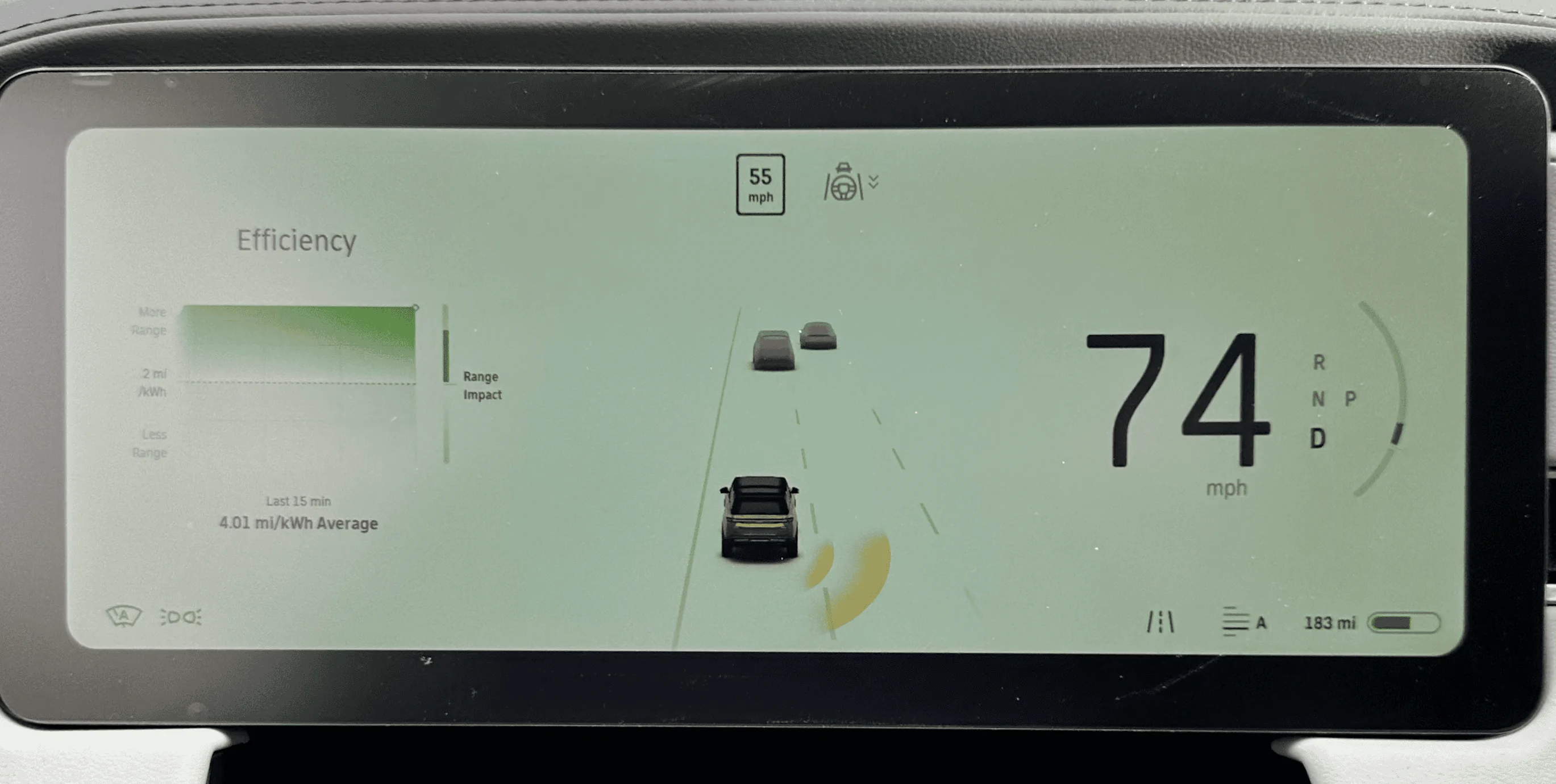
I drove up and back to Leadville this week on I-70, my first time using my new R1S in the mountains. A couple of times on long descents, I got a warning that regenerative braking was reduced, and so had to use the regular brake pedal more, but there was always a warning. And it only lasted a few seconds, and then regenerative braking seemed to be back to normal.

Certainly leads to pretty nice efficiency graph. I came down from the tunnel through Idaho Springs averaging 80-85 mph, but was still able to get a 4+ efficiency. Going the other way up the hill was not quite as impressive... :)

(had to slow down to take the photo)

Rivian R1T R1S Regeneration Concerns tempImageKz7zMG
Sponsored


Top