Sponsored

Need help fixing range while towing (it’s 30% 😵)

Zoidz

Well-Known Member
First Name
Gil
Joined
Feb 28, 2021
Threads
226
Messages
5,191
Reaction score
11,695
Location
PA
Vehicles
23 R1S Adv, Avalanche, BMWs-X3,330cic,K1200RS bike
Occupation
Engineer
Thanks for all the info. To clarify I’m not looking to tow long distances. I’m trying to determine if there is anything else I can do with my Rivian and/or travel trailer to get the most out of my range. So let me be more specific with my 2 questions…

1. Any ideas why the nav range would be different from the range on the driver display and energy screens?

2. Are there any settings or anything that I should consider toying with that could potentially extend my range?
Increase your tire pressure to 53 - 55 psi to reduce rolling resistance, of course verifying that you don't exceed maximum tire pressure for the tires on the vehicle. This will give a rougher ride and possibly increase wear on the center of the tires. But for short distances, meh....
Sponsored


VandalSibs

Well-Known Member
First Name
Andrew
Joined
Dec 27, 2023
Threads
15
Messages
1,382
Reaction score
2,399
Location
Eastern Washington State
Website
www.sibulskymusic.com
Vehicles
R1T Dual Motor Large Pack
Occupation
Composer, IT Service Desk Analyst
Clubs
 
Thanks for all the info. To clarify I’m not looking to tow long distances. I’m trying to determine if there is anything else I can do with my Rivian and/or travel trailer to get the most out of my range. So let me be more specific with my 2 questions…

1. Any ideas why the nav range would be different from the range on the driver display and energy screens?

2. Are there any settings or anything that I should consider toying with that could potentially extend my range?
1. Ignore the estimated range on the trailer profile screen. In my experience, the est. range/battery remaining when driving a route with the navigation running is very accurate. You should be able to rely on it.

2a. Drop your speed by 5 miles per hour - 60mph seems to be the sweet spot for towing, ICE or EV. Now granted, traffic flow can mess with that, but speed is always going to be the biggest effect on range in a vehicle, no matter the "fuel". I've gotten used to driving 60mph on freeways when towing.... and it helps that it's the law where I live (rigs over 10k lbs combined have to do the semi-truck speed limits in Washington, and my R1T + my 16ft camper are over that number). People are gonna pass me, and I've just gotten used to that fact.

2b. Mentioned above - make sure your tire pressure (on both your car and the trailer!) are where they should be.
 
OP
OP

Flyedouglas

Active Member
First Name
Eric
Joined
Jun 28, 2025
Threads
6
Messages
25
Reaction score
15
Location
Chicago
Vehicles
R1S
1. Ignore the estimated range on the trailer profile screen. In my experience, the est. range/battery remaining when driving a route with the navigation running is very accurate. You should be able to rely on it.

2a. Drop your speed by 5 miles per hour - 60mph seems to be the sweet spot for towing, ICE or EV. Now granted, traffic flow can mess with that, but speed is always going to be the biggest effect on range in a vehicle, no matter the "fuel". I've gotten used to driving 60mph on freeways when towing.... and it helps that it's the law where I live (rigs over 10k lbs combined have to do the semi-truck speed limits in Washington, and my R1T + my 16ft camper are over that number). People are gonna pass me, and I've just gotten used to that fact.

2b. Mentioned above - make sure your tire pressure (on both your car and the trailer!) are where they should be.

Thank you! All extremely helpful. I sincerely appreciate it. I was planning to limit my speed on the way back to maybe 55. Though it’s a little frustrating that the speed limit most of the way is 70.
 

KootenayEV

Well-Known Member
First Name
Andrew
Joined
Sep 22, 2021
Threads
28
Messages
614
Reaction score
589
Location
Nelson, BC
Vehicles
R1T, Tesla Model 3
Occupation
Environmental Engineer
Thanks for all the info. To clarify I’m not looking to tow long distances. I’m trying to determine if there is anything else I can do with my Rivian and/or travel trailer to get the most out of my range. So let me be more specific with my 2 questions…

1. Any ideas why the nav range would be different from the range on the driver display and energy screens?

2. Are there any settings or anything that I should consider toying with that could potentially extend my range?
For #1, this is a limitation of how Rivian currently calculates 100% range on that screen. Rather than using the data it accumulates on each trailer, it largely generates this range value based on the estimated weight of the trailer. I've towed 10,000km with my Airstream 20FB and it displays an average efficiency of 2.0 km/kWh (about 1.25 m/kWh); this is accumulated data from towing anywhere from 90 km/h on secondary highways up to 120 km/h on Interstates and over huge mountain passes.

However, the 100% range is ALWAYS higher than what I can actually achieve, and I can watch it vary directly depending on what it estimates my trailer to be for weight! I've seen it range from about 300km up to 350km, when the actual, based on displayed efficiency, should be about 260km. The weight estimate varies between 4000 lbs to 5500 lbs (depending on how much load is actually in the trailer plus the types of roads I've been driving). The 100% range varies the most with changes in estimated weight. It does change a small amount based on the average efficiency. I'm not sure the internal algorithm they are using to show the 100% range value, but my guess is that for most people it is inaccurate.

But, as you've found out, the navigation system itself is quite accurate, so just ignore the 100% value and use the navigation system.

For #2, there are no settings on the vehicle you could tweak that would make a substantial difference to your range. Your best bet would be to lower your speed, or tow a more aerodynamic trailer.

For the conditions you mentioned and the trailer you showed in the photo, I'm not surprised at your achieved efficiency (cross-winds add drag too, not just headwinds).

Best regards :)
 

mkg3

Well-Known Member
Joined
Nov 19, 2021
Threads
91
Messages
2,788
Reaction score
3,709
Location
SoCal
Vehicles
R1S, Model 3, Outback, Artura
Clubs
 
Thank you! All extremely helpful. I sincerely appreciate it. I was planning to limit my speed on the way back to maybe 55. Though it’s a little frustrating that the speed limit most of the way is 70.
Two quick thing.

First, the drag calculation goes velocity squared so driving at 60 vs 55 reduced drag by 16% that your motor has to work to overcome. If you drove at 70, that would be 36% increase in drag over 60, and more over 55. A huge hit on energy consumption.

The other is that if you are towing, I believe in many states, you have to follow the same rules as big rig trucks so the speed limit is usually 10mph lower than the posted.

As they say, YMMV :)
 

Sponsored

mkhuffman

Well-Known Member
First Name
Mike
Joined
Nov 9, 2020
Threads
14
Messages
2,848
Reaction score
3,205
Location
Virginia
Vehicles
2025 R1T Tri-Max, Jeep GC-L, VW Jetta
1. Any ideas why the nav range would be different from the range on the driver display and energy screens?
The truck does not know the aerodynamic properties of the trailer you are towing. All it knows is the estimated weight.
 

JamuJoe

Well-Known Member
First Name
Joseph
Joined
Nov 19, 2020
Threads
20
Messages
207
Reaction score
494
Location
Hesperus, CO
Vehicles
RAM 2500, Polestar 2, R1T Max Pack Performance
Occupation
Retired Petroleum Engineer
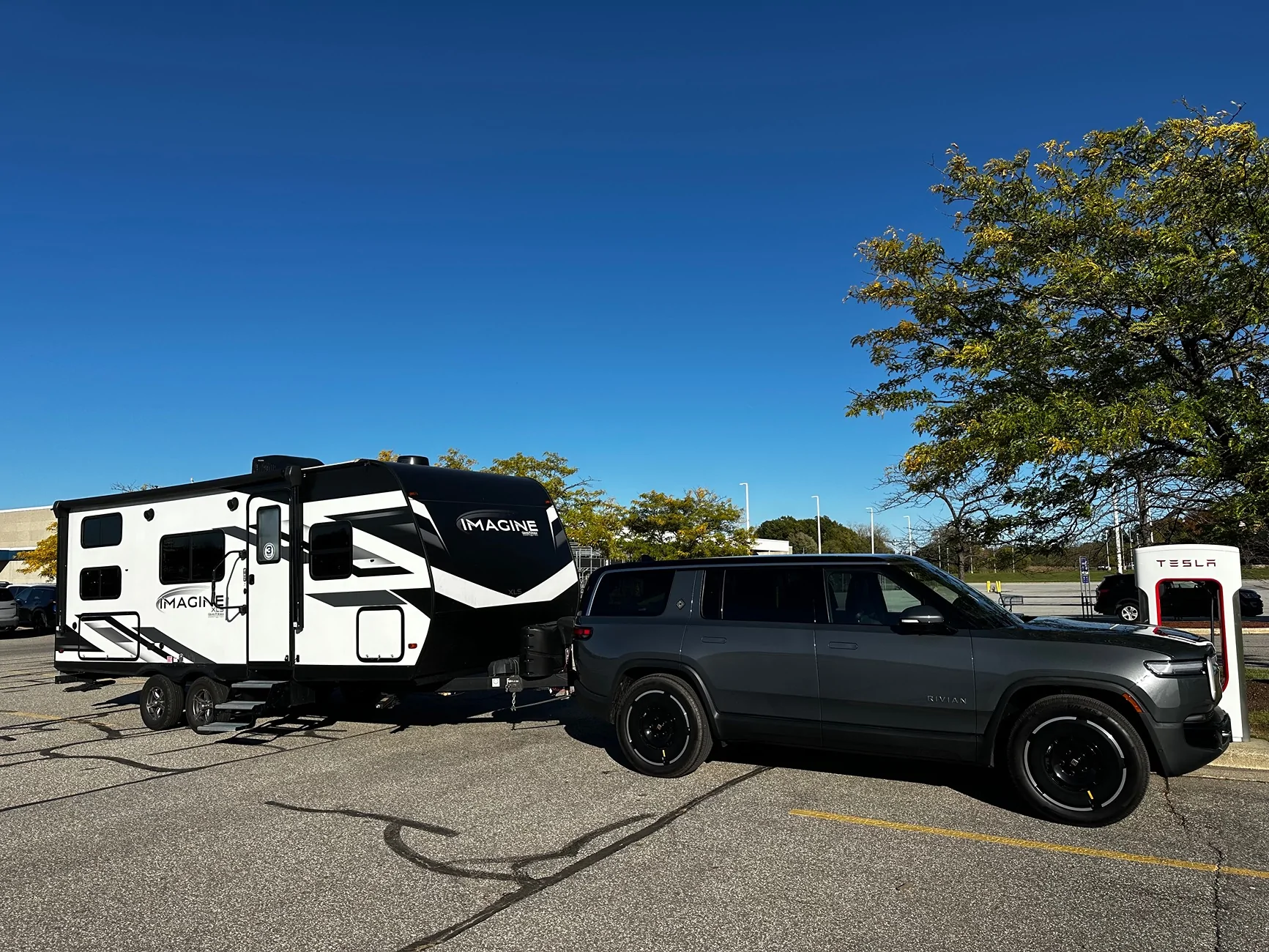
Good morning all! I’ve been in the market for a travel trailer for awhile now. I wanted to experience towing with my R1S and get some idea on the actual towing range I should expect so I rented the exact model I’ve been looking into and towed it to a campsite 180 miles away for a few days. While the truck did a great job towing my range was much less than expected (I’ve been reading up on Rivian towing for months). I’d love to have any thoughts/ideas on things I should consider checking or changing for the trip back to try to increase my range any. I’ll list some details below about the trailer and how I towed it…

Gen 2 R1S Dual Motor Max Pack
-Set to FIRM with Regen HIGH
-Max speed on highway 65mph (used cruise control most of the trip)
-Very gentle with acceleration and tried to utilize regen braking over manual braking as much as possible.
-Trailer brake gain set to 5

Trailer:
-Loaded weight approx 5,200-5,500 lbs
-Tongue weight approx 460 lbs
-Dimensions 25L/8W/11H
-Weight distribution hitch

Initially when I hooked up and started driving the Rivian estimated the trailer weight at 4,500 lbs. but after awhile I checked it again and it updated to 5,500 lbs.

The outside air temp was in the low 60’s. Winds were fairly gusty a good portion of the trip approximately 15-20mph. There was a bit of stop and go traffic and a few back roads but the high majority of the trip was flat highway, averaging around 60mph (no faster than 65mph) with cruise control on.

My normal range charged to 100% is 410. With the trailer plugged in and driving for a bit both the energy screen and my driver’s side display estimated the full charge range at 225 miles. However the nav display was calculating my charge/mileage at arrival much lower (initially 50 miles less, with the delta slowly growing as the drive continued). As it turns out the nav display was much more accurate.

Then end result was an average of 0.93kwh/mi or approximately 125 miles for a 100% charge.

So first of all can anyone tell me why the energy and driver’s display range estimates would differ from the nav estimates?

Second of all does anyone have any ideas on what I can check/change to possibly increase my range? My only idea so far… while stopped at a charging session I noticed that the trailer was not longitudinally level. The front was sitting higher than the back. Could that be affecting my range that much? I plan to adjust the WDH to have it sit closer to level for the drive back. I’ve attached a photo where you can see how far off it is from level.

Sorry for the dissertation but any help would be sincerely appreciated.

IMG_4328.webp
There is really nothing within your control (given your trailer)
except speed and acceleration.. Wind, elevation changes, temperature, traffic all affect efficiency. I’ve averaged 1.1 kWh/mi for over 14K miles towing a 7500 lb 28’ Airstream with my Perf, Dual, Max R1T. My 21” road tires are the most efficient, I’m now running Michelin LTX2 M&S at 48 psi. Increased psi might help, but I like the ride at 48. Speed really matters, and like you, I generally keep it at 60 mph. On the ‘Blue Highways’ which we prefer, I do 55 and see a marked increase in efficiency.
Increase your tire pressure to 53 - 55 psi to reduce rolling resistance, of course verifying that you don't exceed maximum tire pressure for the tires on the vehicle. This will give a rougher ride and possibly increase wear on the center of the tires. But for short distances, meh....
 

Time2Roll

Well-Known Member
Joined
Jul 10, 2025
Threads
2
Messages
771
Reaction score
662
Location
SoCal
Vehicles
2026 R1S Quad - 2001 F150
Slow down is easiest and yet the most difficult. Think 55 - 58 mph max.
Set the cruise and enjoy some music etc. It is not that much extra time as expected. Especially if a charging stop can be avoided. Just hard to watch people drive past at 70+

Eventually consider something like Trail Manor or Pop-Up trailer.
 

CharonPDX

Well-Known Member
First Name
Charon
Joined
Jul 12, 2021
Threads
31
Messages
2,499
Reaction score
4,172
Location
Cascadia
Vehicles
'22 R1T LE, '16 Model S, '19 Arcimoto FUV
Occupation
InfoSec Geek
Clubs
 
Just piling on the choir - if "smaller trailer" isn't an option, then driving slower is your only way to improve efficiency. Instead of taking the interstate at 65 MPH, take slower state highways and go 55.
 

Sponsored

blturner

Well-Known Member
First Name
Brian
Joined
Jun 10, 2021
Threads
17
Messages
262
Reaction score
238
Location
Kansas City MO
Vehicles
Rivian R1T
Occupation
Space Pirate
lowering the frontal height of the trailer will help a bit. Upping the tire pressure is an easy couple of percent. As so many have said, slowing down. Smaller wheels on the trailer will lower it a bit but has some drawbacks. Moving the AC unit off the top would help a bit. My Vee-nose enclosed trailer does better than my much lighter flatbed with my side by side on it. That is wind resistance. Tailgating tractor trailers works but is obviously dangerous. ;)

The reason why the trip range is more accurate is that it considers current performance much more heavily than the normal range indicator. That 410 number is probably a bit optimistic anyway. So you're probably getting closer to 40% than 30% of normal.

One more thing to check is touch the tires and wheel hubs of the trailer, and for that matter the truck when you first stop after being on the highway. If anything is getting hot that means you have a problem. Trailer brakes can drag, trailer tires can be cheap and defective. None of that should be hot enough to burn you. If you have a temp gun you can measure the difference in tire temp to see when adding pressure stops helping. Decreased rolling resistance will show up as lower temperatures. Low rolling resistance trailer tires are probably a thing but I have not looked.
 

Birdowin

Well-Known Member
First Name
Matt
Joined
Mar 14, 2022
Threads
16
Messages
277
Reaction score
220
Location
Portland OR
Vehicles
Rivian R1T / Tesla model S
Occupation
Retired from construction.
The nav range on my 2022 R1t has always been more accurate than the drivers display, even when not towing. I don't know why. I always count on the nav range. It gets more accurate the closer you get to your destination.
 

mkhuffman

Well-Known Member
First Name
Mike
Joined
Nov 9, 2020
Threads
14
Messages
2,848
Reaction score
3,205
Location
Virginia
Vehicles
2025 R1T Tri-Max, Jeep GC-L, VW Jetta
The nav range on my 2022 R1t has always been more accurate than the drivers display, even when not towing. I don't know why. I always count on the nav range. It gets more accurate the closer you get to your destination.
I think the reason it is more accurate is because it knows what roads you will be driving on and about what your speed will be. It probably also takes into account elevation gain/loss.

With no destination set in the nav, the GOM range on the driver display has no idea where you are going or how fast you will drive so it defaults to EPA range.
 

Anna Kelly

Active Member
First Name
Anna
Joined
Mar 10, 2025
Threads
0
Messages
38
Reaction score
37
Location
Denver, CO
Vehicles
R1S
Occupation
Physician
I just finished a 7200 mile road trip towing a 16' Airstream Caravel, about 4500# loaded, using a weight distribution hitch. I have a 2025 dual-large R1S. I averaged 1.1 miles/ kWh, but that varied quite a bit over many different types of terrain. I had to charge every 80 - 120 miles (but I also tried to leave about 40-50 miles "spare" in my battery just in case of unforeseen circumstances, such as a charger that didn't work). I didn't mind because I was on vacation, and I actually prefer to get out and stretch my legs every couple of hours. I have to echo many of the above comments.

1) Aerodynamics are more important than, or at least as important as, weight. Wholeheartedly agree with the above Tesla air drag chart.

2) Slowing down saves a LOT on your range. There were times, especially in Wyoming which has VERY FEW charging stations (they actively discourage EV's by making it illegal for charging companies to make a profit on chargers), when I would not be able to make it to the next stop going 65 MPH. But by watching the energy screen, I was able to recapture enough range by slowing down to 55 or 60 to make it to the next stop. Discovering this early on in my trip made the difference between sweating it out with range anxiety and actually being able to enjoy the scenery. And it only added a few minutes to the trip.

3) Elevation changes make a bigger difference while towing than just driving. This is where weight DOES matter. However, you also make up almost all the difference when going back downhill because of regenerative braking. The Rivian takes elevation changes into account pretty accurately in the energy screen. (I learned to pretty much ignore the driver's display)

4) Added bonus of towing a camper with an EV - I could charge overnight at most of my camping stops which was like getting a free tank of gas! So I disagree with the above comment on buying a diesel tow vehicle. It's a blast to tow with a Rivian, so enjoy your adventures, and maybe see you on the road!
Sponsored


Top