Sponsored

50 amp vs 40 amp vs 30 amp

Monkey

Well-Known Member
Joined
Sep 28, 2021
Threads
1
Messages
538
Reaction score
731
Location
Colorado
Vehicles
Tesla Y, Ford F-350 and lots more…
Occupation
Software Developer
Well the 2-2-2-4 is out... I didnt read the fine print for the Rivian charger only having a lug large enough for a 6.
Yeah, 2-2-2-4 is overkill and what you want if you're feeding a 120A sub-panel in your garage.

The run from the outside fuse panel to the side garage is about 40-50 feet (guessing). I would prefer it to be in the front of the garage, so I can park outside if I have a project in the garage. That would add another 20ish feet.
So 75 should do it. At least for a ballpark price estimate.

Just a quick search shows a 6-6-6-6 at $1.91 a foot. Code requires a ground and earth. So using my guess of 50 ft, wire is at $95
https://www.lowes.com/pd/Southwire-...r-Service-Entrance-Cable-By-the-Foot/50333145
You don't need 6-6-6-6. I would run that by an electrician, but I don't know if the aluminum wire is going to be the right choice here. They do have 6 gauge aluminum with the proper ratings as far as I can tell, but not 100% sure. For your dedicated charger circuit, you just need the two hots and a ground. If you can do 6/2 aluminum THHN, it's only $1.10/ft here:
https://www.wireandcableyourway.com/6-2-6-ground-ser-aluminum-building-wire

That's the wrong stuff. It's 6 gauge, but once again has an extra conductor you don't need to pay for and it's NM/B or Romex and not rated to 90C at the proper amperage. This is what you would run for a 50A circuit. In that case it would work for a car charger that can charge at 40A or your electric range on a 50A plug.

I think UF-B wire does qualify, here but its intended use is power transfer between buildings. It's expensive.

Both cases would require a conduit.
You're in conduit no matter what if you're running it on the exterior. But yes, conduit for it all unless you can run MC cable, but that just comes in flexible metal conduit however it's not rated for exterior use so isn't what you want here.

Ideally, you would you would use this wire:
https://www.lowes.com/pd/Southwire-SIMpull-6-AWG-Stranded-Black-Copper-THHN-Wire-By-the-Foot/3129547

You would buy a separate 75ft (or whatever length you end up needing) in black, another in red and one in green. Then pull the three of them through your conduit. Lowe's isn't the greatest place to buy wire except for the usual 14 and 12 AWG Romex. You can buy this 6 gauge THHN wire for a lot less elsewhere:
https://www.wireandcableyourway.com/6-awg-thhn-building-wire

Labor actually isnt to bad. as its all outside the house.. Fuse box to garage. Just have to drill thru the masonry at the garage to feed it into the garage.

Edit:

I do have an additional question. When we say 40 or 50 or 60 amp... Are we talking total amps, or per leg? So for a 40 amp, 20/20 total 40 or 40/40 total 80? I am assuming its the 20/20, but looking for clarification. That might be why the GC was going the aluminum route to run to another breaker box.
The amp rating is for the whole circuit at 240V 60A. You have both 120V legs plus ground. So you would be using a 60 Amp dual-pole breaker. Like this one, for example, but you need the right one to fit your panel:
https://www.lowes.com/pd/Eaton-Type-BR-60-Amp-2-Pole-Standard-Trip-Circuit-Breaker/1114115

And you're fine with a standard breaker (not a more expensive GFCI) as the Rivian charger has fault protection built in.
Sponsored


 

VSG

Well-Known Member
Joined
Oct 3, 2022
Threads
4
Messages
3,252
Reaction score
6,079
Location
WA
Vehicles
R1T LE/RB/OC/20
The reasons are debatable, but the electric grid is increasingly unreliable. We used to literally go -years- between outages, now losing power for half a day or more occurs at least once a month.
What's not debatable is that in TN, electric vehicles have nothing to do with the reliability of your grid. The statistics I found show that only 0.4% of all vehicles registered in your state are EVs, which can't have any appreciable affect on your grid at all.
 

Joe schmoe

Well-Known Member
Joined
Sep 23, 2021
Threads
24
Messages
337
Reaction score
506
Location
Tennessee
Vehicles
Tesla model S
What's not debatable is that in TN, electric vehicles have nothing to do with the reliability of your grid. The statistics I found show that only 0.4% of all vehicles registered in your state are EVs, which can't have any appreciable affect on your grid at all.
I never suggested that EVs have anything to do with it. I typically don't drive much, and over the last 8+ years my daily driver has been an EV I honestly haven't even noticed an increment in my electric bill.

I think the biggest problem in most of the country is poor corporate governance, and perverse financial incentives that don't prioritize maintenance.
 

VSG

Well-Known Member
Joined
Oct 3, 2022
Threads
4
Messages
3,252
Reaction score
6,079
Location
WA
Vehicles
R1T LE/RB/OC/20
I never suggested that EVs have anything to do with it.
I wasn't sure what you were suggesting, but the whole "debate" about how the grid "can't handle EVs" is one of the main talking points that EV opponents frequently bring up. Every time there's a major outage in, say, Texas, EV opponents will point to it and blame wind farms or EVs etc. when these have nothing to do with the problem.

(The latest is the claim that off-shore wind farms kill whales. Bullshit. And what about the alternative - off-short oil rigs? Those are *good* for whales?)

So sorry, I'm a little sensitive when people talk about how some well-established scientific or engineering fact is debatable. In that context, I felt it important to make it clear that EVs have nothing to do with the problems your grid is having.

I think the biggest problem in most of the country is poor corporate governance, and perverse financial incentives that don't prioritize maintenance.
Yup. What threw me was mainly your use of the word "debatable", because I don't think any of these things are unknown or arguable factors, so in my mind there's nothing to debate (and those that do debate about these things tend to be those who place blame on EVs instead). All our infrastructure is aging, and long-term infrastructure investment is often put off in favor of short-term "more important" spending. Infrastructure seems to get attention only when a bridge collapses, or a grid causes a fire, etc. And then the inclination is to sue, not to increase preventative maintenance.
 

Zoidz

Well-Known Member
First Name
Gil
Joined
Feb 28, 2021
Threads
226
Messages
5,199
Reaction score
11,701
Location
PA
Vehicles
23 R1S Adv, Avalanche, BMWs-X3,330cic,K1200RS bike
Occupation
Engineer
Well the 2-2-2-4 is out... I didnt read the fine print for the Rivian charger only having a lug large enough for a 6.

The run from the outside fuse panel to the side garage is about 40-50 feet (guessing). I would prefer it to be in the front of the garage, so I can park outside if I have a project in the garage. That would add another 20ish feet.

Just a quick search shows a 6-6-6-6 at $1.91 a foot. Code requires a ground and earth. So using my guess of 50 ft, wire is at $95
https://www.lowes.com/pd/Southwire-...r-Service-Entrance-Cable-By-the-Foot/50333145


Edit:

I do have an additional question. When we say 40 or 50 or 60 amp... Are we talking total amps, or per leg? So for a 40 amp, 20/20 total 40 or 40/40 total 80? I am assuming its the 20/20, but looking for clarification. That might be why the GC was going the aluminum route to run to another breaker box.
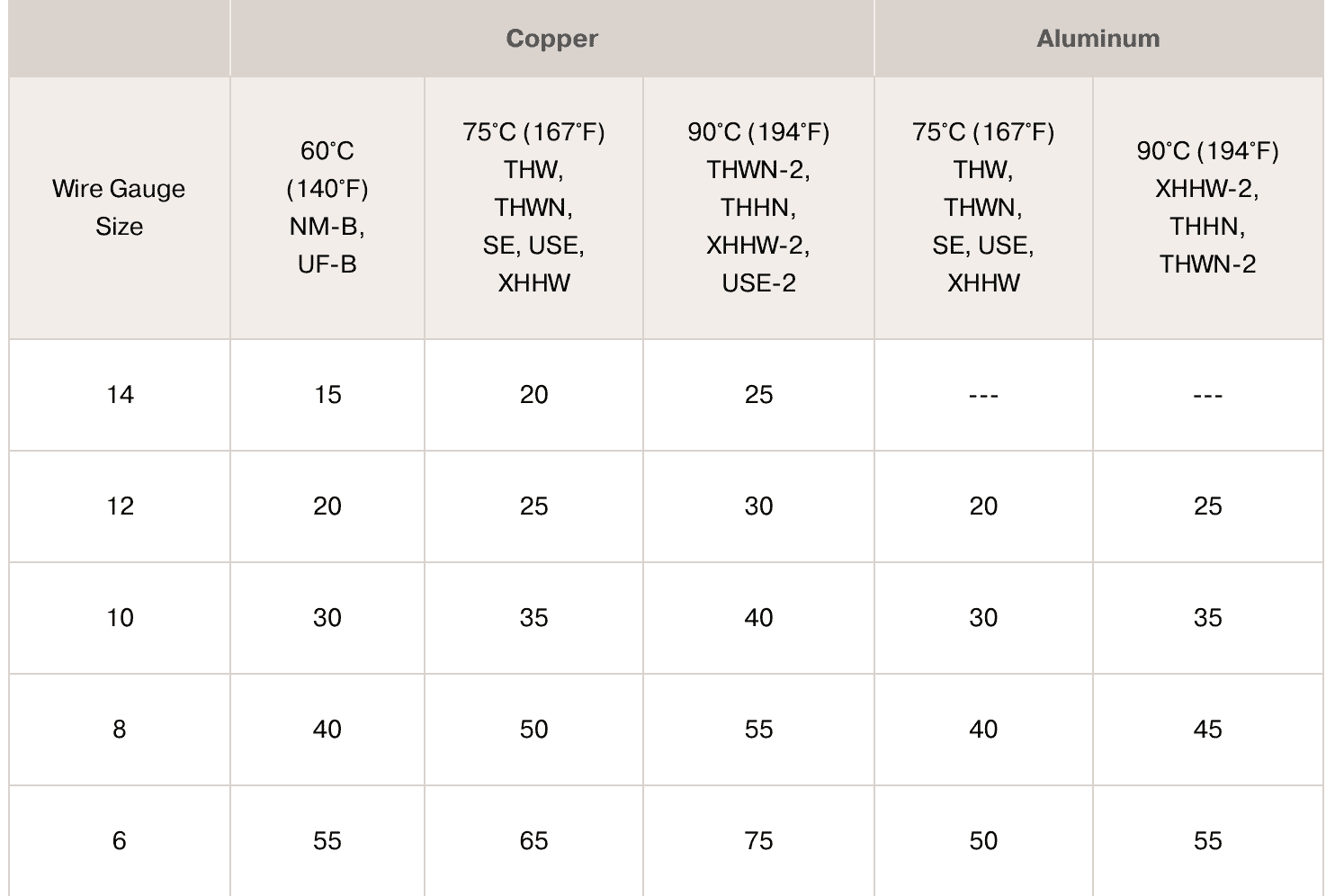
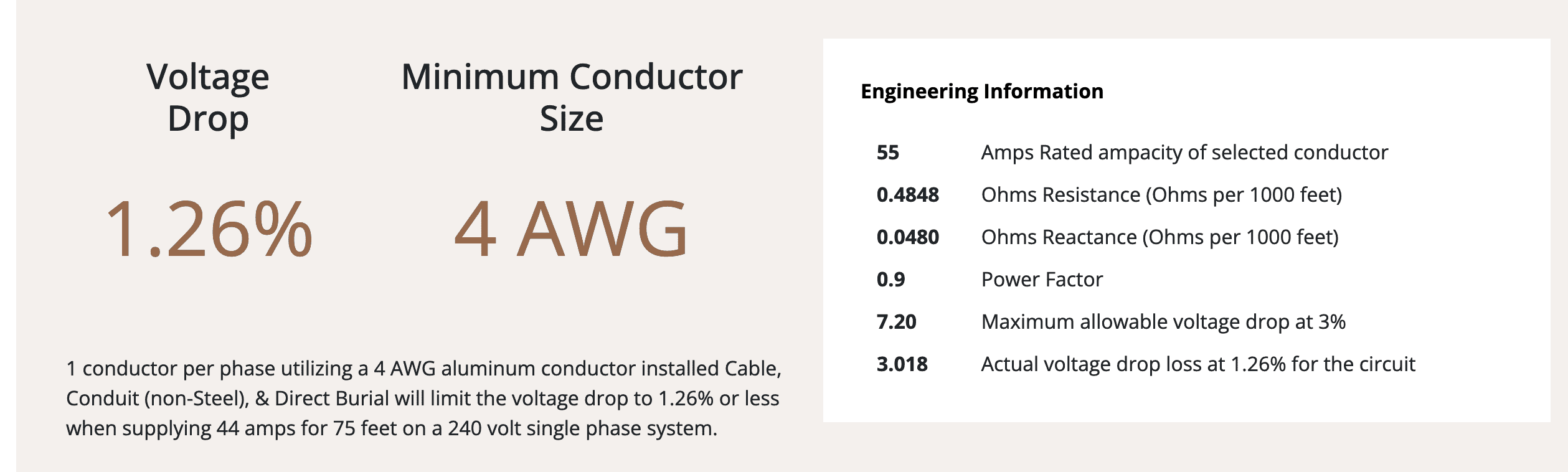
Aluminum has lower ampacity than copper. 6 gauge aluminum THHN is rated at 55 amps, so your max charge rate will be 44 amps with the 80% rule. Aluminum also had a high voltage drop rating. #6 Aluminum is not the right thing to use here. To meet voltage drop specs at 75 feet, you would use #4.

IMO you are stuck in "Analysis Paralysis" worrying about less than $500 cost differential on something you don't really understand all the technical details of. I'm not trying to be a d!^* but if you can't afford the additional $500 cost to do the best and common sense install of at least #6 THHN copper, can you afford owning a RIvian?

300 feet of #6 THHN copper should cost your electrician about $.80 - $.90 cents a foot at his supply house. That's less than $300.

In this application, full amperage is running in each leg. You can see this by attaching a clamp on ammeter. There is no neutral return path for current to flow anywhere else.

Rivian R1T R1S 50 amp vs 40 amp vs 30 amp 1695902413669

Rivian R1T R1S 50 amp vs 40 amp vs 30 amp 1695903299286
 
Last edited:

TollKeeper

Well-Known Member
First Name
Brian
Joined
Feb 1, 2022
Threads
12
Messages
1,446
Reaction score
1,453
Location
Brighton, CO
Vehicles
24 Rivian R1S, 04 GMC Envoy XUV, 12 Toyota Sienna
Occupation
Ast HR Director
As stated in my original post... This was an electricians suggestion. He has not come out to look at see whats going on, I was just trying to get more info about what he was talking about.. yikes.
Sponsored


Top