
-
👉 R2 Orders ➡ Add Your R2 Orders / VIN / Delivery Info 📊
Sponsored

JacobAZ
Well-Known Member
Yes I have. I have a Jackery 3kw battery. mostly use to power the freezer so it does not need to stay in the truck while camping. But also have used at campgrounds with 30 amp service that say "NO EV CHARGING". In this case I plug the battery into the campground outlet (hey just charging the battery, not the EV) and the truck into the battery with the portable charger. You will need a neutral ground bonding plug into one of the battery outlets.
Thebandit
Well-Known Member
You might get a few miles out of one. You have to factor in overhead losses. A 2 kWh one will effectively maybe get you 1 kWh if charge over the course of, what, an hour? One with a 240v output might do a bit better, if you have one sitting around.
A generator is probably a better idea if you have one, because those can run quite a bit longer. Even a modest portable inverter generator can run for many hours on a single propane tank.
A generator is probably a better idea if you have one, because those can run quite a bit longer. Even a modest portable inverter generator can run for many hours on a single propane tank.
JacobAZ
Well-Known Member
Lets stop speculating ... Real world experience ... Most of the larger portable batteries 3kwh - 3.6 kw have a 30 amp 120 volt outlet. You can go with 5kkwh, but they weigh around 100 lbs, so not that portable. with the 30 amp outlet you can charge at about 2.8 kw per hour. You can't overload the battery since it will not output more than it is capable. There is some overheard loss but its not that much. As for range, it of course depends upon your efficiency, which depends upon all the usual factors.
Sponsored

CharonPDX
Well-Known Member
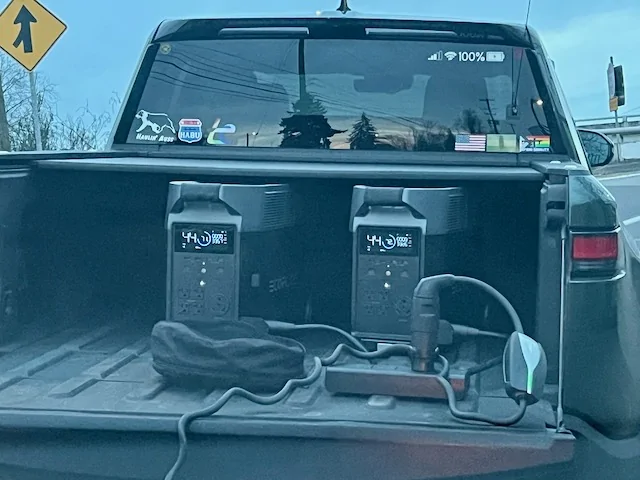
I have rescue-charged other EVs using my dual EcoFlow + 240V combiner before. Note that most of these portable batteries have a "floating ground" or no ground connected at all; and nearly all portable EVSEs insist on a proper ground. My Tesla Gen 1 Mobile Cord is the only one that works with this setup without neutral and ground bonded. And my Rivian mobile cord doesn't work even *WITH* a neutral-ground bonding plug. (The official one by EcoFlow or a cheap third party one that EcoFlow recommends against.)


JacobAZ
Well-Known Member
I have rescue-charged other EVs using my dual EcoFlow + 240V combiner before. Note that most of these portable batteries have a "floating ground" or no ground connected at all; and nearly all portable EVSEs insist on a proper ground. My Tesla Gen 1 Mobile Cord is the only one that works with this setup without neutral and ground bonded. And my Rivian mobile cord doesn't work even *WITH* a neutral-ground bonding plug. (The official one by EcoFlow or a cheap third party one that EcoFlow recommends against.)
JacobAZ
Well-Known Member
The Rivian mobile charger does work with a neutral grounding plug In a Jackery battery and many others. For the battery to work with a grounding plug it must have actual contacts in the ground hole of the receptacle. Some brands, maybe EcoFlo, just have a hole and no contact or wire internally. The 240 volt setup within the Rivian mobile chargers (and all EVSEs I have seen) do not have a neutral, just 2 hots and a ground. Generally, the only 240 volt devices which require a neutral are devices which internally need 240 and 120 volts. One of the hots is split off to also provide 120 via the neutral. So that may have something to do with the grounding plug not working in your setup. All that the grounding plug does is within the battery connects ground to neutral completing the circuit. The mobile charger can"t tell the difference for its ground.
CharonPDX
Well-Known Member
The big EcoFlow Delta units pictured do have neutral and ground conductors in the sockets - because both operate in "grid-tied" mode when you plug them into grid power - fully passing through grid power to all three leads in the NEMA 5-15 and TT-30 sockets.
And they have a ground bonding adapter that when operating a single unit in 120V mode you plug in to one of the 120V 15A sockets on the front, and it also connects to a data port on the unit, so the unit can control when to bond neutral to ground. (The bonding adapter has an RJ-45 on one end for the data connection, and a standard IEC C14 socket on the other - you use the same power cable you'd connect the unit to the wall to charge it.)
When using the 240V combiner as pictured, that 240V combiner has two NEMA 6-20 sockets (three-pole: hot1, hot2, ground) and one L14-30 socket (locking four-pole: hot1, hot2, neutral, ground.)
In my picture, I'm using an L14-30-to-14-50 adapter to connect the Tesla Mobile Cord at 240V.
The official EcoFlow recommendation for using the bonding adapter with the 240V combiner is to connect it to one of the two NEMA 6-20 sockets using a NEMA 6-20 to IEC C14 cord. I don't know how it then combines neutral to ground, since the 6-20 socket doesn't have neutral - it must pass it through the "data" connector. (In fact, when connecting anything to the plug you connect the 240V combiner to, it disables the units' onboard 120V sockets.)
With the 240V combiner, you can draw 120V off either hot lead on the L14-30 socket plus neutral.
And they have a ground bonding adapter that when operating a single unit in 120V mode you plug in to one of the 120V 15A sockets on the front, and it also connects to a data port on the unit, so the unit can control when to bond neutral to ground. (The bonding adapter has an RJ-45 on one end for the data connection, and a standard IEC C14 socket on the other - you use the same power cable you'd connect the unit to the wall to charge it.)
When using the 240V combiner as pictured, that 240V combiner has two NEMA 6-20 sockets (three-pole: hot1, hot2, ground) and one L14-30 socket (locking four-pole: hot1, hot2, neutral, ground.)
In my picture, I'm using an L14-30-to-14-50 adapter to connect the Tesla Mobile Cord at 240V.
The official EcoFlow recommendation for using the bonding adapter with the 240V combiner is to connect it to one of the two NEMA 6-20 sockets using a NEMA 6-20 to IEC C14 cord. I don't know how it then combines neutral to ground, since the 6-20 socket doesn't have neutral - it must pass it through the "data" connector. (In fact, when connecting anything to the plug you connect the 240V combiner to, it disables the units' onboard 120V sockets.)
With the 240V combiner, you can draw 120V off either hot lead on the L14-30 socket plus neutral.
JacobAZ
Well-Known Member
Another of the great mysteries of life. I vote for magic.The official EcoFlow recommendation for using the bonding adapter with the 240V combiner is to connect it to one of the two NEMA 6-20 sockets using a NEMA 6-20 to IEC C14 cord. I don't know how it then combines neutral to ground, since the 6-20 socket doesn't have neutral
Sponsored
BCondrey
Well-Known Member
- First Name
- Barry
- Joined
- Dec 12, 2021
- Threads
- 0
- Messages
- 736
- Reaction score
- 757
- Location
- Richmond, VA
- Vehicles
- R1T
- Occupation
- IT
The 30A outlet on many of these units is a TT-30, which is just a 30A 120V outlet. With an adapter, plugged into the 14-50 on the mobile EVSE, thats going to be limited to a slightly fast L1 charge at 120V/16A. I've never tried it, but that is what I've read.Lets stop speculating ... Real world experience ... Most of the larger portable batteries 3kwh - 3.6 kw have a 30 amp 120 volt outlet. You can go with 5kkwh, but they weigh around 100 lbs, so not that portable. with the 30 amp outlet you can charge at about 2.8 kw per hour. You can't overload the battery since it will not output more than it is capable. There is some overheard loss but its not that much. As for range, it of course depends upon your efficiency, which depends upon all the usual factors.
NY_Rob
Well-Known Member
- First Name
- Rob
- Joined
- Feb 9, 2022
- Threads
- 23
- Messages
- 5,534
- Reaction score
- 8,221
- Location
- long island
- Vehicles
- Model 3 LR AWD, BMW i3 REX, 2024 Rubicon 4xe
- Occupation
- IT
Why???? Bad things can happen if you run your main battery down to zero or however low it allows you to go before it taps out. It's a test which will produce no meaningful results other than seeing if you'll brick your vehicle. If you're looking for your max range, just run it down to 10% and extrapolate the remaining energy to miles result.I wanna do a 0% run..
Last edited:

Zoidz
Well-Known Member
Why???? Bad things can happen if you run your main battery down to zero or however low it allows you to go. It's a test which will produce no meaningful results other than seeing if you'll brick your vehicle. If you're looking for your max range, just run it down to 10% and extrapolate the remaining energy to miles result.


slillie
Well-Known Member
I agree! 0% charge = Bad Juju!Why???? Bad things can happen if you run your main battery down to zero or however low it allows you to go before it taps out. It's a test which will produce no meaningful results other than seeing if you'll brick your vehicle. If you're looking for your max range, just run it down to 10% and extrapolate the remaining energy to miles result.

SwampNut
Well-Known Member
It's worth noting that mine does, on my generator, so likely to be a connection issue as others stated.And my Rivian mobile cord doesn't work even *WITH* a neutral-ground bonding plug.
I ran mine to DEAD-dead-dead (full shutdown), and after it was recharged to 100% and leaving it to balance, I gained over 10 miles of range.just run it down to 10% and extrapolate the remaining energy to miles result.
Sponsored
Similar threads
- Replies
- 2,296
- Views
- 639,428

