
Sponsored

DC Throttling "battery conditioning"

SASSquatch

Well-Known Member
Joined
Feb 3, 2022
Threads
36
Messages
2,303
Reaction score
4,471
Location
Washington DC
Vehicles
BMW i3s Ford C-Max Hybrid
Occupation
Semi-Autonomous Yeti
Clubs
 
I haven't heard official feedback to Kyle other than it currently doesn't precondition, nor have I heard of an owner asking their guide yet.


So batteries like to be in a specific temp range when charging. Ideally its somewhere in the 25 to 35 celsius rsnge, but 15 degrees is also "ok" on the low end.

Coldgating is when the battery is colder than ideal, and it has to slow down charging to protect itself.

yo-yoing is basically just rapidly speeding up and slowing down to push and pull a bunch of energy through the pack to try and warm it up before getting to the charger.

Battery conditioning is just trying to get the battery in the ideal temperature range (typically). Either cooling or warming.

Preconditioning is doing that before getting to the charger.

And in most cases it looks like what you suggested would be pretty close to ideal for the R1T charging curve.


Yeah, it's definitely got me a little concerned. He loves the truck, but he's definitely not impressed by the charging. I'm frankly pretty surprised how poor their thermal management prior to ordering charging seems to be currently.
I think we should all reserve judgement on the thermal management until RIVIAN has had enough of these on the road to get sufficient data points. My feeling is that they are being extremely conservative because they want to see how the battery does. The Mach e had a frustrating initial charge curve (see Kyle's Mach e videos).

I think the curve can and will be fixed with updates but I think they are trying to get data on performance before they make any significant adjustments.

Whether folks understand or appreciate it, everyone that is taking delivery of an R1T in the early days is a beta tester.

Look at all the improvements Tesla made to the Model S day 1 to day 1000.

Be patient.
Sponsored

 
Last edited:
SANZC02

Well-Known Member
First Name
Bob
Joined
Feb 11, 2021
Threads
50
Messages
7,398
Reaction score
12,680
Location
California
Vehicles
Tesla Model S, LE - R1S
Occupation
Retired
I think we should all reserve judgement on the thermal management until RIVIAN has had enough of these on the road to get sufficient data points. My feeling is that they are being extremely conservative because they want to see how the battery does. The Mach e had a frustrating initial charge curve (see Kyle's Mach e videos).

I think the curve can and will be fixed with updates but I think they are trying to get data on performance before they make any significant adjustments.

Whether folks understand or appreciate it, everyone that is taking delivery of an R1T in the early days is a beta tester.

Look at all the improvements Tesla made to the Model S day 1 to Day 1000.

Be patient.
The good news is they have several good logs to pull data from with all of the charging Kyle did running into this multiple times.
 
OP
OP
SeaGeo

SeaGeo

Well-Known Member
First Name
Brice
Joined
Jan 12, 2021
Threads
50
Messages
5,673
Reaction score
10,212
Location
Seattle
Vehicles
Xc60 T8
Occupation
Engineer
I think we should all reserve judgement on the thermal management until RIVIAN has had enough of these on the road to get sufficient data points. My feeling is that they are being extremely conservative because they want to see how the battery does. The Mach e had a frustrating initial charge curve (see Kyle's Mach e videos).

I think the curve can and will be fixed with updates but I think they are trying to get data on performance before they make any significant adjustments.

Whether folks understand or appreciate it, everyone that is taking delivery of an R1T in the early days is a beta tester.

Look at all the improvements Tesla made to the Model S day 1 to Day 1000.

Be patient.
Ok, I'm genuinely curious here. People keep referring to the mach e curve like Ford has done some magic with it. Did they fix the charging curve other than the arbitrary reduction they applied to it above 80%? I feel like I'm missing something.

No judgment here, I'm mostly just confused. And (like I said) a little concerned because the car isn't particularly fast charging as it is.

Soap box time. Feel free to stop reading. lol ?

This isn't 2012 with the Model S or whenever it was released. Many manufacturers have produced EVs that have managed thermals well. It's not voodoo at this point. TBH, after being in development for so long, being an EV only company, and having been in an open beta for the last... 6 months, I would have expected them to have some of these issues worked out by now.

Do I think they'll fix it? Sure. Am I mad, or worked up? Not really. I'm mostly just intellectually curious about what to expect from my truck, and what I've seen so far is "meh" on the charging front.

Personally I think "the curve" is... ok. If you can reliably ride it like the ID.4 curve when it's warm out that's fine. BUT the ID.4 absolutely sucks to drive in the winter because it doesn't precondition. I'm not particularly thrilled to have that happen with a truck that costs twice as much. They haven't announced any plans to fix it. This also isn't the EV6 or Ioniq5 where the cars are pumping massive amounts of energy into the pack relative to it's size. I totally get the e-gmp cars being a bit finnicky out of the gate because of that. The R1T curve is already comparatively a very conservative curve that's also currently unreliable.

What I would like to know is what's causing the curve to be so unreliable (apparently thermals), and if they plan to fix it. Communicating on what they're doing to fix deficiencies where they're encountered is the next phase of communication if they're going to use us as beta testers. Honestly, just a "yeah, we're working on preconditioning. It will be ready within a couple of months" would be enough for me.

Hyundai/Kia have acknowledge that they need to enable preconditioning, and that it's coming in an update. So that communication isn't unheard of. Polestar enabled it. Lucid has shipped with it. Rivian thus far has said preconditioning isn't there, and apparently telling TFL that it isn't necessary (which i suspect was a miscommunication). It's not clear to the user what's going on or if it does precondition. In fact, their website says it will heat it up and cool it down the pack in a support article. But it doesn't seem to be doing that well enough to manage charging. And I wouldn't consider 40 degrees "extreme weather".
Rivian R1T R1S DC Throttling "battery conditioning" 1648085456415


Currently the car isn't verbose enough for the average consumer to understand *why* their $80k truck is charging so slowly. Which I view as a problem.

The screenshot below is actually all that the owner manual says about it. Is battery conditioning not functioning properly? Kyle plugged in once at 3% and had battery conditioning occur mid-charge, so "battery conditioning stopped" very well could have been the issue there. But that doesn't explain plugging in at 19% and having it happen.
Rivian R1T R1S DC Throttling "battery conditioning" 1648084211719


There's no info in the manual about what it is doing when it says it's conditioning the battery during a charge. There's no way for owner Bob to know why it's doing that. Is it too cold? Too hot? Is it broken? Is that going to happen most times?

Point being, even as a total Rivian nerd, I don't know if they're going to fix it (I suspect they will), and I don't know what's causing the slow charging curves other than hunches after living vicariously through a guy driving the equivalent of across the Country for a day.
 

Rivian_Hugh_III

Well-Known Member
Joined
Oct 4, 2021
Threads
68
Messages
890
Reaction score
1,427
Location
Midwest
Vehicles
2008 Infiniti EX35
I sometimes wonder whether the initial deliveries being March had to do with a shotty cold weather charging curve. Imagine January deliveries followed by an avalanche of complaints about abysmal charging curves in the freezing tundras of Minnesota and Michigan. March gets you out of the hot seat, gives you a little data for moderate cold and gives you 9 months to work things out.
 
OP
OP
SeaGeo

SeaGeo

Well-Known Member
First Name
Brice
Joined
Jan 12, 2021
Threads
50
Messages
5,673
Reaction score
10,212
Location
Seattle
Vehicles
Xc60 T8
Occupation
Engineer
I sometimes wonder whether the initial deliveries being March had to do with a shotty cold weather charging curve. Imagine January deliveries followed by an avalanche of complaints about abysmal charging curves in the freezing tundras of Minnesota and Michigan. March gets you out of the hot seat, gives you a little data for moderate cold and gives you 9 months to work things out.
lol, that's some next level deliver chess thinking right there.
 

Sponsored

RWerksman

Well-Known Member
Site Sponsor
First Name
Rob @ OSEV
Joined
Nov 13, 2020
Threads
81
Messages
1,773
Reaction score
3,737
Location
Pittsburgh
Website
opensourceev.com
Vehicles
Jeep & R1T & Silverado EV
Clubs
 
Ok, I'm genuinely curious here. People keep referring to the mach e curve like Ford has done some magic with it. Did they fix the charging curve other than the arbitrary reduction they applied to it above 80%? I feel like I'm missing something.

No judgment here, I'm mostly just confused. And (like I said) a little concerned because the car isn't particularly fast charging as it is.

Soap box time. Feel free to stop reading. lol ?
I feel like you take what I'm thinking about something and post it more better than I ever could.

?

I'm really, really interested to see how this develops throughout the Spring. If we get to late Summer and we're still seeing the same behavior, we'll have to unpack the torches we stowed after RJ's email earlier this month.
 

SASSquatch

Well-Known Member
Joined
Feb 3, 2022
Threads
36
Messages
2,303
Reaction score
4,471
Location
Washington DC
Vehicles
BMW i3s Ford C-Max Hybrid
Occupation
Semi-Autonomous Yeti
Clubs
 
Ok, I'm genuinely curious here. People keep referring to the mach e curve like Ford has done some magic with it. Did they fix the charging curve other than the arbitrary reduction they applied to it above 80%? I feel like I'm missing something.

No judgment here, I'm mostly just confused. And (like I said) a little concerned because the car isn't particularly fast charging as it is.

Soap box time. Feel free to stop reading. lol ?

This isn't 2012 with the Model S or whenever it was released. Many manufacturers have produced EVs that have managed thermals well. It's not voodoo at this point. TBH, after being in development for so long, being an EV only company, and having been in an open beta for the last... 6 months, I would have expected them to have some of these issues worked out by now.

Do I think they'll fix it? Sure. Am I mad, or worked up? Not really. I'm mostly just intellectually curious about what to expect from my truck, and what I've seen so far is "meh" on the charging front.

Personally I think "the curve" is... ok. If you can reliably ride it like the ID.4 curve when it's warm out that's fine. BUT the ID.4 absolutely sucks to drive in the winter because it doesn't precondition. I'm not particularly thrilled to have that happen with a truck that costs twice as much. They haven't announced any plans to fix it. This also isn't the EV6 or Ioniq5 where the cars are pumping massive amounts of energy into the pack relative to it's size. I totally get the e-gmp cars being a bit finnicky out of the gate because of that. The R1T curve is already comparatively a very conservative curve that's also currently unreliable.

What I would like to know is what's causing the curve to be so unreliable (apparently thermals), and if they plan to fix it. Communicating on what they're doing to fix deficiencies where they're encountered is the next phase of communication if they're going to use us as beta testers. Honestly, just a "yeah, we're working on preconditioning. It will be ready within a couple of months" would be enough for me.

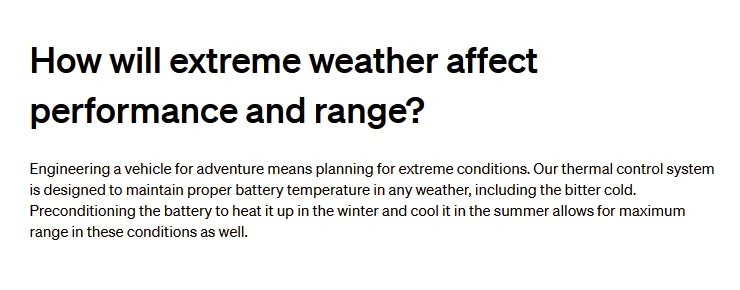
Hyundai/Kia have acknowledge that they need to enable preconditioning, and that it's coming in an update. So that communication isn't unheard of. Polestar enabled it. Lucid has shipped with it. Rivian thus far has said preconditioning isn't there, and apparently telling TFL that it isn't necessary (which i suspect was a miscommunication). It's not clear to the user what's going on or if it does precondition. In fact, their website says it will heat it up and cool it down the pack in a support article. But it doesn't seem to be doing that well enough to manage charging. And I wouldn't consider 40 degrees "extreme weather".
1648085456415.png


Currently the car isn't verbose enough for the average consumer to understand *why* their $80k truck is charging so slowly. Which I view as a problem.

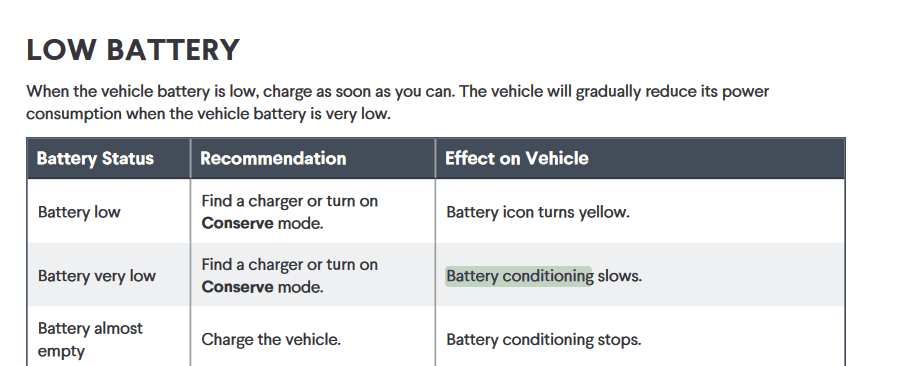
The screenshot below is actually all that the owner manual says about it. Is battery conditioning not functioning properly? Kyle plugged in once at 3% and had battery conditioning occur mid-charge, so "battery conditioning stopped" very well could have been the issue there. But that doesn't explain plugging in at 19% and having it happen.
1648084211719.png


There's no info in the manual about what it is doing when it says it's conditioning the battery during a charge. There's no way for owner Bob to know why it's doing that. Is it too cold? Too hot? Is it broken? Is that going to happen most times?

Point being, even as a total Rivian nerd, I don't know if they're going to fix it (I suspect they will), and I don't know what's causing the slow charging curves other than hunches after living vicariously through a guy driving the equivalent of across the Country for a day.
You can read about the Mach e updates that lead to improved charging curves here.

Also, I'm not disagreeing with anything you are saying, other than it's a new company, a new vehicle, a new platform, and a charging network (Rivian) that doesn't exist yet so we are relying on 3rd party charging that is all over the place in terms of what speeds and amps they are limited to.

That said, I have owned 3 electric vehicles, and 5 vehicles total that were first generation vehicles and I can speak from personal experience that I dealt with a significant number of issues as a first generation vehicle owner that ultimately were worked out in subsequent generations.

The BMW i3, which at the time was one of the most innovative EVs on the market, and loaded was north of $60K left me stranded dozens of times due to various charging fails across the first year of ownership.

I'm not expecting my R1T until 2023 so I have more patience than someone who might be expecting delivery in the next few months - and I acknowledge that inherent bias. I just personally think that any first generation vehicle will have issues that need to be worked out over time as enough data comes in.
 
OP
OP
SeaGeo

SeaGeo

Well-Known Member
First Name
Brice
Joined
Jan 12, 2021
Threads
50
Messages
5,673
Reaction score
10,212
Location
Seattle
Vehicles
Xc60 T8
Occupation
Engineer
You can read about the Mach e updates that lead to improved charging curves here.
Yeah. That's what I was thinking. Ford does not get credit for that. They have a big ass buffer and still throttled the shit out of it when nobody else does.

They still haven’t fixed the time based curve as far as I've seen.

Edit: I do think we are generally on the same page regarding Rivian. I just expect them to do a but better at this point. The issue isn't EA (the amperage limit is...). They just need to get their battery management up to sniff. Which is what they have bragged about in the past. So I'm not as lenient with "version 1" stuff with them on this.
 
Last edited:

Nolf

Member
First Name
Mike
Joined
Jul 3, 2021
Threads
0
Messages
16
Reaction score
17
Location
Mequon, WI
Vehicles
Infiniti JX35, 2 Honda CRVs
Occupation
CIO
Clubs
 
Thank you for this. For the newbie (me) can you explain coldgating, yo-yo driving, and battery conditioning?

Is it effectively that because the car was using energy during the charge to warm the battery, it could not draw?

One key use case in the winter is driving in the call about 250 miles one way. Does the current state of information suggest I should stop at 15% and charge to 50 and then hit the road? Thank you in advance.
As someone new to EVs myself, I'm wondering why I need to care about this. It seems the EV community is way more into details than I have ever been with any car I have ever owned. Every feature. Every measurement. People act like it's the last car they will ever buy.
 

Riviot

Well-Known Member
Joined
Mar 29, 2021
Threads
121
Messages
6,430
Reaction score
10,805
Location
Kitsap, WA
Vehicles
R1T
Clubs
 
As someone new to EVs myself, I'm wondering why I need to care about this. It seems the EV community is way more into details than I have ever been with any car I have ever owned. Every feature. Every measurement. People act like it's the last car they will ever buy.
Monitoring battery health is like scheduling oil changes. Some folks are obsessive about the type and timing of oil changes, others run it hard and dry until they blow a header.

And for some folks on here, it will be the last car they buy...
 

Sponsored

electruck

Well-Known Member
Joined
Oct 6, 2019
Threads
74
Messages
4,155
Reaction score
7,728
Location
Dallas, TX
Vehicles
2023 Rivian R1S
As someone new to EVs myself, I'm wondering why I need to care about this. It seems the EV community is way more into details than I have ever been with any car I have ever owned. Every feature. Every measurement. People act like it's the last car they will ever buy.
This subject gets a lot of discussion only in part because a lot of us geek out on the technical details. More importantly, we like to have a basic understanding of the factors impacting charging time as it allows for better time management. In other words, it allows us to avoid sitting at a charging station for excessive amounts of time when the vehicle really isn't adding much charge. EVs are not like ICE vehicles where you will charge to 100% at every pit stop on a road trip (unless you like to waste significant amounts of time) so it's important to know what charging strategy will work best (ie, get you to your destination in the shortest elapsed time).
 

rogunenode

Active Member
First Name
Chris
Joined
Mar 16, 2022
Threads
0
Messages
28
Reaction score
34
Location
Nederland, CO
Vehicles
Tesla Model 3 Performance
As someone new to EVs myself, I'm wondering why I need to care about this. It seems the EV community is way more into details than I have ever been with any car I have ever owned. Every feature. Every measurement. People act like it's the last car they will ever buy.
I suppose you may want to care about this in particular as Rivian/3rd party charging networks each still have issues that could result in poor charging performance so any of your planned trips could take quite a bit longer and be more frustrating than expected or advertised.

When people talk about Tesla's competition and why buy Tesla, this is a key reason why in my opinion. You can buy a Tesla and have reliable, good travel experiences with little effort or knowledge of your car's battery and charging networks.
 

godfodder0901

Well-Known Member
First Name
Jared
Joined
Mar 12, 2019
Threads
27
Messages
5,749
Reaction score
10,138
Location
Washington
Vehicles
2022 Rivian R1T LE
Monitoring battery health is like scheduling oil changes. Some folks are obsessive about the type and timing of oil changes, others run it hard and dry until they blow a header.

And for some folks on here, it will be the last car they buy...
That turned dark...
Rivian R1T R1S DC Throttling "battery conditioning" giphy
 

Andystroh

Well-Known Member
First Name
Andrew
Joined
Mar 18, 2021
Threads
25
Messages
551
Reaction score
1,168
Location
Colorado
Vehicles
R1T
Clubs
 
As someone new to EVs myself, I'm wondering why I need to care about this. It seems the EV community is way more into details than I have ever been with any car I have ever owned. Every feature. Every measurement. People act like it's the last car they will ever buy.
FWIW I am not typically into these details on cars, but owning my first EV currently charging is the one thing I am interested in the details. When the car charges at 50% of the manufacturer advised charging rate because it’s “cold” out, these details might mean an extra hour at the charger, or an extra 3 hours charging in a full day of driving (speaking more about my ID4 experience than the Rivian).
 
OP
OP
SeaGeo

SeaGeo

Well-Known Member
First Name
Brice
Joined
Jan 12, 2021
Threads
50
Messages
5,673
Reaction score
10,212
Location
Seattle
Vehicles
Xc60 T8
Occupation
Engineer
I suppose you may want to care about this in particular as Rivian/3rd party charging networks each still have issues that could result in poor charging performance so any of your planned trips could take quite a bit longer and be more frustrating than expected or advertised.

When people talk about Tesla's competition and why buy Tesla, this is a key reason why in my opinion. You can buy a Tesla and have reliable, good travel experiences with little effort or knowledge of your car's battery and charging networks.
I think it's a bit more about a lack of familiarity with how Rivian is choosing to deal with things. I'd still look to understand the curve of a tesla. I don't generally worry about EA, for example Kyle didn't have a single EA issue over his trip from Fort Collins to Phoenix and back.

FWIW I am not typically into these details on cars, but owning my first EV currently charging is the one thing I am interested in the details. When the car charges at 50% of the manufacturer advised charging rate because it’s “cold” out, these details might mean an extra hour at the charger, or an extra 3 hours charging in a full day of driving (speaking more about my ID4 experience than the Rivian).
Sounds like we're both scarred by VW not preconditioning. lol.
Sponsored


Top