Sponsored

Electrical people. Opinions on this L2 Install?

babock

Well-Known Member
First Name
Bruce
Joined
Dec 6, 2024
Threads
5
Messages
141
Reaction score
111
Location
Los Angeles and South Lake Tahoe
Vehicles
2025 Rivian R1T, 2024 GMC Denali 2500HD, 2022 Hyundai SantaFe PHEV
Occupation
Retired Electrical Engineer
It will probably be fine, and you have it permitted. Can’t tell you how many times I have seen this. They love running that 6/2 ROMEX. The funny thing is the Romex is rated for 90c just like the THHN but NEC requires ampacity derating to 60C which is why its ampacity is only 55 amps.
And the circuit load is only 48A!
Sponsored


Zoidz

Well-Known Member
First Name
Gil
Joined
Feb 28, 2021
Threads
227
Messages
5,217
Reaction score
11,734
Location
PA
Vehicles
23 R1S Adv, Avalanche, BMWs-X3,330cic,K1200RS bike
Occupation
Engineer
It will probably be fine, and you have it permitted. Can’t tell you how many times I have seen this. They love running that 6/2 ROMEX. The funny thing is the Romex is rated for 90c just like the THHN but NEC requires ampacity derating to 60C which is why its ampacity is only 55 amps.
It's not really a funny thing, it's a technical physics thing. It's because the Romex is tightly bundled with a jacket and therefore heat does not dissipate as quickly as separate THHN conductors. Lower amps = lower heat.
 

godfodder0901

Well-Known Member
First Name
Jared
Joined
Mar 12, 2019
Threads
27
Messages
5,769
Reaction score
10,160
Location
Washington
Vehicles
2022 Rivian R1T LE

dradam

Well-Known Member
Joined
Sep 18, 2022
Threads
23
Messages
427
Reaction score
518
Location
Maryland
Vehicles
2023 R1S OC LA Silver 21 as of 23xxx Nov 3, 2023 !!
There has always been a lot of controversy on this in the forums. While op will know to charge at a lower amperage nec is worried about the next tenant who may not be so smart.
 

Sponsored

godfodder0901

Well-Known Member
First Name
Jared
Joined
Mar 12, 2019
Threads
27
Messages
5,769
Reaction score
10,160
Location
Washington
Vehicles
2022 Rivian R1T LE
LOL...that is the breaker derating...not the wire!
Makes sense. Must be why the NEC refers to the wire temp, the wire guage, and the wire ampacity...
 

Electrified Outdoors

Well-Known Member
First Name
Ken
Joined
Jan 30, 2023
Threads
63
Messages
3,683
Reaction score
3,982
Location
Mount Airy, Maryland
Website
EVoutdoors.org
Vehicles
2024 Rivian R1S Quad, 2024 Silverado EV RST First Edition
Occupation
Real Estate
Clubs
 
LOL...that is the breaker derating...not the wire!
There has been a lot of controversy. I am very cautious after seeing many mishaps involving melting and smoking.

As was stated by @Zoidz the bundling and jacketing plus the fact that it is running through unconditioned spaces....is why they derate to 60C ampacity.

The breaker protects you from overloading the conductor. So what you have is a 60 amp breaker but a conductor that is only rated for 55. Electricians may tell you that you can "round up" because there is no 55 amp breaker... but Its too borderline for me for an EV charging application and technically it doesn't meet code requirements since the over current protection will not kick in before the ampacity limit of the conductor has been exceeded. So the conductor would be the weak link...but...hopefully breaker should pop if the conductor heats up too much.

I am very passionate about EV charging safety and have a very very low risk tolerance.
 

ElGuano

Well-Known Member
Joined
Oct 9, 2024
Threads
50
Messages
871
Reaction score
1,240
Location
Cali
Vehicles
R1T Trimax - Storm Blue, Driftwood, Sport Dark
I am very passionate about EV charging safety and have a very very low risk tolerance.
I think ultimately this is it.

If an electrician installs it, the code says it's OK, inspector signs off on the permit, then what you're left with is risk tolerance and "need." Will 48amp continuous exceed 55amp rated wiring? Normally, no. And I've seen tests where wire insulation lasts 2-3x the rated ampacity of the wire without melting.

But I've also seem a lot of reports of melted conductors, chargers, breakers and wires due to the high draw of EV charging. AND, for myself, the difference between 11.1kw and 9.6kw is...tiny. As in, not worth being troubled over. So the peace of mind from the extra protection of double-buffering outweighs the benefit of 1.5kw more power. My truck is still going to be charged up overnight. But I can accept that means I also err towards "very very low risk tolerance."
 

dradam

Well-Known Member
Joined
Sep 18, 2022
Threads
23
Messages
427
Reaction score
518
Location
Maryland
Vehicles
2023 R1S OC LA Silver 21 as of 23xxx Nov 3, 2023 !!
I think ultimately this is it.

If an electrician installs it, the code says it's OK, inspector signs off on the permit, then what you're left with is risk tolerance and "need." Will 48amp continuous exceed 55amp rated wiring? Normally, no. And I've seen tests where wire insulation lasts 2-3x the rated ampacity of the wire without melting.

But I've also seem a lot of reports of melted conductors, chargers, breakers and wires due to the high draw of EV charging. AND, for myself, the difference between 11.1kw and 9.6kw is...tiny. As in, not worth being troubled over. So the peace of mind from the extra protection of double-buffering outweighs the benefit of 1.5kw more power. My truck is still going to be charged up overnight. But I can accept that means I also err towards "very very low risk tolerance."
Unfortunately some electricians don't seem to follow the code and use romex where a 48 A cahrge could be us . I had to educaate my electrician and we went with 6AWG in flex metal conduit which does not have to be derated. Frankly 4AWG would put all this to bed, but the Rivian charging block connector is speced to 6AWG even though 4 AWG I'm told it can fit. Telsa block can take 4AWG last I checked.
 

Zoidz

Well-Known Member
First Name
Gil
Joined
Feb 28, 2021
Threads
227
Messages
5,217
Reaction score
11,734
Location
PA
Vehicles
23 R1S Adv, Avalanche, BMWs-X3,330cic,K1200RS bike
Occupation
Engineer
There's a lot of misunderstanding about what circuit breakers are for, what they do, and most importantly when they do it.

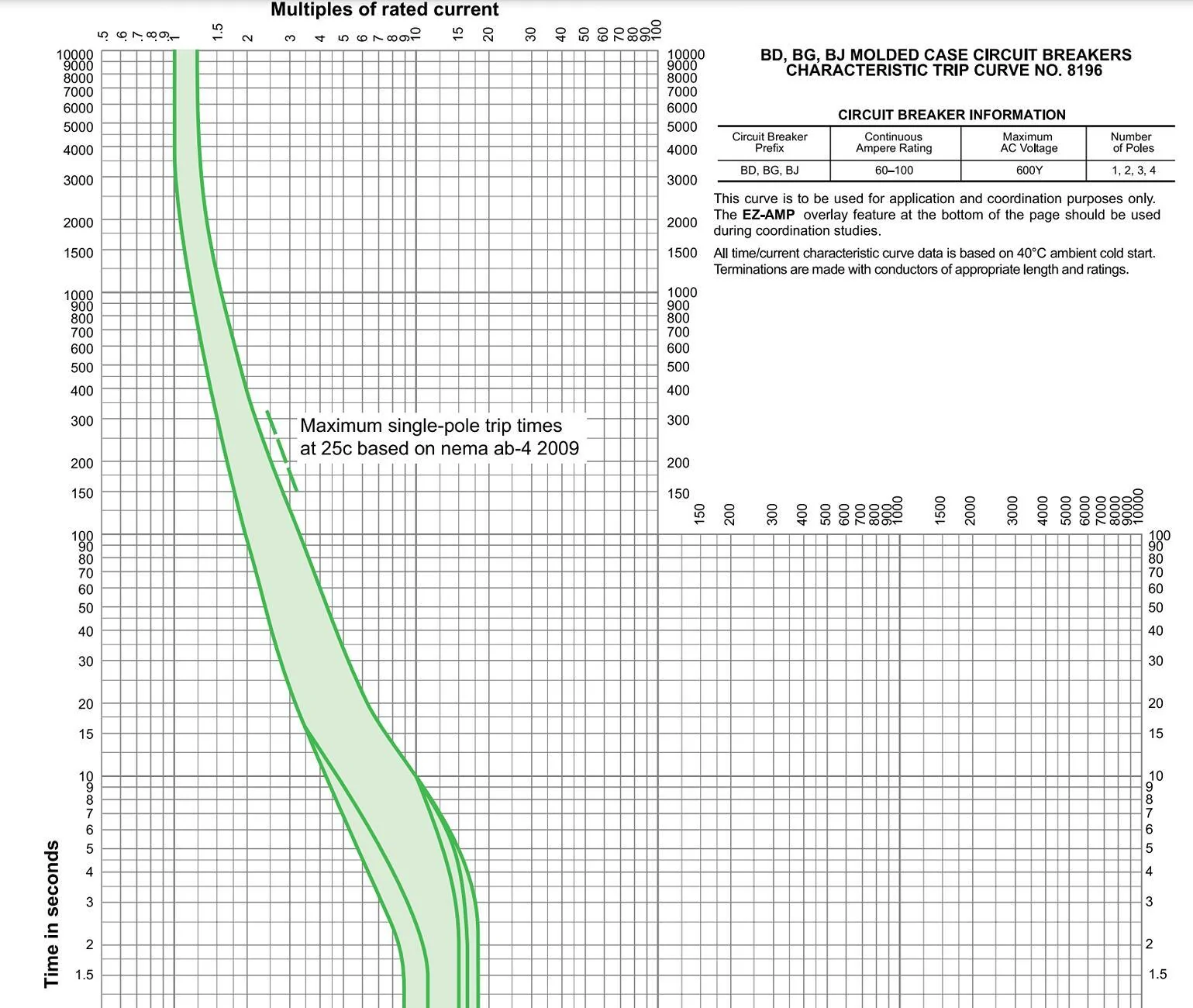
A 60 amp circuit breaker can experience a 62 amp continuous load and NEVER trip, by design. At 90 amp load, it might take that breaker 16 minutes to trip, by design.

A few of you are probably thinking @Zoidz is full of crap. Let's take a somewhat technical dive to see what a breaker really does.

There is a graph referred to as a Breaker Curve. It illustrates the designed trip characteristics of the breaker. The graph below is for a common brand most have heard of - Square D. You can see on the left that it is time to trip in secconds, and across the top is multiples of rated current. Using our 60 amp breaker example, you can see that the green "trip" area goes stright up "off the chart" at 10,000 seconds (16 minutes) where it is at 1x to 1.25x rated current.

This illustrates that a 60 amp breaker may never trip at 62 amps.

Let's look at a current load of 120 amps - that's 2x of the breaker rated current and the wire. Find the 2 multiple across the top, and follow it down to the green area. It's roughly 150 to 400 seconds until the breaker trips.

This is by design - the breaker will (is supposed to) heat up and trip BEFORE the wire gets hot enough to melt the insulation. That's why the current rating differs by insulation type. It's not the wire melting that is the concern, it's the insulation melting and causing a massive high amperage short circuit.

If there was a massive high amperage short, such as 15x, (900 amps) the curve shows the breaker tripping in just a second or two. Again, the wires don't have time to get hot enough to melt the insulation.

Why is there this delay? Many devices (motors, heaters, even larger old school light bulbs) draw 2x or 3x their rated current on start up until the motor starts spinning. the heater element gets hot, etc. You don't want the breaker to trip every time you turn on your electric oven or range, right?

Rivian R1T R1S Electrical people. Opinions on this L2 Install? 1738076233725-x7
 

Sponsored

babock

Well-Known Member
First Name
Bruce
Joined
Dec 6, 2024
Threads
5
Messages
141
Reaction score
111
Location
Los Angeles and South Lake Tahoe
Vehicles
2025 Rivian R1T, 2024 GMC Denali 2500HD, 2022 Hyundai SantaFe PHEV
Occupation
Retired Electrical Engineer
The 48A draw by the hardwired EV charger is under the ampacity of the wire and is under the 80% rule for the breaker.

I am an EE. It is well within specs and that is what ultimately matters.
 

SamDoe1

Well-Known Member
Joined
Nov 22, 2022
Threads
2
Messages
253
Reaction score
280
Location
Minnesota
Vehicles
Rivian R1T, BMW M2 Comp
Clubs
 
The time to learn about proper wiring and electrical code is before the fire trucks show up, not after.

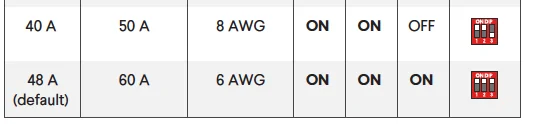
If you're wiring up a home charger, there's very little reason to not just turn the thing down anyway. I have my Rivian wall charger set to 40A instead of 48A just for safety sake.
 

Electrified Outdoors

Well-Known Member
First Name
Ken
Joined
Jan 30, 2023
Threads
63
Messages
3,683
Reaction score
3,982
Location
Mount Airy, Maryland
Website
EVoutdoors.org
Vehicles
2024 Rivian R1S Quad, 2024 Silverado EV RST First Edition
Occupation
Real Estate
Clubs
 
The time to learn about proper wiring and electrical code is before the fire trucks show up, not after.
Well said. If you don't, could be a really hard lesson. I am not going to debate it but just will say that the NEC has buffers built-in to keep things safe. EVs are still something new to the industry..which I am not an electrician btw...but the code has been very slow to adapt to the very long, continuous, high loads introduced to all the components that is unique to EV charging. Especially as we get into large batteries like in the Rivian which can make sessions even longer.

We have already seen the industry adapt the 14-50 plugs because the plugs that are perfectly safe for normal loads can melt and burn of the EV charging application. They were very slow to do this IMO.

The conductor is not rated for 120% of the continuous load at 55 amps and so it does not pass code for a continuous load of 48 amps. It doesn't help that many electricians have been installing mostly 50 amp circuits for 40a charging for years and the fact that 4/2 ROMEX is not very easy to get the last time I checked.

I digress.
 

orttauq

Well-Known Member
First Name
Eric
Joined
Jan 12, 2025
Threads
8
Messages
85
Reaction score
51
Location
Spokane Washington
Vehicles
2025 R1S
Occupation
IT
Clubs
 
There has been a lot of back and forth and opinions here but I have found it all useful. I have decided to set my rate down from 48A Default on my Rivian charger.
Rivian R1T R1S Electrical people. Opinions on this L2 Install? 1738082325517-z
 

Dark-Fx

Well-Known Member
First Name
Brian
Joined
Jul 15, 2020
Threads
149
Messages
13,648
Reaction score
27,662
Location
Michigan
Vehicles
R1T, R1S, Livewire One, Sierra EV, R1S
Occupation
Engineering
Clubs
 
Some codes allow to round up as a 55 amp breaker is rare.

Personally I’m not a fan of rounding up as at some point the person installing that circuit will not be around and all people will see is the 60 amp breaker and thing that circuit is good for 48 amp continuous load. I’d prefer the 50 amp breaker so the lowest portion of that circuit is visible and not hidden in a wall.
It's not really a funny thing, it's a technical physics thing. It's because the Romex is tightly bundled with a jacket and therefore heat does not dissipate as quickly as separate THHN conductors. Lower amps = lower heat.
Fun fact. Canada allows usage of the 75° C ampacity for NM-B.

There's a lot of misunderstanding about what circuit breakers are for, what they do, and most importantly when they do it.

A 60 amp circuit breaker can experience a 62 amp continuous load and NEVER trip, by design. At 90 amp load, it might take that breaker 16 minutes to trip, by design.

A few of you are probably thinking @Zoidz is full of crap. Let's take a somewhat technical dive to see what a breaker really does.

There is a graph referred to as a Breaker Curve. It illustrates the designed trip characteristics of the breaker. The graph below is for a common brand most have heard of - Square D. You can see on the left that it is time to trip in secconds, and across the top is multiples of rated current. Using our 60 amp breaker example, you can see that the green "trip" area goes stright up "off the chart" at 10,000 seconds (16 minutes) where it is at 1x to 1.25x rated current.

This illustrates that a 60 amp breaker may never trip at 62 amps.

Let's look at a current load of 120 amps - that's 2x of the breaker rated current and the wire. Find the 2 multiple across the top, and follow it down to the green area. It's roughly 150 to 400 seconds until the breaker trips.

This is by design - the breaker will (is supposed to) heat up and trip BEFORE the wire gets hot enough to melt the insulation. That's why the current rating differs by insulation type. It's not the wire melting that is the concern, it's the insulation melting and causing a massive high amperage short circuit.

If there was a massive high amperage short, such as 15x, (900 amps) the curve shows the breaker tripping in just a second or two. Again, the wires don't have time to get hot enough to melt the insulation.

Why is there this delay? Many devices (motors, heaters, even larger old school light bulbs) draw 2x or 3x their rated current on start up until the motor starts spinning. the heater element gets hot, etc. You don't want the breaker to trip every time you turn on your electric oven or range, right?

1738076233725-x7.webp
I believe you, I was pulling 120A for about 30 minutes through a 100A breaker before I realized it was happening. Nothing was into the "too hot to touch" territory yet either, and nothing tripped. Currently working on configuring a power meter for my Wallbox chargers so I don't make that mistake again.
Sponsored


Top