Sponsored

Supratachophobia

Well-Known Member
Joined
Apr 8, 2023
Threads
9
Messages
1,781
Reaction score
2,122
Location
Ohio
Vehicles
S
Clubs
 
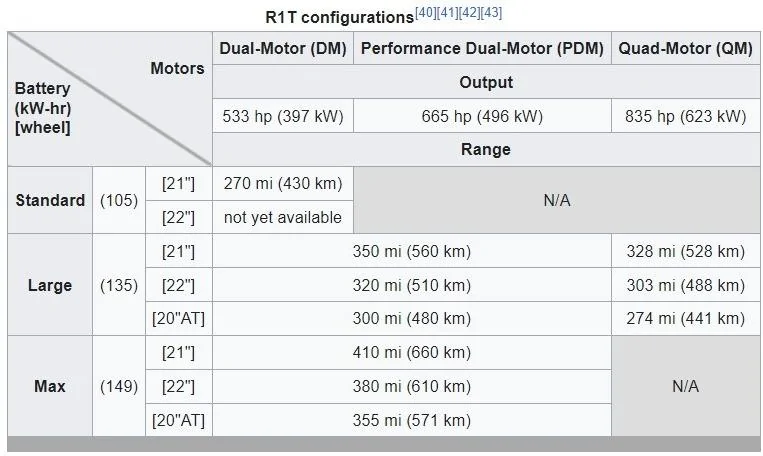
Nice job on that post. I realized that I needed to avoid tire size variations and just use the 21"s (aka most efficient) when I saw the Wiki page table (below). I recall for the Model X that Tesla used to have a footnote on the config page that the 22" would loose 10% range vs the 20".

Wiki page:
PyY9Z7e.webp


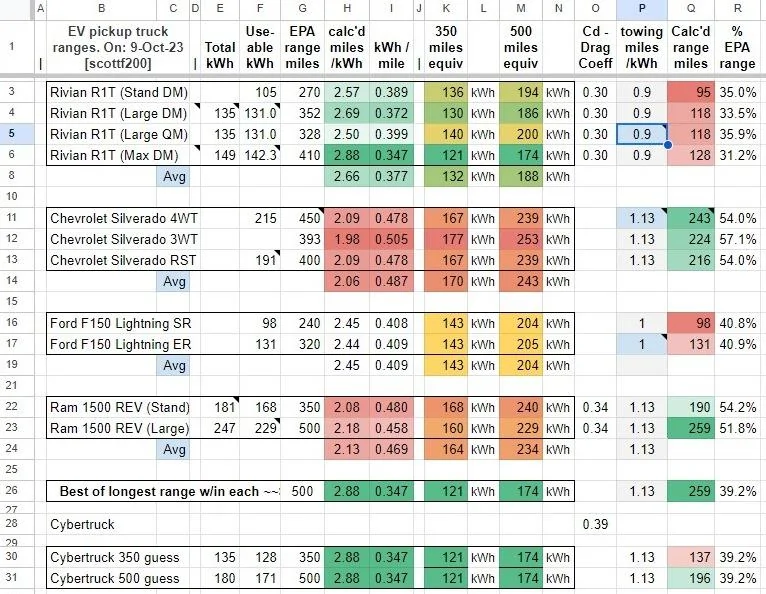
Good observation and question. It is a calculation:
[(towing miles per kWh) / (calc'd miles per kWh)] * (EPA range miles)
and I only had a "(towing miles per kWh)" for one example (blue shade) which was a 7420 lbs dual axle trailer. I added column R showing that resulting % of the EPA range. ie. 328 mi*35.9%=118 mi.
? Do you have any other 'towing miles/kWh' value sources. I think I used a YT from Edmunds Cars where the Rivian got 0.9 and the Ford got 1.0. (The Ford got 1.5 in a diff test with a flat trailer).
1r64YHC.webp


Obviously, things get a little fuzzy if you are doing Calcs like I am for the 'miles/kWh' and you change the 'usable kWh'. I used the kWh numbers from that Car and Driver article and did the calc.
My 19's on the Tesla absolutely blew my 21's out of the water in range. On the Rivian, the 20's with the right tires should be the best range.
Sponsored


Electrified Outdoors

Well-Known Member
First Name
Ken
Joined
Jan 30, 2023
Threads
63
Messages
3,683
Reaction score
3,980
Location
Mount Airy, Maryland
Website
EVoutdoors.org
Vehicles
2024 Rivian R1S Quad, 2024 Silverado EV RST First Edition
Occupation
Real Estate
Clubs
 
Towing efficiency is highly dependent on what your towing. Specifically the aero of it. Weight comes into play more if there is a significant change in elevation on the route.

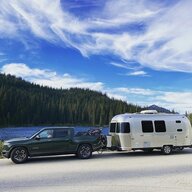
I have made several trips in both the R1S and the R1T. Our tavel trailer is 28ft long and a box on wheels. Its tandem axle as well. Mh trips in that, including a 1200 mile trip in 90+ heat range between 1.0 and 1.2 mi per kwh. The lower the speed the higher the number. The 1.0 is a 65 mph and with heavy AC use. The unit loaded is about 5500 lbs or so.

More recently i towed a UTV. Trailer and UTV about 4,000 lbs and its a flat trailer with tandem axles. With heavy rain and 10 mph winds i averaged between 1.3 and 1.4 mi per kwh.

The T has a slight efficiency advantage over the S as well. Both my T and S have the 21" road wheels.
 

KootenayEV

Well-Known Member
First Name
Andrew
Joined
Sep 22, 2021
Threads
28
Messages
614
Reaction score
589
Location
Nelson, BC
Vehicles
R1T, Tesla Model 3
Occupation
Environmental Engineer
I think cooling is the issue and that would require a different heat/cool pump system or an 800V setup to allow less amperage.
AFAIK, at the individual cell level, having the total system at 800V vs 400V won't make a difference; the cell is going to see the same voltage/amps. If anything, unless they changed the cooling system, heat build-up over a charge may be the same or worse on Max pack than the large (because you'll be charging for a longer period of time).
 

iamnid

Well-Known Member
Joined
Aug 10, 2023
Threads
7
Messages
623
Reaction score
778
Location
California
Vehicles
Mercedes EQE, Rivian R1S
I don't see many use cases where the max pack makes any sense for $10,000.00. Unless you have a specific need to drive 400 miles in one day without charging it, it isn't going to help much on a road trip except for that first leg before you hit a charger. THEN, you'll likely be charging from 10% - 70% before you head off to the next charger anyway and the advantage of the additional 50 miles or range will be quite a bit less and it isn't like this battery charges any faster than the large pack. It seems like towing will only get you about 25 miles more per 100% charge which likely won't make much difference as charging stops are dictated by the charger locations and 25 miles isn't likely to stretch you to a further charger (ignoring that you only get that 25 miles if you sit for 2 hours and charge it up to 100% at each stop).
 

HaveBlue

Well-Known Member
Joined
Nov 22, 2022
Threads
41
Messages
2,928
Reaction score
2,237
Location
91107
Vehicles
R1S DMP Max, Lifted GX470, APR Audi A7, BMW 325Ci
Clubs
 
AFAIK, at the individual cell level, having the total system at 800V vs 400V won't make a difference; the cell is going to see the same voltage/amps. If anything, unless they changed the cooling system, heat build-up over a charge may be the same or worse on Max pack than the large (because you'll be charging for a longer period of time).
Heat tolerance is current related not voltage. For instance wire is rated in Amps based on the conductor thickness. If you go over the ampacity of the wire, the resistance increases and causes heat that ultimately melts the wire. The voltage does not affect this. You can go as high as you want. This is why HID headlights can have tiny little wire while passing 1000V. This is why cross country high tension lines are limited to 500A but 100,000+ volts in order to transmit enormous KW. If they wanted higher current, the thickness of the cable would be impossibly large and expensive.
This is why 800V is so much better because you can effectively sneak power into the pack without raising the current. By changing the series wiring in the pack, you can send more voltage and the same current effectively doubling the KW input.

Of course the voltage does affect the insulation since higher voltage will arc and either needs thick insulation or an appropriate air gap.
 

Sponsored

usofrob

Well-Known Member
First Name
Robert
Joined
Apr 9, 2022
Threads
5
Messages
671
Reaction score
583
Location
Michigan
Vehicles
Tesla 3, lotus Elise
Occupation
MBSE
Someone with a Max Pack should check the charge curve, because it might be higher. If the pack is basically the same but with higher voltage cells, then the cell pack would be like 15% higher KW and the same charge %/time. I bet people could get almost 250KW. What do you think?
 

Supratachophobia

Well-Known Member
Joined
Apr 8, 2023
Threads
9
Messages
1,781
Reaction score
2,122
Location
Ohio
Vehicles
S
Clubs
 
Someone with a Max Pack should check the charge curve, because it might be higher. If the pack is basically the same but with higher voltage cells, then the cell pack would be like 15% higher KW and the same charge %/time. I bet people could get almost 250KW. What do you think?
The cells won't operate at a higher voltage. They'll still cap out at 4.2v at full charge. But their chemical make-up allows them to store
5200mah of energy as opposed to 4800mah per cell in the large pack.
 

usofrob

Well-Known Member
First Name
Robert
Joined
Apr 9, 2022
Threads
5
Messages
671
Reaction score
583
Location
Michigan
Vehicles
Tesla 3, lotus Elise
Occupation
MBSE
The cells won't operate at a higher voltage. They'll still cap out at 4.2v at full charge. But their chemical make-up allows them to store
5200mah of energy as opposed to 4800mah per cell in the large pack.
Sadness. :( My misunderstanding.
I wonder if the rate of recharge (C) is any different then.
 

usofrob

Well-Known Member
First Name
Robert
Joined
Apr 9, 2022
Threads
5
Messages
671
Reaction score
583
Location
Michigan
Vehicles
Tesla 3, lotus Elise
Occupation
MBSE
So, then the received KW at each % of battery should be about the same, it'll just take like 15% longer per percent?
Check my math, but I think that means it'll still receive more total kWh as it should be able to continue to receive near peak KW until it starts tapering at the similar percentage as the large pack. So, I guess slightly slower at low % then a little higher after the Large pack tapers and the max is still less than that percent. But, I wouldn't imagine it would make more than a couple minutes difference max, assuming all things equal.
 

Sponsored

KootenayEV

Well-Known Member
First Name
Andrew
Joined
Sep 22, 2021
Threads
28
Messages
614
Reaction score
589
Location
Nelson, BC
Vehicles
R1T, Tesla Model 3
Occupation
Environmental Engineer
KootenayEV said:
AFAIK, at the individual cell level, having the total system at 800V vs 400V won't make a difference; the cell is going to see the same voltage/amps. If anything, unless they changed the cooling system, heat build-up over a charge may be the same or worse on Max pack than the large (because you'll be charging for a longer period of time).
Heat tolerance is current related not voltage. For instance wire is rated in Amps based on the conductor thickness. If you go over the ampacity of the wire, the resistance increases and causes heat that ultimately melts the wire. The voltage does not affect this. You can go as high as you want. This is why HID headlights can have tiny little wire while passing 1000V. This is why cross country high tension lines are limited to 500A but 100,000+ volts in order to transmit enormous KW. If they wanted higher current, the thickness of the cable would be impossibly large and expensive.
This is why 800V is so much better because you can effectively sneak power into the pack without raising the current. By changing the series wiring in the pack, you can send more voltage and the same current effectively doubling the KW input.

Of course the voltage does affect the insulation since higher voltage will arc and either needs thick insulation or an appropriate air gap.
All those things you mentioned are related to system voltage - yes the conductors from the charge port to the battery and the battery to inverter could indeed be thinner due to reduced amps from increased volts (for the same watts). But at the cell level, the voltage/amps are the same whether the system voltage is 400 or 800v. Hence there is no advantage in thermals etc.

The reason 800v cars generally have a higher charging rate (assuming that the batteries can take the higher C rating) is due to the system improvements you mentioned that carry over to the charging station itself. On the car end, the fundamental technical side is (IMO) really more constrained by the C rating of the cells (and/or the company's tolerance to push the envelope rather than be conservative) and the thermal design.
 

KootenayEV

Well-Known Member
First Name
Andrew
Joined
Sep 22, 2021
Threads
28
Messages
614
Reaction score
589
Location
Nelson, BC
Vehicles
R1T, Tesla Model 3
Occupation
Environmental Engineer
So, then the received KW at each % of battery should be about the same, it'll just take like 15% longer per percent?
Check my math, but I think that means it'll still receive more total kWh as it should be able to continue to receive near peak KW until it starts tapering at the similar percentage as the large pack. So, I guess slightly slower at low % then a little higher after the Large pack tapers and the max is still less than that percent. But, I wouldn't imagine it would make more than a couple minutes difference max, assuming all things equal.
The current pack is constrained by thermal performance it seems, so unless they made improvements at the same time for the Max pack, I don't expect it to charge any faster really.
 

scottf200

Well-Known Member
First Name
Scott
Joined
Nov 25, 2019
Threads
6
Messages
432
Reaction score
296
Location
WNC
Vehicles
Past Ford Exped; curr TMX 100D; future BEV truck/SUV
Occupation
sw engineer
Towing efficiency is highly dependent on what your towing. Specifically the aero of it. Weight comes into play more if there is a significant change in elevation on the route.

I have made several trips in both the R1S and the R1T. Our tavel trailer is 28ft long and a box on wheels. Its tandem axle as well. Mh trips in that, including a 1200 mile trip in 90+ heat range between 1.0 and 1.2 mi per kwh. The lower the speed the higher the number. The 1.0 is a 65 mph and with heavy AC use. The unit loaded is about 5500 lbs or so.

More recently i towed a UTV. Trailer and UTV about 4,000 lbs and its a flat trailer with tandem axles. With heavy rain and 10 mph winds i averaged between 1.3 and 1.4 mi per kwh.

The T has a slight efficiency advantage over the S as well. Both my T and S have the 21" road wheels.
Indeed I understand it can vary a LOT based on what you are towing. Varies a LOT on speed as well it seems from my experience and researched. Thank you for those numbers They are inline with others. I don't know how to represent them in a single column of a 'simplfied' overview spreadsheet tho.
 

Electrified Outdoors

Well-Known Member
First Name
Ken
Joined
Jan 30, 2023
Threads
63
Messages
3,683
Reaction score
3,980
Location
Mount Airy, Maryland
Website
EVoutdoors.org
Vehicles
2024 Rivian R1S Quad, 2024 Silverado EV RST First Edition
Occupation
Real Estate
Clubs
 
Indeed I understand it can vary a LOT based on what you are towing. Varies a LOT on speed as well it seems from my experience and researched. Thank you for those numbers They are inline with others. I don't know how to represent them in a single column of a 'simplfied' overview spreadsheet tho.
Your correct... Speed is huge... There is a significant difference between 60 and 65. Also, if your driving into a 10+ mph headwind it has a significant affect.

The truck, in large pack, carries the equivalent energy of about 4.5 gallons of gas. This is why small changes, especially when towing, have a dramatic affect on range.
 

Supratachophobia

Well-Known Member
Joined
Apr 8, 2023
Threads
9
Messages
1,781
Reaction score
2,122
Location
Ohio
Vehicles
S
Clubs
 
So, then the received KW at each % of battery should be about the same, it'll just take like 15% longer per percent?
Check my math, but I think that means it'll still receive more total kWh as it should be able to continue to receive near peak KW until it starts tapering at the similar percentage as the large pack. So, I guess slightly slower at low % then a little higher after the Large pack tapers and the max is still less than that percent. But, I wouldn't imagine it would make more than a couple minutes difference max, assuming all things equal.
Correct, but don't forget heat buildup.
Sponsored


Top