Sponsored

kylealden

Well-Known Member
First Name
Kyle
Joined
Feb 25, 2021
Threads
20
Messages
1,458
Reaction score
4,461
Location
Seattle
Vehicles
2022 Rivian R1T LE (QM/L), 2024 Zero DSR/X
Occupation
Product Management
The plug standard and the closed door agreements are two separate things.
Sure, and I agree with your overall points, but they don't contradict what I'm getting at.

  1. The plug "standard" is not a standard. It's a published specification. This is important because, for example, Tesla could unilaterally change the next revision of the standard without any input from other adoptees, or advance warning; for example, it could launch Supercharger V5 with a new NACS v2 plug and give themselves a huge head start on design and production of vehicles and infrastructure, and disregard the design requirements of any other OEM; and because:
  2. A common connector specification is not an interoperability guarantee. Tesla is requiring agreements with unknown terms to get access to their supercharger network; there's no guarantee that a spec-compliant connector implementation will get access. And we don't know how onerous the terms are - it could be annual piles of money, it could be patent cross-licensing, etc.
Now, clearly Rivian and other OEMs believe the above two caveats are outweighed by the opportunity here to radically accelerate their access to charging infrastructure and improve customer experience; it's hard to disagree with that perspective. My only point is that it's still factually true that they are ceding major (and unknown) amounts of control and autonomy to Tesla to do so.
Sponsored


COdogman

Well-Known Member
First Name
Brian
Joined
Jan 21, 2022
Threads
33
Messages
11,641
Reaction score
34,494
Location
CO
Vehicles
2023 R1T
Occupation
Cyber defender
Clubs
 
The part in red is what I want to address. The plug standard and the closed door agreements are two separate things. Right now if I wanted to start an EV company named Fuck Elon Musk using the NACS plug I could. I could charge at any station using that plug that was open. If an EA station put in a charger with NACS plug I could use it without any agreement or even while openly giving Elon a hard time.

The agreement would come into play if I wanted access to the supercharger network which Tesla never said was open to all. Now if I named my company Fuck Elon Musk chances are he's not going to grant me a deal to use his network but that doesn't mean he can stop me from using the plug. I'm sure someone is going to chime in on this comment saying that the "in good faith" stipulation of the opening NACS could mean that Elon could say I wasn't using it in good faith and could sue and stop me but that isn't true.

That In good faith language is a legally understood and defined concept and it basically means I am free to use it so long as I don't make any money off the direct use of it. Like I don't try to patent the charging port or somehow sell the fact that I offer that port as an option. If I am not directly monetizing it I am using it in good faith because it is open to all. That is totally and completely a separate thing from accessing the supercharger network.

The reason all the manufacturers who have switched ALSO have the closed door agreement with Tesla is because at this time the ONLY point in switching is to gain access to the supercharger network. Going forward if enough people switch all chargers even non Tesla ones will offer NACS and therefore standardizing will happen regardless. It's even a good thing for everyone else to adopt regardless if they get access to the supercharger network because putting the ports in the same place on every vehicle would allow all charger manufacturers to put in shorter cords like the superchargers which save money and require less maintenance and won't get damaged as much.
If all the other manufacturers saw that "open patent" offer the same way you do, why has not a single one taken advantage of it to this point? Even without access to the SC network there are still plenty of destination chargers their customers would have access to. And using a CCS adapter they could still utilize EA and the other networks.

The only explanation I can think of is none of them trust that Tesla's offer is genuine. If I owned an auto company I would want something more solid than "legally understood" and hope that I don't get sued.
 

Mathme

Well-Known Member
First Name
Matt
Joined
Jul 25, 2022
Threads
3
Messages
1,375
Reaction score
1,808
Location
Los Altos, CA
Vehicles
R1T: El Cap, OC, 20AT, Off road package
Occupation
High Tech
I thought I heard free charging through the end of 2023 on the RAN.

Ideally it'd be nice if Tesla and Rivian have reciprocal benefits on their respective charging networks. In other words, Rivian owners pay Tesla pricing on Tesla network and Tesla pays Rivian pricing on RAN. Additionally, it'd be nice if Rivian focused on the Adventure locations and not right across the parking lot from Tesla chargers.

OK...now I can step back from my idyllic world and wait for reality...
 

Donald Stanfield

Well-Known Member
First Name
Donald
Joined
Jul 31, 2022
Threads
59
Messages
8,307
Reaction score
16,656
Location
USA
Vehicles
2025 R1S Tri Ascend, 2024 i4 M50
Occupation
Stuff and things
Sure, and I agree with your overall points, but they don't contradict what I'm getting at.

  1. The plug "standard" is not a standard. It's a published specification. This is important because, for example, Tesla could unilaterally change the next revision of the standard without any input from other adoptees, and because:
Sure they could, but they aren't going to because it doesn't benefit them to do so. What Tesla wants here is plenty of people using their supercharger network because they charge a high enough rate to cover the costs of their expansion just with their charging alone. That's why it's more expensive than EA or other competitors. Tesla makes money off people charging on their network.
  1. A common connector specification is not an interoperability guarantee. Tesla is requiring agreements with unknown terms to get access to their supercharger network; there's no guarantee that a spec-compliant connector implementation will get access. And we don't know how onerous the terms are - it could be annual piles of money, it could be patent cross-licensing, etc.
You're right these OEMs like Rivian could have signed away rights to their IP or done other things very detrimental to their business like fork over piles of cash to Elon but I doubt it personally. Simply by charging at his stations Elon wins. Every non Tesla that charges there, probably at a slightly higher rate, is giving Elon money to expand his network. Every station they have over and above their competitors puts them ahead of the game.

Flash forward 10 years and the supercharger network will be by far the biggest game in town. Any manufacturer that uses it will have the same seamless experience that Tesla users do now because by the network being gated with agreements the one thing I'm fairly certain Tesla is forcing other manufacturers to do is use a standardized set of communication protocols for charging along with port location and standard. That will create the same experience for everyone Tesla users already enjoy. The biggest hurdle EA and other guys have is creating software that will talk with every manufacturer who is coded a little differently in charging.

Tesla can tell everyone who is using their network that you must communicate in X way, have your port in Y location and use our native app. That way they control the experience in a standard way which gives the end user a repeatable experience. Once that network is fully built Elon can offer free charging for a certain amount of time or half cost charging for every one of his vehicles and it will be subsidized by every non Tesla using his network. So long as he keeps the cost of non Tesla charging roughly in line with open source competitors people will still use it and he will be able to because the number of paying users and the fact that he forces a standard on all cars using it keep his costs down.

Now, clearly Rivian and other OEMs believe the above two caveats are outweighed by the opportunity here to radically accelerate their access to charging infrastructure and improve customer experience; it's hard to disagree with that perspective. My only point is that it's still factually true that they are ceding major (and unknown) amounts of control and autonomy to Tesla to do so.
Replies in red.
 

Sponsored

Donald Stanfield

Well-Known Member
First Name
Donald
Joined
Jul 31, 2022
Threads
59
Messages
8,307
Reaction score
16,656
Location
USA
Vehicles
2025 R1S Tri Ascend, 2024 i4 M50
Occupation
Stuff and things
If all the other manufacturers saw that "open patent" offer the same way you do, why has not a single one taken advantage of it to this point? Even without access to the SC network there are still plenty of destination chargers their customers would have access to. And using a CCS adapter they could still utilize EA and the other networks.

The only explanation I can think of is none of them trust that Tesla's offer is genuine. If I owned an auto company I would want something more solid than "legally understood" and hope that I don't get sued.
Simply put because there's no point it doing so without access to Tesla's network. There already is a CCS to NACS adapter that works for destination charging that anyone can use right now. I have one in my frunk for traveling. So why switch when it doesn't gain you anything you don't already have.

We don't know what Tesla is requiring for agreement and I've already outlined what I believe to be the strategy for Tesla with allowing non Telsas to charge on his network. He is using it to get control over the charging in the USA to a large degree which he will later leverage to subsidize charging for his vehicles on the backs of his competitors. Maybe these holdout OEMs agree with me and see the writing on the wall that it's not a good trade.

I would hope that enough holdouts remain to allow for a viable competitor in charging networks like EA to continue to grow and improve. That will keep Tesla honest in the future so they cannot scalp non Tesla users on their network and have to remain price competitive to a degree in order to continue to have the third party users which will continue to subsidize his future low cost or no cost charging for his vehicles.

It's also important to note that what's good for the manufacturer and what's good for the end user are two different things. Sure this might incentivize buying a Tesla in the future it won't make them put everyone else out of business. People will still buy what other manufacturers have for sale and it will probably force them to make their cars better or cheaper in order to compete with the Tesla incentive. That's good for all of us.

So long as viable networks still get built like RAN and EA Elon will have to keep charging prices competitive which will limit how much of a subsidy he can offer to his own vehicles and keep everyone else from getting scalped at a supercharger.
 

Zoidz

Well-Known Member
First Name
Gil
Joined
Feb 28, 2021
Threads
226
Messages
5,185
Reaction score
11,685
Location
PA
Vehicles
23 R1S Adv, Avalanche, BMWs-X3,330cic,K1200RS bike
Occupation
Engineer
The part in red is what I want to address. The plug standard and the closed door agreements are two separate things. Right now if I wanted to start an EV company named Fuck Elon Musk using the NACS plug I could. I could charge at any station using that plug that was open. If an EA station put in a charger with NACS plug I could use it without any agreement or even while openly giving Elon a hard time.
....
Agree, and there's another aspect that the people who believe it is 100% open and full of Elon's love are missing. Tesla has said NOTHING about open standards regarding the communications protocol(s) and behind the scenes network(s) that manage the multi-manufacturer adoption.

With Elon's PayPal / X.com history and dreams, I fully expect he plans on making money not only on the electricity, but also on "interchange fees" between the various billing systems that connect everything, such as when your Supercharger fees will magically appear in your Rivian account. That does cost IT money to provide and support and he's not going to do it for free. Personally, I believe this may well become part of his Twitter -> X App/X.com dream. For anyone who wants to understand more about what I'm saying, an analogy is the fees and communications protocol mess that is the credit card industry.
 

Joel

Well-Known Member
First Name
Joel
Joined
Jul 29, 2019
Threads
1
Messages
425
Reaction score
324
Location
Florida
Vehicles
Volvo
Agree, and there's another aspect that the people who believe it is 100% open and full of Elon's love are missing. Tesla has said NOTHING about open standards regarding the communications protocol(s) and behind the scenes network(s) that manage the multi-manufacturer adoption.

With Elon's PayPal / X.com history and dreams, I fully expect he plans on making money not only on the electricity, but also on "interchange fees" between the various billing systems that connect everything, such as when your Supercharger fees will magically appear in your Rivian account. That does cost IT money to provide and support and he's not going to do it for free. Personally, I believe this may well become part of his Twitter -> X App/X.com dream. For anyone who wants to understand more about what I'm saying, an analogy is the fees and communications protocol mess that is the credit card industry.
I am fairly certain Tesla made changes to the communication protocol in 2019 to more CCS compliant. Additionally, Tesla is working with Charin to have it officially the standard.
 

EVTrukHog

Well-Known Member
First Name
Matt
Joined
Aug 31, 2021
Threads
37
Messages
666
Reaction score
1,018
Location
USA
Vehicles
R1T, C6 Corvette, Ford Explorer
Seems like Beta vs VHS deja vu....
 

Sponsored

Autolycus

Well-Known Member
Joined
May 2, 2021
Threads
15
Messages
2,234
Reaction score
3,430
Location
ATL
Vehicles
ICE only :(
Agree, and there's another aspect that the people who believe it is 100% open and full of Elon's love are missing. Tesla has said NOTHING about open standards regarding the communications protocol(s) and behind the scenes network(s) that manage the multi-manufacturer adoption.

With Elon's PayPal / X.com history and dreams, I fully expect he plans on making money not only on the electricity, but also on "interchange fees" between the various billing systems that connect everything, such as when your Supercharger fees will magically appear in your Rivian account. That does cost IT money to provide and support and he's not going to do it for free. Personally, I believe this may well become part of his Twitter -> X App/X.com dream. For anyone who wants to understand more about what I'm saying, an analogy is the fees and communications protocol mess that is the credit card industry.
I'm still a skeptic of what exactly Tesla has opened up and what "standard" really exists here, but the "NACS" specification does include the following:

  1. 4.1.13 Control Pilot (CP)
    CP is used as a digital communication path between the charging system and vehicle. The control pilot uses pulse width modulation to communicate charging state and current in accordance with Annex A of IEC 61851-1. Power Line Communication is superimposed onto the control pilot line while DC charging.
  1. 4.5.1 For DC charging, communication between the EV and EVSE shall be power line communication over the control pilot line as depicted in DIN 70121.
  2. 4.5.2 The North American Charging Standard is compatible with “plug and charge” as defined in ISO-15118.
I don't think that fleshes out every communication requirement, but it does at least seem that they're adopting communication standards that look pretty close to those of CCS. For comparison, here's the communication portion of the wikipedia entry on CCS:

Unlike the connector and inlet, which depend on the geographical location, the charging communication is the same around the globe. Generally two types of communication can be differentiated.

  • Basic signaling (BS) is done using a pulse-width modulation (PWM) signal which is transferred over the control pilot (CP) contact according to IEC 61851-1. This communication is used for safety-related functions, indicating for example if the connector is plugged in, before contacts are made live (or energized) and if both charging station and electric vehicle are ready for charging. AC charging is possible using the PWM signal only. In this case the charging station uses the duty cycle of the PWM to inform the onboard charger of the maximum available current at the charging station (A pulse width of 5% indicates that HLC shall be used).
  • High-level communication (HLC) is done by modulating a high-frequency signal over the CP contact (also known as Power Line Communication or PLC) to transfer more complex information, which may be used e.g. for DC charging or for other services such as "plug and charge" or load balancing. High-level communication is based on the standard DIN SPEC 70121 and the ISO/IEC 15118-series.
 

Donald Stanfield

Well-Known Member
First Name
Donald
Joined
Jul 31, 2022
Threads
59
Messages
8,307
Reaction score
16,656
Location
USA
Vehicles
2025 R1S Tri Ascend, 2024 i4 M50
Occupation
Stuff and things
Agree, and there's another aspect that the people who believe it is 100% open and full of Elon's love are missing. Tesla has said NOTHING about open standards regarding the communications protocol(s) and behind the scenes network(s) that manage the multi-manufacturer adoption.

With Elon's PayPal / X.com history and dreams, I fully expect he plans on making money not only on the electricity, but also on "interchange fees" between the various billing systems that connect everything, such as when your Supercharger fees will magically appear in your Rivian account. That does cost IT money to provide and support and he's not going to do it for free. Personally, I believe this may well become part of his Twitter -> X App/X.com dream. For anyone who wants to understand more about what I'm saying, an analogy is the fees and communications protocol mess that is the credit card industry.
Very good point that’s probably how he’s going to get more money from non Tesla vehicles. He will force them to use a payment gateway he owns and get an extra 1-2% off each transaction for the privilege of using his chargers.

CC companies do this all the time now and the whole payment gateway thing depends on volume and type of business for your rates now. So Ford might get lower processing than Rivian or vice versa depending on how much business they do with Elon.
 

junkanoo

Well-Known Member
First Name
Richard
Joined
Mar 11, 2022
Threads
7
Messages
198
Reaction score
251
Location
Connecticut
Vehicles
Acura RDX, Suburu Outback, R1S
Occupation
Supply Chain Planning
Cashflow positive soon. Does that mean our free charging is going to come to an end? :-(
I mean it was supposed to come to an end months ago. Even worse RJ plans to open them to non-Rivian's. Both are clearly needed to make them profitable.

This just goes to show that Rivian knows what they are doing. Sticking with diversifying their business with charging and software is smart because they can be more than just a car company. All these silly comments that they should mothball their RAN network were just wrong, they already have been ramping their in house charging kit so time to capitalize on that investment.
You do realize that "cashflow positive" is just a long-winded way of saying 'Revenue' right?

Now, if Rivian wants to make the case as to how they will make the RAN network profitable (along with when and by how much), I'm sure we all would love to see it in writing.

If "in house charging kit" means a 'wall charger' ... this is not a differentiating product. And my utility gave me 600 reasons not to use the Rivian charger.

Instead, Rivian needs to focus on beating competitors at something meaningful. Because I fully believe that there will be fewer fish in the sea, not more.
 

Derek

Well-Known Member
First Name
Derek
Joined
Oct 7, 2021
Threads
24
Messages
94
Reaction score
191
Location
California
Vehicles
Tesla Model 3, R1T
Clubs
 
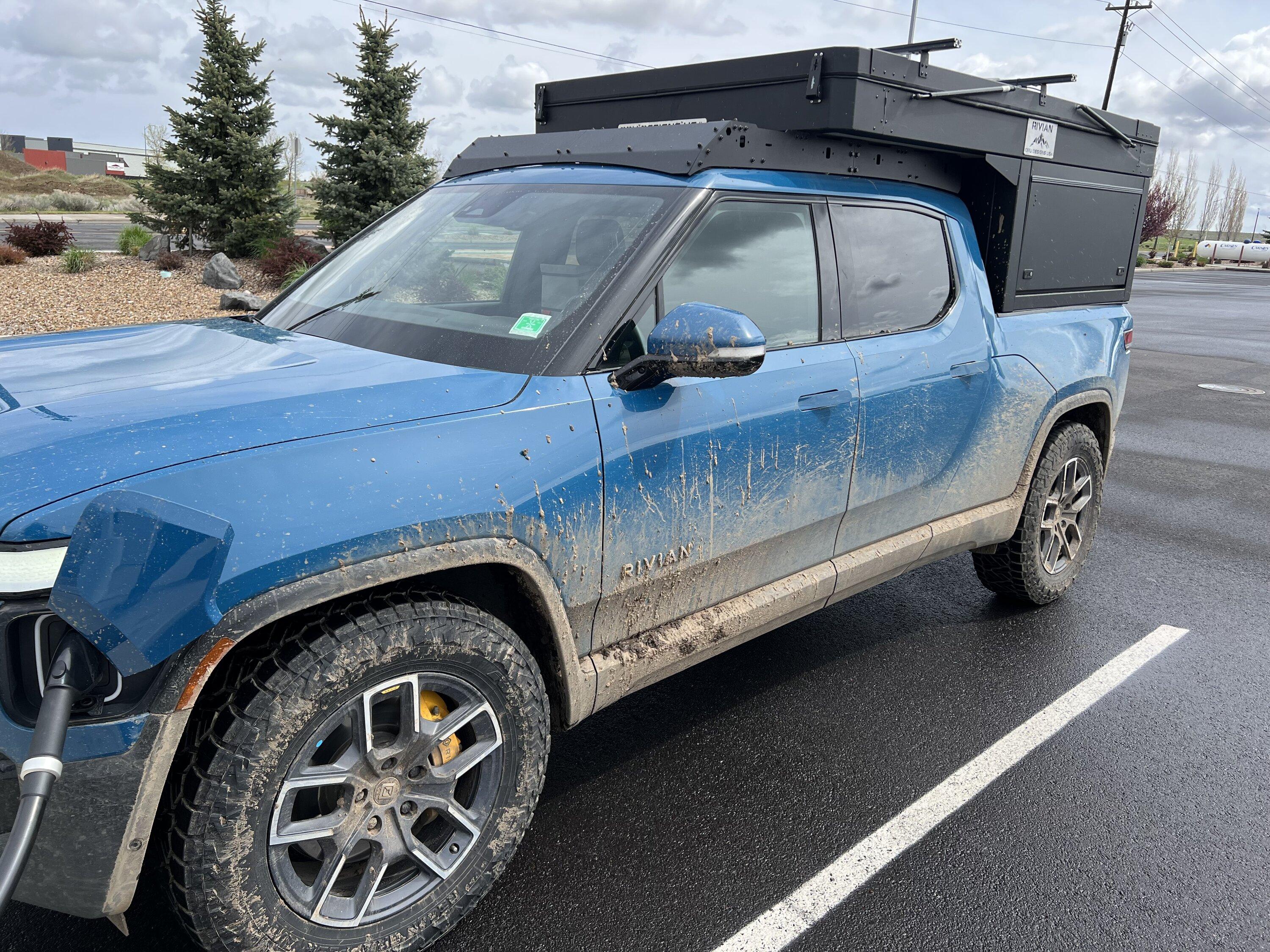
Time for a central (or coastal) OR road trip then ;) Personally I have been putting those chargers in Madras and Crescent to work exploring the high desert.
IMG_4793.jpeg
It would be a great post if you would do a walkthrough of the setup on your rig.
 

s4wrxttcs

Well-Known Member
Joined
Aug 16, 2022
Threads
4
Messages
1,293
Reaction score
1,493
Location
Snohomish, WA
Vehicles
Rivian R1T
Occupation
Engineer
because they didn't say it out loud, it implied NACS only
That would make them ineligible for any of the federal government funding as it requires CCS ports.

So my guess is they'll have both CCS ports and NACS ports.
Sponsored


Top