
Sponsored

Why is 4 mi/kwh the max in the Efficiency screen?

Jabbahop

Well-Known Member
First Name
Michael
Joined
Sep 5, 2021
Threads
28
Messages
264
Reaction score
423
Location
utah and vermont
Vehicles
‘14 BMW i3, ‘19 BMW i3, ‘22 R1T -> ‘24 R1S Max
Occupation
retired
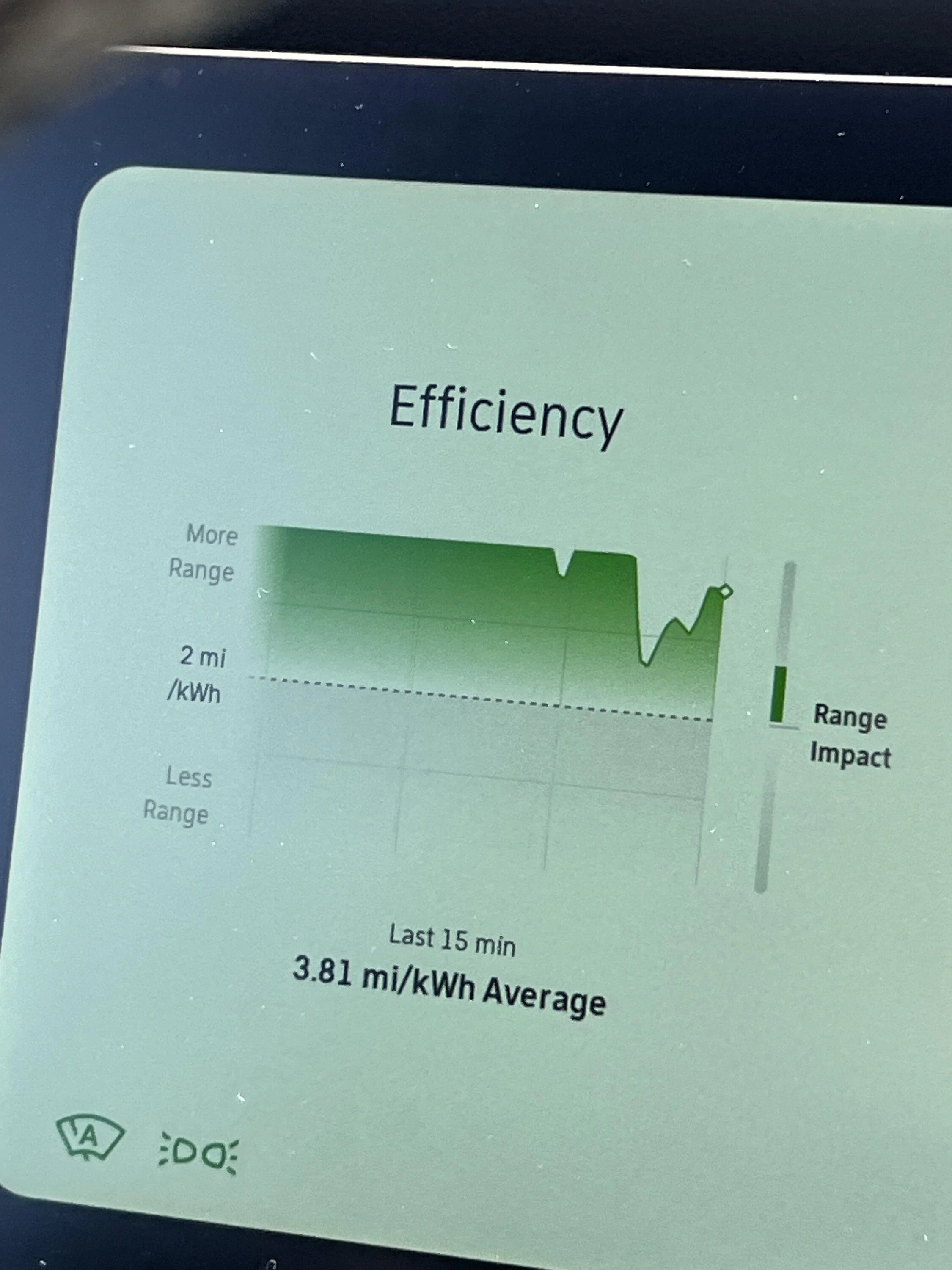
Seems like there is a hard limit @ 4 mi/kwh on the efficiency screen no matter how slow or how much you descend. That screen and the max efficiency was the same for our R1T with 20” AT as it is for the dual motor R1S with 21” AS tires.

Anyone know why?

Rivian R1T R1S Why is 4 mi/kwh the max in the Efficiency screen? IMG_2937
Sponsored


godfodder0901

Well-Known Member
First Name
Jared
Joined
Mar 12, 2019
Threads
27
Messages
5,749
Reaction score
10,138
Location
Washington
Vehicles
2022 Rivian R1T LE
Seems like there is a hard limit @ 4 mi/kwh on the efficiency screen no matter how slow or how much you descend. That screen and the max efficiency was the same for our R1T with 20” AT as it is for the dual motor R1S with 21” AS tires.

Anyone know why?

IMG_2937.jpeg
Because you won't reasonably get that kind of efficiency except for long, steep declines.
 
OP
OP
Jabbahop

Jabbahop

Well-Known Member
First Name
Michael
Joined
Sep 5, 2021
Threads
28
Messages
264
Reaction score
423
Location
utah and vermont
Vehicles
‘14 BMW i3, ‘19 BMW i3, ‘22 R1T -> ‘24 R1S Max
Occupation
retired
Because you won't reasonably get that kind of efficiency except for long, steep declines.
I am getting them on my ”commute” to town and it isn’t very steep - 35-45mph with a few hundred feet of vertical over 8-10 miles.
 

Proxy

Well-Known Member
First Name
Me
Joined
Nov 11, 2023
Threads
2
Messages
198
Reaction score
224
Location
Ventura County
Vehicles
R1T R1S
Occupation
Professional
Makes sense. 99% of owners will stay below 4 mi/kwh for most of the time they will look at the graph. No reason to complicate it with auto ranging or changing the scale to top out at 6 and make it less useful for most owners.
 

Sponsored

sub

Well-Known Member
Joined
Jul 23, 2021
Threads
33
Messages
1,872
Reaction score
3,304
Location
USA
Vehicles
Rivian R1S, Tesla Model 3
Because Rivian got the units wrong.

With the units Rivian is choosing to use, when rolling down a hill the number very quickly explodes past infinity. No matter where Rivian drew the line, you're going to be off the chart. How do you chart a number that's bigger than Infinity? Setting the top higher, just compresses the rest of the data into a meaningless line and you're still way over the top of the chart.

You wouldn't have this problem it they displayed the efficiency in kilowatt hours per mile instead miles per kilowatt hour.

Instead of values between 0.5 and way past 1000000000000000000000000000, the range of possible values in kilowatt hours per mile is roughly -1 to 2.

When all possible values fit on the chart, it makes a much prettier chart and is much easier to comprehend.

I have no idea why Rivian chose such stupid units, but if they are going to stick to their decision to support those stupid units, they should at least add an option to invert the units for people who would prefer that.
 

VSG

Well-Known Member
Joined
Oct 3, 2022
Threads
4
Messages
3,204
Reaction score
5,987
Location
WA
Vehicles
R1T LE/RB/OC/20
@sub correctly identifies why the graph needs to clip values above some arbitrary ceiling (in this case 4 miles/kWh.)

I personally wouldn't characterize these units as "wrong” or ”stupid" because this is the way efficiency has traditionally been measured in the US. Miles/gallon has the same limitation. Inverting the definition may make a prettier graph but it would require people to think about efficiency in a different way than they're accustomed to. There are already too many artificial barriers to EV adoption - we don't need to go out of our way to create new ones

BTW this discussion of whether the definition should be inverted has a long history even in ICE vehicles - I first read about this maybe 45 years ago after the gas crisis when EPA gas mileage ratings became a big thing.
 

ksurfier

Well-Known Member
First Name
Ken
Joined
Aug 23, 2022
Threads
42
Messages
1,049
Reaction score
918
Location
CA
Vehicles
R1SQM, Tesla
Occupation
Fake Science Lead
Clubs
 
I guess I’m torn on what I prefer, I got used to Tesla using Wh per mile (usually 250 or so). 1000 divided by wh/mile = MPK so pretty easy. Tesla focuses on the amount of energy consumed to travel one mile while Rivian is looking at the distance traveled per unit energy (1,000 wh). For Tesla, lower values are more efficient but Rivian it’s the opposite.

Maybe we need a third option and it should be like boats: KPM per hour, the hours cancel and we are left with KPM.
Shoot, I think I’m more confused now than I was before…but honestly, maybe it could just be a setting in the menu?
 

zefram47

Well-Known Member
First Name
Aaron
Joined
Feb 6, 2022
Threads
18
Messages
2,749
Reaction score
4,511
Location
Denver, CO
Vehicles
Rivian R1T, Alfa Romeo 4C
Occupation
Software Engineer
Because you won't reasonably get that kind of efficiency except for long, steep declines.
Sure, but living in/near the mountains it's not uncommon to pin that graph for more than 15 minutes at a time. Kinda fun trying too.
 

sub

Well-Known Member
Joined
Jul 23, 2021
Threads
33
Messages
1,872
Reaction score
3,304
Location
USA
Vehicles
Rivian R1S, Tesla Model 3
BTW this discussion of whether the definition should be inverted has a long history even in ICE vehicles - I first read about this maybe 45 years ago after the gas crisis when EPA gas mileage ratings became a big thing.
MPG works well in gas vehicles for the same reason it shouldn't be mi/KWH for EVs.

0 in the denominator is objectively a problem that should be avoided whenever possible.

In a gas vehicle, the gallons used never approaches 0 (unless you turn the vehicle off) and negative values are nonsense. So gallons is a great choice for the denominator. MPG will never explode on you. Speed can approach 0 so if we did gal/mi the number would explode as speed approaches 0. MPG never will. So MPG is the better unit.

But in an EV the KWH term not only frequently approaches 0 every time you let up on the accelerater, it frequently crosses 0 into negative values (regen). So it is a really bad choice for the denominator.

Speed can also approach 0 in an EV but when it does KWH is usually also approaching 0 so it still resists exploding as long as you don't continue to hold the pedal down after you have crashed into a wall. ( which may also result in a different kind of explosion)
 
Last edited:

Sponsored

Electrified Outdoors

Well-Known Member
First Name
Ken
Joined
Jan 30, 2023
Threads
63
Messages
3,683
Reaction score
3,980
Location
Mount Airy, Maryland
Website
EVoutdoors.org
Vehicles
2024 Rivian R1S Quad, 2024 Silverado EV RST First Edition
Occupation
Real Estate
Clubs
 
That screen isn't an accurate representation of your average range. It's only meant to help guide folks on the impact of driving conditions on range.

Your trip screen will show an accurate average. I always reset on a road trip. With that I can accurately predict my range based on my average consumption.
 

White Shadow

Well-Known Member
First Name
Thomas
Joined
Nov 11, 2021
Threads
13
Messages
1,406
Reaction score
1,159
Location
NJ
Vehicles
Jeep & Audi
Occupation
SP
It's pretty typical in an ICE vehicle to see the MPG readout to go to 99 when coasting down a hill. Why doesn't it go higher? I don't know, but in theory (and actually reality), you're actually getting an infinite amount of fuel economy when coasting downhill in an ICE car, as the fuel injectors can be shut off completely. Yet the fuel economy readout tops out at 99 mpg.

So maybe with Rivian, you're still getting more than what the readout shows, but it's all averaged in over time.
 

White Shadow

Well-Known Member
First Name
Thomas
Joined
Nov 11, 2021
Threads
13
Messages
1,406
Reaction score
1,159
Location
NJ
Vehicles
Jeep & Audi
Occupation
SP
I guess I’m torn on what I prefer, I got used to Tesla using Wh per mile (usually 250 or so). 1000 divided by wh/mile = MPK so pretty easy. Tesla focuses on the amount of energy consumed to travel one mile while Rivian is looking at the distance traveled per unit energy (1,000 wh). For Tesla, lower values are more efficient but Rivian it’s the opposite.

Maybe we need a third option and it should be like boats: KPM per hour, the hours cancel and we are left with KPM.
Shoot, I think I’m more confused now than I was before…but honestly, maybe it could just be a setting in the menu?
Wh per mile is by far a better way of doing it, but for most people. Kwh/mile makes more sense because it's so much easier, right? People can relate to someone saying that their EV averages 2.5 Kwh per mile when they compare their own EV that averages only 1.8 Kwh per mile.
 

racekarl

Well-Known Member
Joined
Jan 5, 2023
Threads
9
Messages
554
Reaction score
825
Location
MA
Vehicles
2023 R1T
Inverting the definition may make a prettier graph but it would require people to think about efficiency in a different way than they're accustomed to.
I'm not sure I agree - Tesla uses a consumption metric by default and theirs is arguably the lingua franca of EV adoption. Other EVs seem to either default to a consumption metric (e.g. wh/mi) or at least let you choose it. Rivian should at least make the (more sensible) consumption metric a configurable option.
 

runningdenver

Well-Known Member
First Name
Richard
Joined
Nov 12, 2023
Threads
4
Messages
227
Reaction score
279
Location
Denver
Vehicles
R1S QM
Occupation
Tech
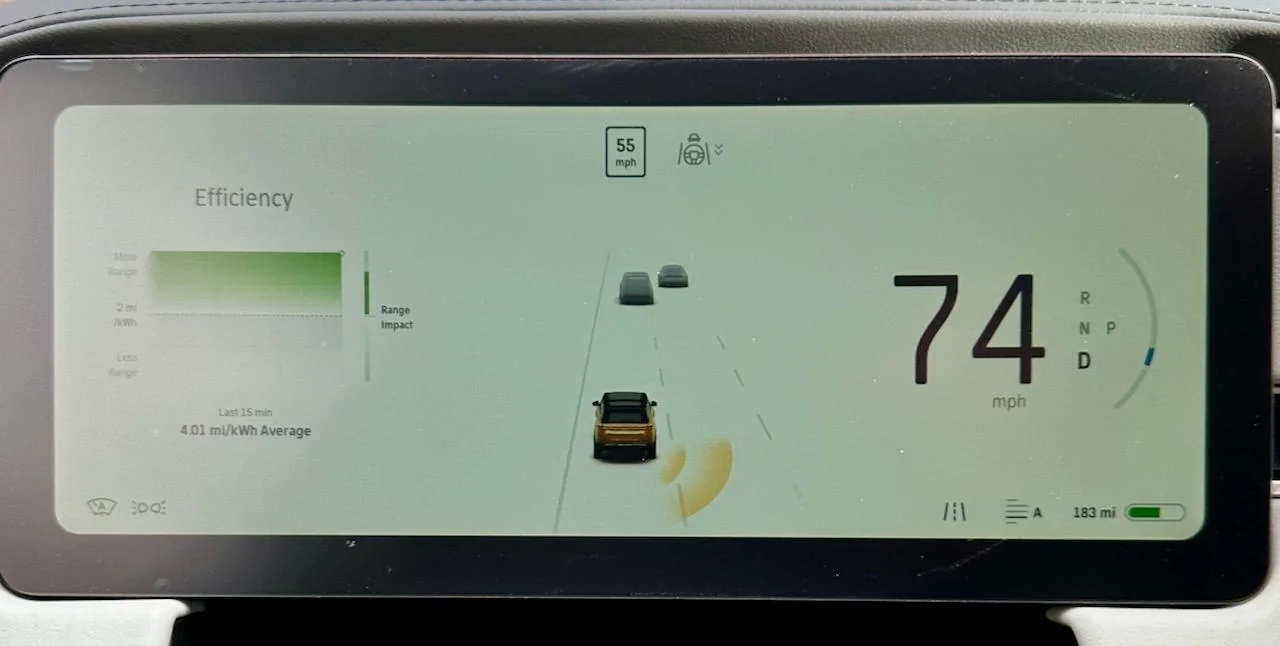
the average efficiency reading does go over 4%, just the graph doesn't. Even coming down from the mountains averaging 80-90 mph, you can still get it over 4 (I had to slow down to take the photo)... Going up is another matter. I'm lucky to get close to 1.5 on the drive up.

Rivian R1T R1S Why is 4 mi/kwh the max in the Efficiency screen? IMG_3557
Sponsored

 
Last edited:


Top