Sponsored

Charge to 70% or 80% ?

CrazyOne

Well-Known Member
Joined
Oct 30, 2021
Threads
3
Messages
1,350
Reaction score
1,141
Location
WA
Vehicles
R1T
Why should we keep it plugged in even when not charging? I have a short commute and only charge/plug in after several days (charging to 70%) or before a longer trip as needed, but otherwise don’t plug it in- I could but didn’t see the need.
There are 3 big contributors to battery degradation from my research on internet university.

High Temperature
Depth of charge
High cell voltage (SOC)

Temperature: It's hard to control temperature for us. Don't park in the sun, when possible.

SOC: Keep it at a low charge that works. 50% is low and there isn't a meaningful benefit below a certain SOC. It's not clear what that number is, but below 70 is generally pretty good. At high SOC, deg happens the longer cells sit at high voltage. At high temperature, it's worse than at low temp.

Depth of charge: Always be charging, when possible. Charging at cooler temperatures will be good. So you can schedule night charging, but it's likey more important to reduce depth of charge than to do so at lower temperature.
Sponsored

 

Hereforthesnacks

Well-Known Member
Joined
Jun 6, 2024
Threads
3
Messages
1,232
Reaction score
1,460
Location
West Coast
Vehicles
Ford Bronco
In the 90s to early 2000s, many of the laptop and small appliance batteries were made of NMH (Nickel-Metal-Hydride) and those cells developed "memory" of charing habits. As such, people were advised to let it drain down to 0%, then fully recharge periodically.

Modern battery, regardless of composition, do not have memory flaw. Having spent couple of years working on hybrid and electric aircraft concepts, I have seen many presentations and papers on the battery operations. If one were to summarize the best reliability and long lasting cells, its usually calls for 20~80% SOC range for Li-Ion cells. Clearly if needed to go lower or to full is use case dependent. If you change the chemical composition, there are different rule of thumb for the ideal charge levels (e.g., LFP really doesn't care and can charge to 100% on the regular basis).

My advise is not to worry about it much, and enjoy your vehicle as you see fit. Just try to keep it in the 20-80 range for the daily. Makes almost no difference if it's 60% or 80%. The only thing is to use around 50% for long term storage (e.g., on vacation for 3+ weeks). I ALWAYS charge to 90~100% on road trips and often run down to 10%. I have done so with our Tesla and our Rivian. No issues.
Yeah I was just wondering if you needed to get to 100% once in a while for calibration. I agree that, if you use your battery reasonably, you are good to go.
 

NY_Rob

Well-Known Member
First Name
Rob
Joined
Feb 9, 2022
Threads
23
Messages
5,391
Reaction score
7,961
Location
long island
Vehicles
Model 3 LR AWD, BMW i3 REX, 2024 Rubicon 4xe
Occupation
IT
Yeah I was just wondering if you needed to get to 100% once in a while for calibration. I agree that, if you use your battery reasonably, you are good to go.
It certainly won't hurt the battery if you start discharging it shortly after reaching 100%. You just don't want to be sitting at 100% for long periods of inactivity. It's also possible that occasionally charging to 100% and discharging to very low levels might help suss out any sub-optimal cells before they fail. Always keeping the charge in the Goldilocks zone (20%-80%) never stress tests the cells.
 

Kaiju

Well-Known Member
Joined
Aug 18, 2024
Threads
2
Messages
136
Reaction score
254
Location
Texas
Vehicles
R1T
If I remember Rivian batteries (at least the Gen 1) do actually have a bit of extra headroom on the order of a few percent. I've seen pictures of the 131kWh battery labels actually being somewhere around 135 actual. That's not much, but it's there.

There's an argument to be made about charging daily, but in terms of degradation the depth of discharge and the average state of charge level both increase it. They both have an influence and it can be roughly the same, however your driving habits play into it. Basically it's frequency of deep charging vs average state of charge over time. Sitting at 70% SoC from being on the charger continously is worse for the battery than being at a 50% average when charging every few days or once a week. Charging 40% in one go is worse for the battery than charging 20% twice as often, however doing that means your state of charge average is higher over the lifetime of the battery...which is worse. The relationship between the two is complicated because one is based on time and one is based on cycles. I don't honestly think it makes a meaningful difference if you charge it every day from 60%-70% or once a week going from 30% to 80%. It's exponentially worse in both cases at the extremes.

From what I gather, the ideal solution for your NMC battery is to keep it at 40-50%, never use more than 20% in one go and charge after every drive. In practical terms though? It seems the most sensible thing is to establish where your comfortable charge floor is and charge it often enough that you don't do more than 30%-40%-ish in one shot. What I mean by charge floor is the minimum range you're comfortable having in the case something unexpected happens. Enough to make an extra trip or two to your kid's school, have to go back and forth from work an extra time, having to run from a disaster area to someplace with power. That sort of thing. I charge mine to 80% every time it goes under 50%, but it doesn't stay plugged in.
 

Jonger1150

Well-Known Member
First Name
Jon
Joined
Jun 28, 2024
Threads
4
Messages
1,023
Reaction score
962
Location
Howell, MI
Vehicles
2024 R1T & 2024 Chevy Blazer EV
Occupation
Nerd
Clubs
 
I wonder if the vehicle stores a log of how often it's charged to certain percentages. I'd pass on any used EV that has been charged to 100% more than 10% of the time.
 

Sponsored

mkg3

Well-Known Member
Joined
Nov 19, 2021
Threads
90
Messages
2,787
Reaction score
3,701
Location
SoCal
Vehicles
R1S, Model 3, Outback, Artura
Clubs
 
I wonder if the vehicle stores a log of how often it's charged to certain percentages. I'd pass on any used EV that has been charged to 100% more than 10% of the time.
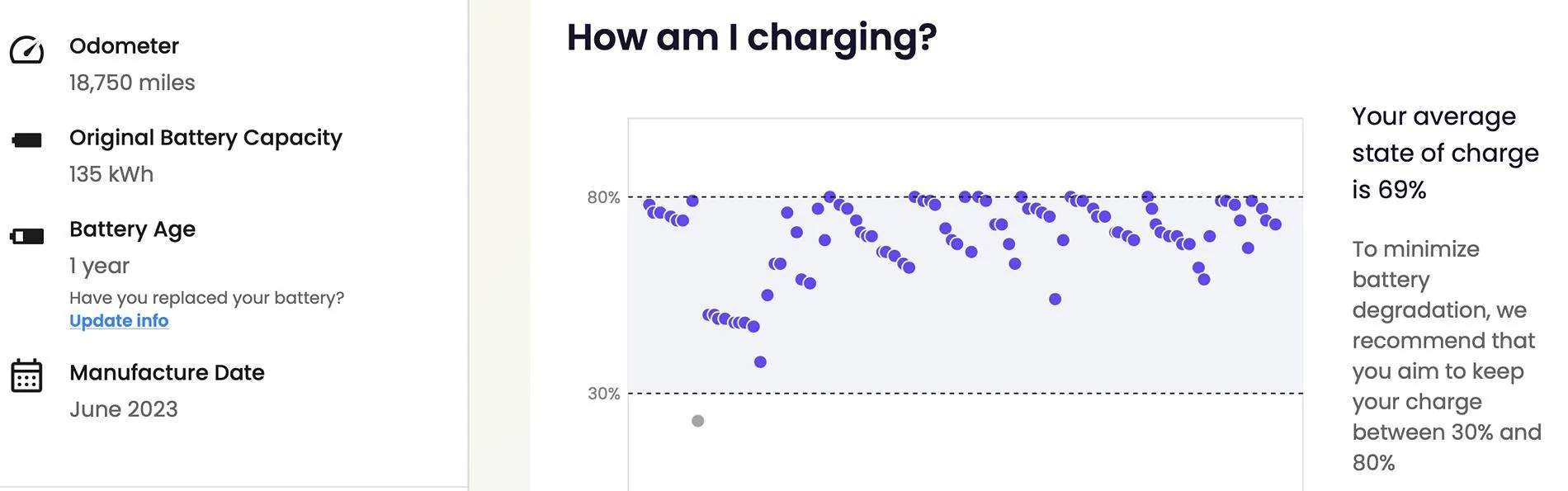
You can sign up to Recurrent,com and get a monthly report of your vehicle, like the image below for our R1S. It shows SOC at various times of the day and drives.

Rivian R1T R1S Charge to 70% or 80% ? 1730664655914-xm
 

misterturbo

Well-Known Member
Joined
May 11, 2024
Threads
5
Messages
117
Reaction score
176
Location
The Northern Neck, Virginia
Vehicles
R1T
Sure! Just F over the next owner. Nobel Prize candidate! Haha
Why would I care about the next owner of a leased vehicle? Why would YOU care?

I’m making a monthly payment to use 100% of the truck, not 80% of it…Why would I limit my usage of it for someone else? It’s not like chase is going to give me money back…
 

JamboF4

Well-Known Member
First Name
Jim
Joined
Oct 8, 2021
Threads
18
Messages
543
Reaction score
404
Location
Ponte Vedra Beach, FL
Vehicles
R1T, C8 ZO6, Tacoma, Arcimoto
Occupation
Retired airline Captain
Why would I care about the next owner of a leased vehicle? Why would YOU care?

I’m making a monthly payment to use 100% of the truck, not 80% of it…Why would I limit my usage of it for someone else? It’s not like chase is going to give me money back…
Yes I would. I’d explain it to you but I’m out of crayons.
 

Sponsored

dradam

Well-Known Member
Joined
Sep 18, 2022
Threads
23
Messages
425
Reaction score
518
Location
Maryland
Vehicles
2023 R1S OC LA Silver 21 as of 23xxx Nov 3, 2023 !!
Engineering Explained on YouTube has excellent videos on changing, for NMC and LFP packs. There is also one on DC Fast Charging. Not short form, but IMO essential knowledge. The videos explain how and why packs degrade, even at molecular level, which yields understanding of what not to do.

You are fine to charge to 80%. Rivian’s recommendation of 70% is a very safe one. Do whichever works for you based on your usage.
I agree that the engineering explained videos on YouTube are excellent. Based on those videos, as well as my personal needs, I usually charge to about 52% nightly. I don’t need more than that for my daily routine. I will charge up Higher when needed or to 100% before a big trip.

I tend to keep my cars for a very long time so I really do wish to prolong The survival of the battery.

I cannot do justice to the explanations given in those videos. But essentially think of the battery is a sponge soaking up electrical charge and expanding And contracting. This leads to Greater utilization of electrolyte solutions. And diminished battery longevity. In the mid range, the expansion contraction is for lack of a better word less Traumatic to the battery.

In a nutshell, it does not seem to make a huge difference and of course you’re driving needs must come first. Because the battery cycles will often outlive the vehicle itself.

Do you check out those videos. They were extremely helpful and I hope they help you as well.
 
OP
OP

greg martin

Active Member
First Name
Greg
Joined
Oct 25, 2024
Threads
8
Messages
30
Reaction score
10
Location
cleveland
Vehicles
mazda 3
Occupation
designer
Thanks all for the advice and information!
Much appreciated!
 

McLovin

Well-Known Member
Joined
Jul 30, 2024
Threads
7
Messages
508
Reaction score
1,153
Location
Virginia
Vehicles
R1T
Clubs
 
Why would I care about the next owner of a leased vehicle? Why would YOU care?

I’m making a monthly payment to use 100% of the truck, not 80% of it…Why would I limit my usage of it for someone else? It’s not like chase is going to give me money back…
I know this is controversial for some people here, but I’m not using my vehicle for the next owner, I’m using it for me. If the next owner isn’t smart enough to inspect the vehicle before they buy it, or get a warranty, that’s on them.

Same reason I have always put regular unleaded in my leased Audis. Car drives & performs fine. I’m not paying an extra $0.50-0.75 per gallon for some other driver’s future use. Not my issue.
 

R1Sky Business

Well-Known Member
Joined
Mar 15, 2022
Threads
55
Messages
5,356
Reaction score
4,385
Location
CA
Vehicles
R1S
Clubs
 
I agree that the engineering explained videos on YouTube are excellent. Based on those videos, as well as my personal needs, I usually charge to about 52% nightly. I don’t need more than that for my daily routine. I will charge up Higher when needed or to 100% before a big trip.

I tend to keep my cars for a very long time so I really do wish to prolong The survival of the battery.

I cannot do justice to the explanations given in those videos. But essentially think of the battery is a sponge soaking up electrical charge and expanding And contracting. This leads to Greater utilization of electrolyte solutions. And diminished battery longevity. In the mid range, the expansion contraction is for lack of a better word less Traumatic to the battery.

In a nutshell, it does not seem to make a huge difference and of course you’re driving needs must come first. Because the battery cycles will often outlive the vehicle itself.

Do you check out those videos. They were extremely helpful and I hope they help you as well.
How much percentage donusbuse daily?
Sponsored


Top