Sponsored

charging session summary (2022.23.5 FW)

ajdelange

Well-Known Member
First Name
A. J.
Joined
Aug 1, 2019
Threads
9
Messages
2,883
Reaction score
2,319
Location
Virginia/Quebec
Vehicles
Tesla XLR+2019, Lexus, Landcruiser, R1T
Occupation
EE Retired
My best guess is either via technical limitation or motivated by safety, the coolant system is being circulated at all times during charging.
Keep in mind that the rectifier/inverter/rectifier use active devices which produce heat which must be removed. Where it goes and whether it has to be pumped or passively transferred has a big effect on the energy required to move it (just pumps or compressor too) and thus the efficiency.
Sponsored


pc500

Well-Known Member
Joined
Jun 22, 2021
Threads
20
Messages
1,045
Reaction score
563
Location
US
Vehicles
dodge ram
Sure, but this assumes people have a 60A circuit and a 48A charger. Or are you saying they should indicate different MPGe for different home charing setups?

I would guess that only a fraction of Rivian owners (just anecdotally on this forum) are able to charge at this rate. And I would guess many more incorrectly assume that slower charging will be more efficient (and maybe better for the life of the battery). The MPGe of the Rivian would be significantly worse if the EPA rated it based on a slower/smaller home charger.

I did not realize this issue was almost as bad for the Tesla crowd.

https://teslamotorsclub.com/tmc/threads/model-3-home-charging-efficiency.202780/

Honestly this slow-charging-is-actually ridiculously-inefficient thing has been the most surprising thing that I have learned since owning my first EV.
You'll have to pick an amperage. The included charger one could be used, or the max charge rate if you'd rather. Something needs to be consistent to make it fair. Even at 48a, the mpge still takes a hit. My nissan leaf would take less of a hit.

It turns out the mpge does include it already today. However it's unclear to me at what charge rate they calculate it.
 
Last edited:

HightiseATX

Active Member
First Name
George
Joined
Aug 16, 2021
Threads
1
Messages
27
Reaction score
33
Location
Austin, TX
Vehicles
2015 Toyota Tacoma
Occupation
Retired
Home EVSE into battery efficiency: I charge at home with a Changepoint Home Flex, which reports Kw/h delivered per charging session. I charge at night in a closed garage, proximity key on, stays unlocked at home., no gear guard. It is hot in Texas even in the evenings.

My EVSE reports steady 11.5 kw output while charging. I'm usually going from ~40% to 70%. I did not include any data where the EVSE reported a second "top off" charging bump.

% loss = ((delivered kw/h as reported by the EVSE) [MINUS] (Kw/h into the battery per R1T))
[DIVIDED BY] (delivered kw/h as reported by the EVSE)

Assuming the EVSE & R1T are reporting accurate data, this should be the total charging loss.

In the last 10 days, I've had six charging sessions:
8/20 13% loss on EVSE delivery of 46.3 kw/h
8/21 12% loss on 32.4 kw/h
8/22 11.4% loss on 32.2 kw/h
8/24 11.8% loss on 43.2 kw/h
8/26 12% loss on 46.8 kw/h
8/28 12% loss on 57.5 kw/h

That is a 12% average loss or
88% of the kw/h I pay for make it into the battery or
I buy 1.136 kw/h to get 1 kw/h into the battery

So when I see my R1T telling me 50 kw/h added during a charging session, I take 50 x 1.136= 56.8 and that is how many Kw/h I paid for to get that charge.

YMMV, just wanted to share my info.
 

Arnie1

Well-Known Member
First Name
Arnie
Joined
Apr 18, 2022
Threads
20
Messages
107
Reaction score
36
Location
Wesley Chapel, FL
Vehicles
2023 Rivian R1S Quad
Occupation
Consulting Engineer
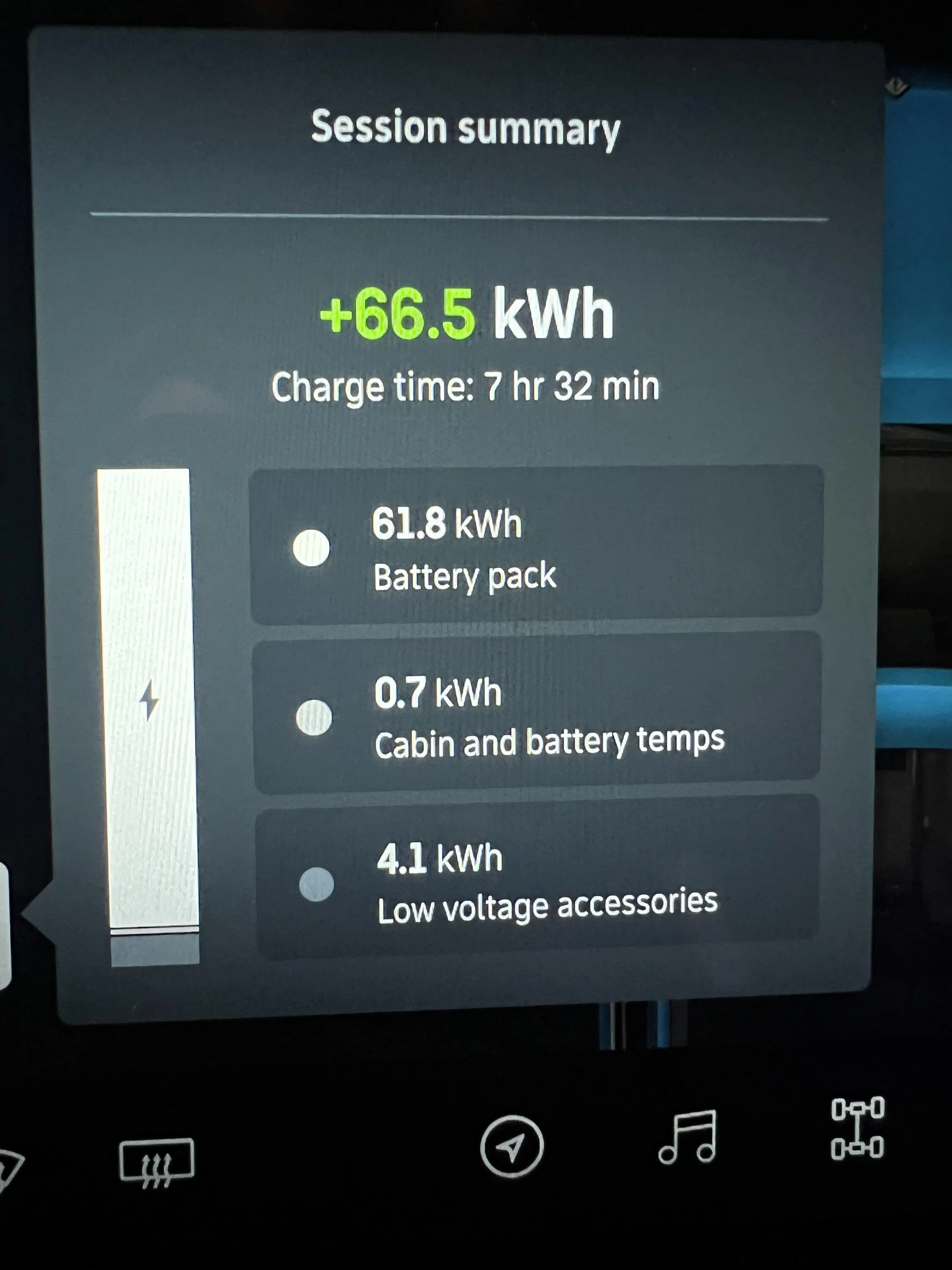
I have proximity key disabled. This is my charge session last night, very typical in my experience.

BD47B709-505B-42D9-9B75-B9B78F85A9EA.jpeg
is it possible to turn off cabin cooling at rest?
Other than battery cooling, gear guard motion detect, and cabin cooling what other vampires are using 10-20%?
Sponsored


Top