Sponsored

Jonger1150

Well-Known Member
First Name
Jon
Joined
Jun 28, 2024
Threads
4
Messages
1,025
Reaction score
964
Location
Howell, MI
Vehicles
2024 R1T & 2024 Chevy Blazer EV
Occupation
Nerd
Clubs
 
Ok so the savings, if regular driving is ~40kW, could be about 10% with the heat pump. That is actually pretty material. I would still prefer the resistive heater but 10% range is not nothing.
Yup, it's definitely ideal to have one. I'm hoping they figure out the sound level by the time gen3 lands. My GF's Blazer EV has a heatpump and that thing is loud as well. It's just how they are.
Sponsored

 
OP
OP
phaduman

phaduman

Well-Known Member
Joined
May 7, 2024
Threads
18
Messages
152
Reaction score
222
Location
San Jose, CA
Vehicles
R1T-G2,Tesla M3&MY, Motorcycles
Occupation
Techie
Our Model3 is pre-Heatpump but our ModelY is with heat pump.
We have driven both through winters, ModelY even more in extreme cold (Tahoe 10F at night winters) and haven’t noticed any unusual loud noises when heating up.

I assume Gen2 has a much larger heat pump than MY - but if that’s rhe case, I would have hoped it heats the cabin faster but it doesn’t. R1T cabin is perhaps not that much bigger than a MY that has a trunk space to heat).
 

pc500

Well-Known Member
Joined
Jun 22, 2021
Threads
20
Messages
1,045
Reaction score
563
Location
US
Vehicles
dodge ram
What's interesting with Rivians is that the battery capacity is so large and the power required to move the vehicle is so much higher than typical EVs (especially compared to something like a model 3), that the overall % spent on heating is much smaller.

On the model 3, the switch to heat pump will have a much more dramatic impact than on the Rivian.

For instance, let's say I'm driving at 70mph, and I'm getting 1.8mi/kWh with my winter tires. That means I'm using about 39 kW.

A 1.5kW space heater can get a small room REALLY toasty. You really only need about 750W to maintain a comfy temp. And the R1T cab is not huge.

But let's be conservative and assume we are using 1kW for resistive heat, and I save half of that with a heat pump, then 0.5/39 is only about 1% of actual saving.

I would give up that 1% to have the resistive heater blast us with hot air very soon after turning it on (no waiting like in a ICE car). In fact this is one aspect my kids and family love about the Rivian. We just use the heater indiscriminately because it's such a small percentage of overall usage.

For a model 3, that is getting 3.5 mi/kWh in the winter, the saving of 0.5kW is more like 2.5%. And if you have less range to start with :), then that 2.5% could be more important too. My guess is the Rivian is probably much better insulated than the Model 3 as well ;-).

But for the Rivian, especially with Large or Max battery packs, I like the luxury of a resistive heater that is quiet.

One thing I've always wondered is if recirculating air vs. bringing in fresh air makes a big difference to how much energy is spent on heating over a long trip. I like using fresh air in general, but I'm not sure how much harder that is causing the heater to work.
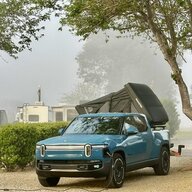
I like heat pump for sleeping/camping in the vehicle. Heater runs 12+ hours with no movement.
 

pc500

Well-Known Member
Joined
Jun 22, 2021
Threads
20
Messages
1,045
Reaction score
563
Location
US
Vehicles
dodge ram
Does the noise bother nearby campers out of curiosity?
I usually use it in Rural Idaho in the forest (boondocking), or at a random rest stop/pullover spot. Given the lack of use in crowded campgrounds, I really don't know.
Sponsored


Top