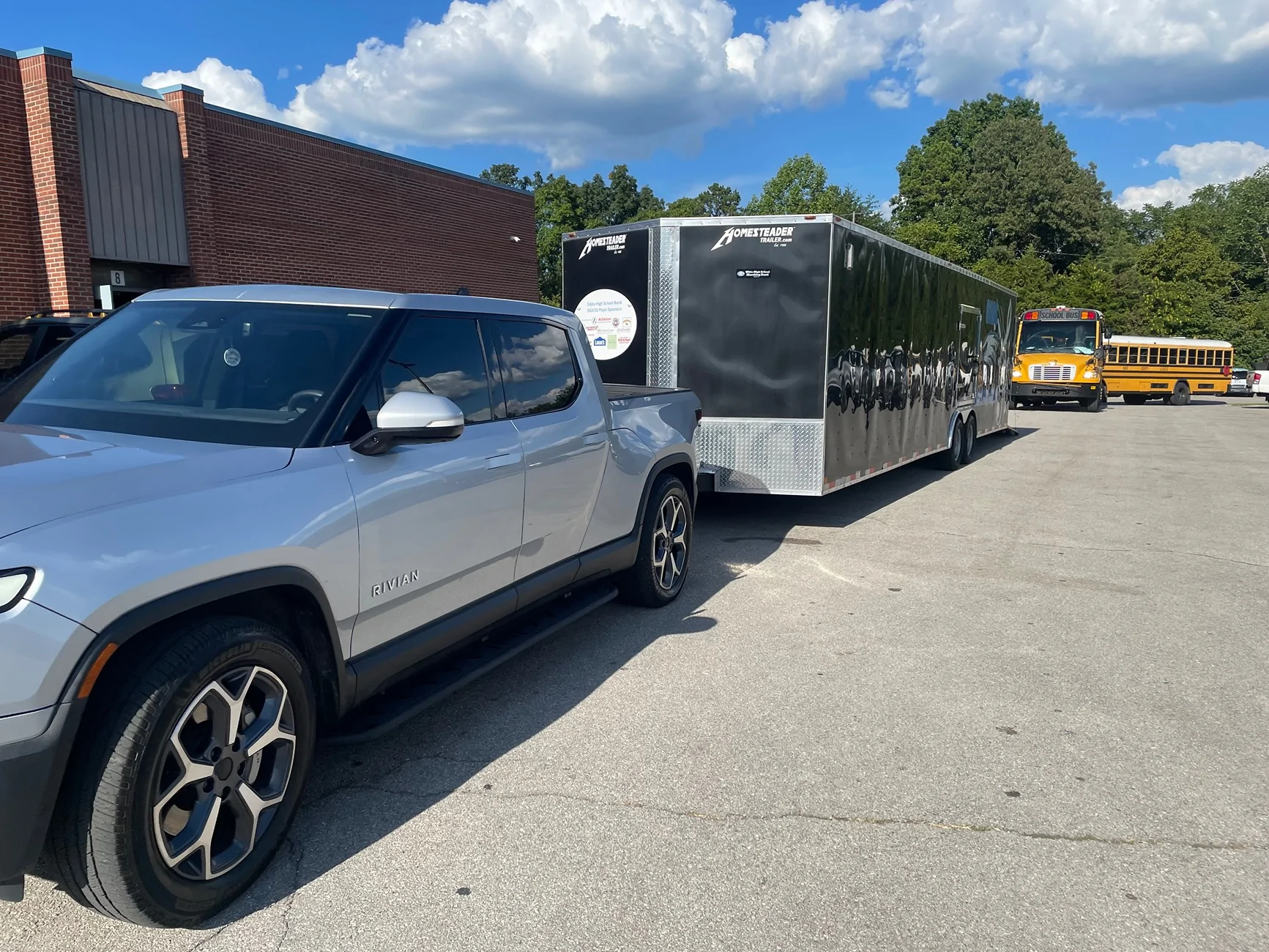

Sponsored

Towing + Efficiency: Please post your experience!

VandalSibs

Well-Known Member
First Name
Andrew
Joined
Dec 27, 2023
Threads
15
Messages
1,377
Reaction score
2,383
Location
Eastern Washington State
Website
www.sibulskymusic.com
Vehicles
R1T Dual Motor Large Pack
Occupation
Composer, IT Service Desk Analyst
Clubs
 
This thread was super helpful to me before my R1T purchase, so continuing the contributions.

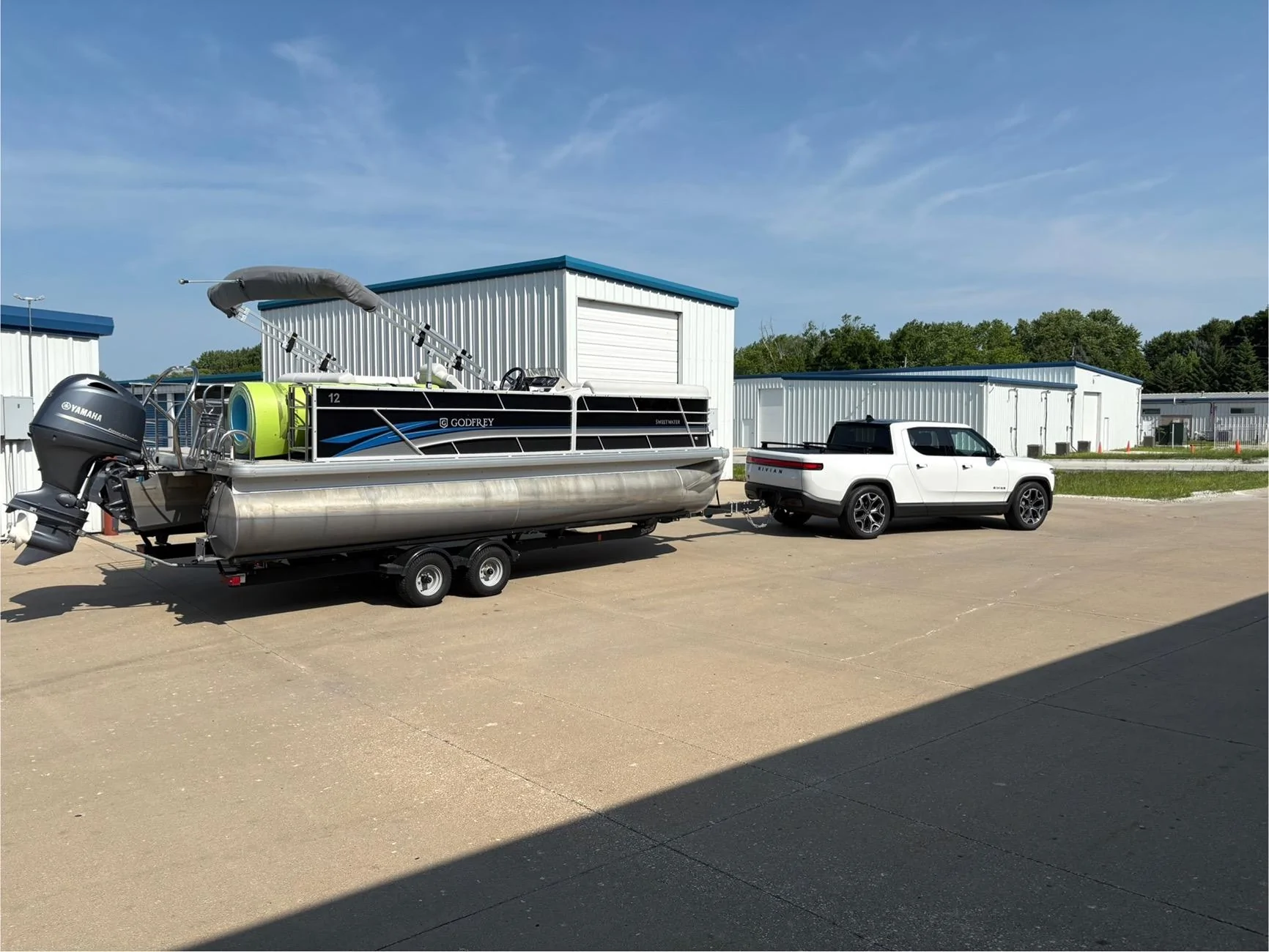
During the summer we trailer a pontoon to a few local lakes and usually do one longer trip with the boat for a summer vacation. It’s a parachute, terrible aero. But you’re all so right that it’s a fantastic tow vehicle.

Good test on an 89 mile round trip to the lake and back. 85-87 degrees and a very small breeze. Gen2 Dual Motor Large pack with the stock 22” sports. Truck was fully loaded with people, coolers and gear. I did lower the boat Bimini top before the drive.

Boat is a 22’ Godfrey with a Shoreland’r dual axle trailer. Roughly 3500 pounds, but as many of you know…the weight isn’t the problem with these. It’s the drag.

Avg 1.05 mi/kwh. Started with 100% SoC and had an indicated 18% SoC remaining (37 miles) when I finished the trip. Truck used 1% sitting in the ramp lot during the day, probably due to gear guard being active. Most of the trip was between 55-62mph, with some minor midwestern hills.

Side note, while I’m happy with this result, I will definitely buy the max pack next time. This truck works perfectly for 99% of my use cases, but that extra buffer when towing would give me options for more sporadic decisions or plan changes. This area has terrible fast charging options.

IMG_9620.jpeg
That's a lot of boat!
Sponsored


MoreTrout

Well-Known Member
First Name
Jay
Joined
Sep 12, 2021
Threads
19
Messages
551
Reaction score
840
Location
PA
Vehicles
Ford Fusion Hybrid, Rivian R1T
Occupation
Retired USN
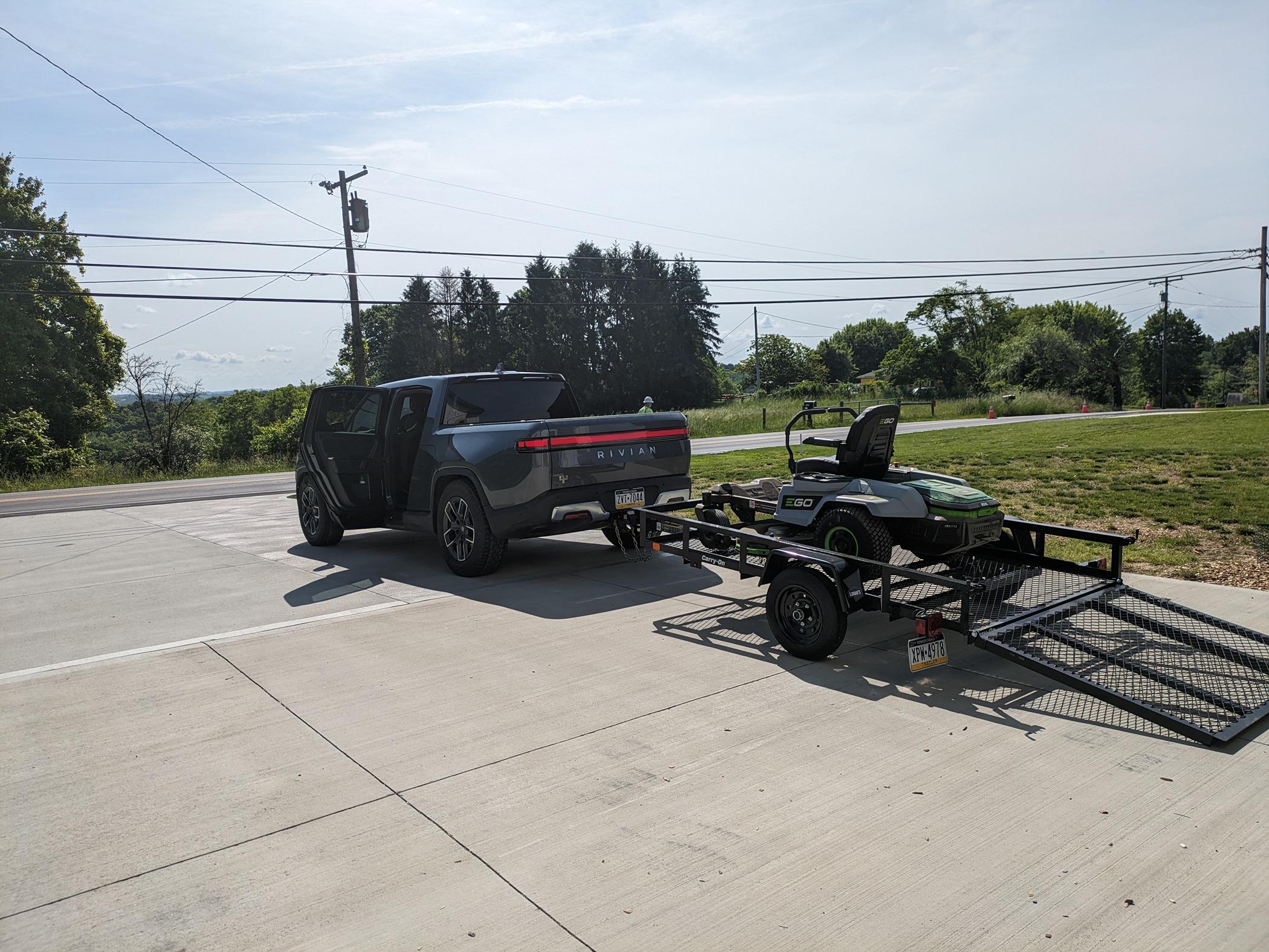
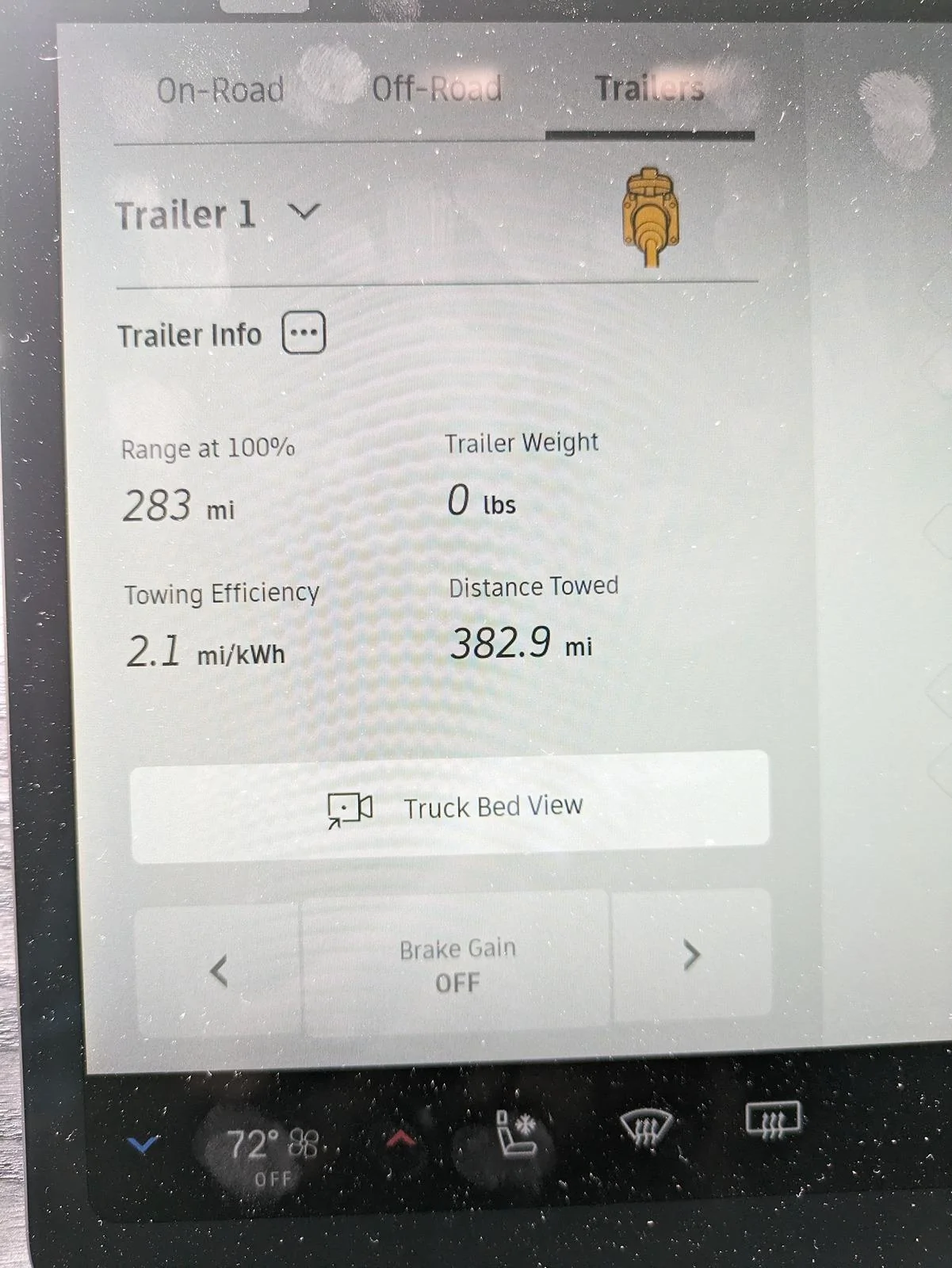
When a belt broke on my riding mower at my camp, I had already decided that I wasn't putting another dime into it, even though it was an easy fix. And I was getting even more agitated pushing my 20 in Kobalt mower back and forth on my close to 1 acre at home for 3 hours twice a week. So I finally pulled the trigger and bought an Ego zero turn for both locations. I knew this also meant getting a trailer to haul it the ~185-200 miles back and forth a couple of trips a month. I had the extra charging stops mapped out along a couple of route options. But boy was I pleasantly surprised at the efficiency on the maiden voyage. I did charge on the way and didn't pay close attention to the exact number, but could have made the trip up without charging and made it somewhere in the mid to high 20% range. Coming back was even better. Starting with 100% I made the 185 mile trip home without a stop and still had 32%. I had suspected I could probably make it without stopping, but never expected to see over 2 mi/kWh. It's about 60/40 highway to single lane roads, but other than about a 25 mile stretch of 65 mph the highways are all 55 mph.

PXL_20240523_141626715.MP.jpg


PXL_20240526_173752365.webp
Thought I would give an update after 2 full seasons of towing this back and forth. I think I just passed around 6k total miles of towing. The long term towing average now sits at 1.94 mi/kWh. Late last summer, I replaced my original 20" Pirelli OEM AT tires after around 34k miles. They were probably ready to replace 2-3k miles before that. I had previously bought a set of very lightly used replacements that only had ~700 miles and 1/32 of wear, so close to new. There was an immediate drop with the newer tires and those first several trips I was probably only getting between 1.7-1.85 mi/kWh, but there has been a definite trend up again. I now have ~53k total miles so about 20k on these tires. Recently I have been coming close to 2.00 mi/kWh on the return trips again. It's around an 800 ft elevation change between locations. Based on the last tire rotation tread check, I'm pretty sure I am going to have to replace them again at the next rotation that is due at 57.5k miles. I'm plenty happy with the efficiency of the Pirelli's both with and without towing, but honestly the road noise right now is starting to get to me.
 

antimatter

Well-Known Member
First Name
Lloyd
Joined
Dec 27, 2024
Threads
4
Messages
109
Reaction score
153
Location
Minneapolis, MN
Vehicles
Honda Ridgeline, Honda CR-Z
Occupation
Chief Compliance Officer
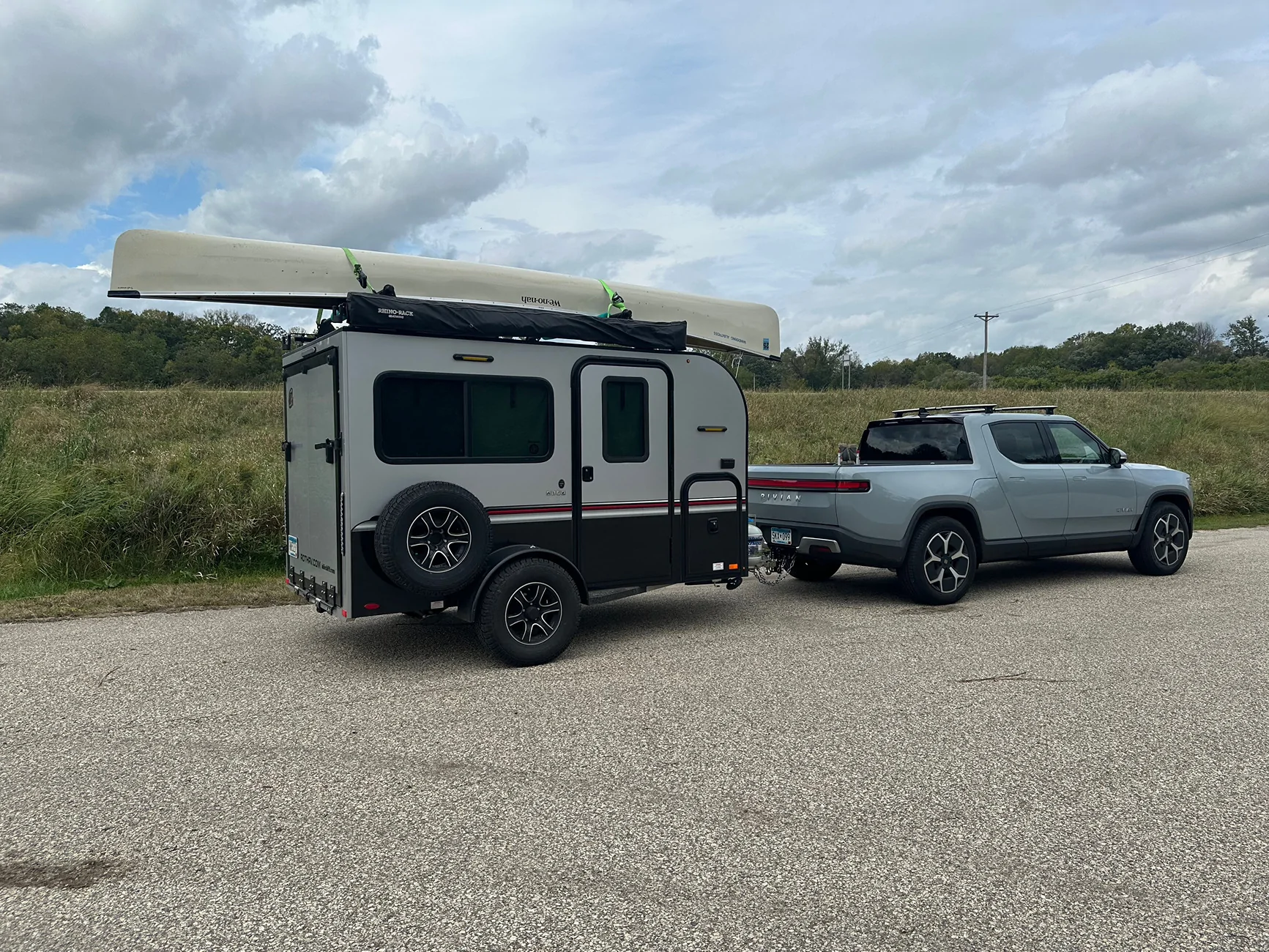
We took a trip from Maple Grove, MN down to Wyalusing State Park, which is just south of Prairie du Chien in Wisconsin. We were pulling a 2021 InTech Flyer Explore with our 2023 Performance Dual Max battery. It's 234 miles each way, with a top speed limit of 65 mph. I decided to go 60 mph on the way down, which turned out to be a good idea since we were bucking a steady headwind of 20-25 mph, and from Rochester MN to Prairie du Chien it seems like it is slightly uphill until you reach the Mississippi River. We started with 100% charge, and stopped to charge up in Rochester at a Circle-K, which required us to drop our trailer. For whatever reason, my Circle-K app wasn't working and I ended up swiping a credit card. The bonus side was that I got charged $0.01 for 66 kwh of energy. The truck was showing efficiency of 1.21 mi/kwh, so we charged up enough for us to make it the rest of the way. This turned out to be a bit optimistic, as the wind picked up and our efficiency fell down to 1.01 mi/kwh. As my charge rate at arrival dropped off, I found a Blink charger in Decorah, IA and added 31 kwh. That was enough for us to get to our camp site and set up camp.

On the trip back, we started with 99% state of charge through a combination of a Tesla charging in downtown PdC, and campsite charging at 12 Amps. This time, we had the wind at our back and a downhill run. That helped us get 1.21 mi/kwh, which meant we could bypass Decorah and make it to Rochester, MN. I was going to stop at a Blink charger at a Ford dealership, but both chargers were blocked by a fellow getting his Mustang looked at by a dealership mechanic. So, we backtracked a couple miles to the same Circle-K we'd used on the way down, dropped the trailer, then added 86 kwh to the truck for a cost of $39.23 ($0.43/kWh plus tax). We ran into several rain squalls on the way home, and arrived with 20% remaining battery.

So, here's the summary:

Trip Down: 234 miles with efficiency of 1.09 overall. Energy added: 97 kWh. Cost: $17.50 ($17.49 at Blink & $0.01 at Circle-K)

Trip Back: 234 miles with efficiency of 1.15 overall. Energy added: 86 kWh. Cost: $39.23.

We did a bunch of driving around with just the truck, and would stop at the Tesla superchargers for 10 minutes to add a bit of power every time we went to town. All said and done, we spent $111.51 to go 604 miles. Gas would have cost me $127.50, so it was close cost-wise (the $0.01 Circle-K charge helped).

For future towing:
1. Assume 1.00 miles per kwh for planning charging.
2. I could have saved myself some hassle by going past Rochester to Stewartville MN, where there are some Electrify America 350 watter chargers. It would have cost more, but it would have been faster to charge and we wouldn't have had to drop the trailer.
Rivian R1T R1S Towing + Efficiency: Please post your experience! 091925 Truck
 

VSG

Well-Known Member
Joined
Oct 3, 2022
Threads
4
Messages
3,198
Reaction score
5,984
Location
WA
Vehicles
R1T LE/RB/OC/20
That canoe probably adds as much drag as the entire rest of your trailer.
 

antimatter

Well-Known Member
First Name
Lloyd
Joined
Dec 27, 2024
Threads
4
Messages
109
Reaction score
153
Location
Minneapolis, MN
Vehicles
Honda Ridgeline, Honda CR-Z
Occupation
Chief Compliance Officer
That canoe probably adds as much drag as the entire rest of your trailer.
It probably also helped a bit when we had the tail wind on the way home.
 

Sponsored

DeanB1452

Well-Known Member
First Name
Dean
Joined
Jun 12, 2023
Threads
12
Messages
394
Reaction score
621
Location
Milpitas, CA
Vehicles
'22 R1T LE/LG/BM
Occupation
IT Administrator
Clubs
 
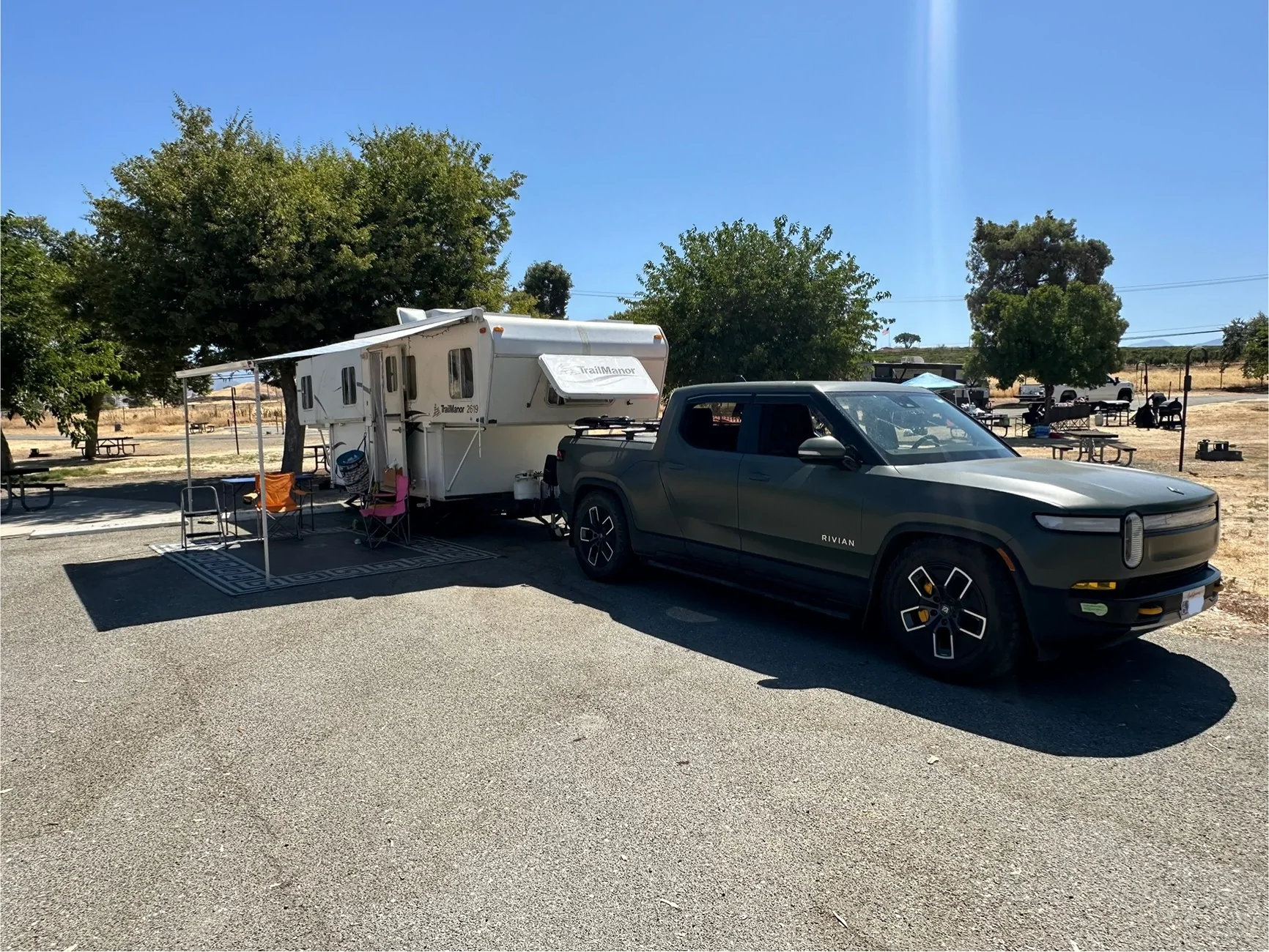
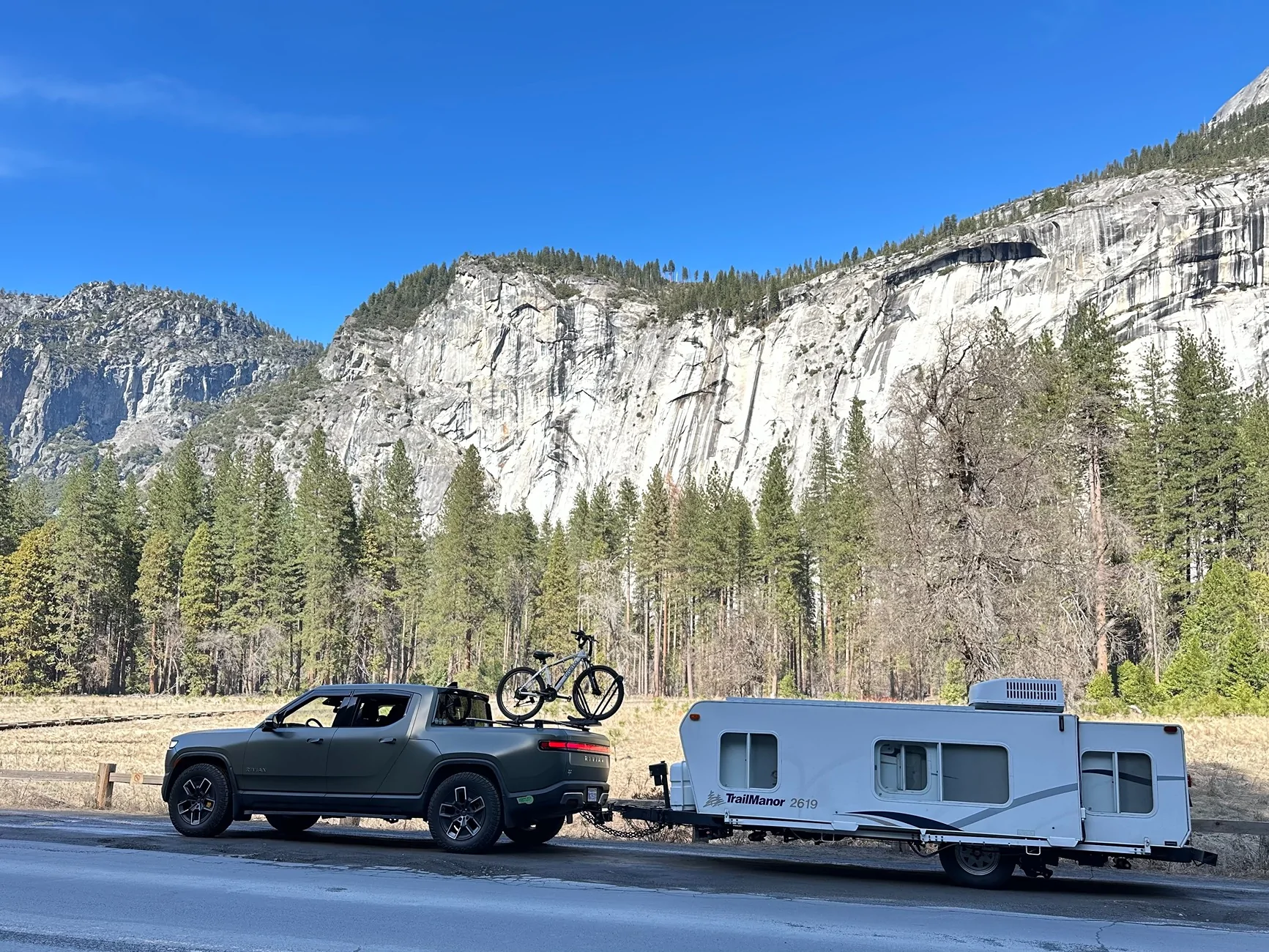
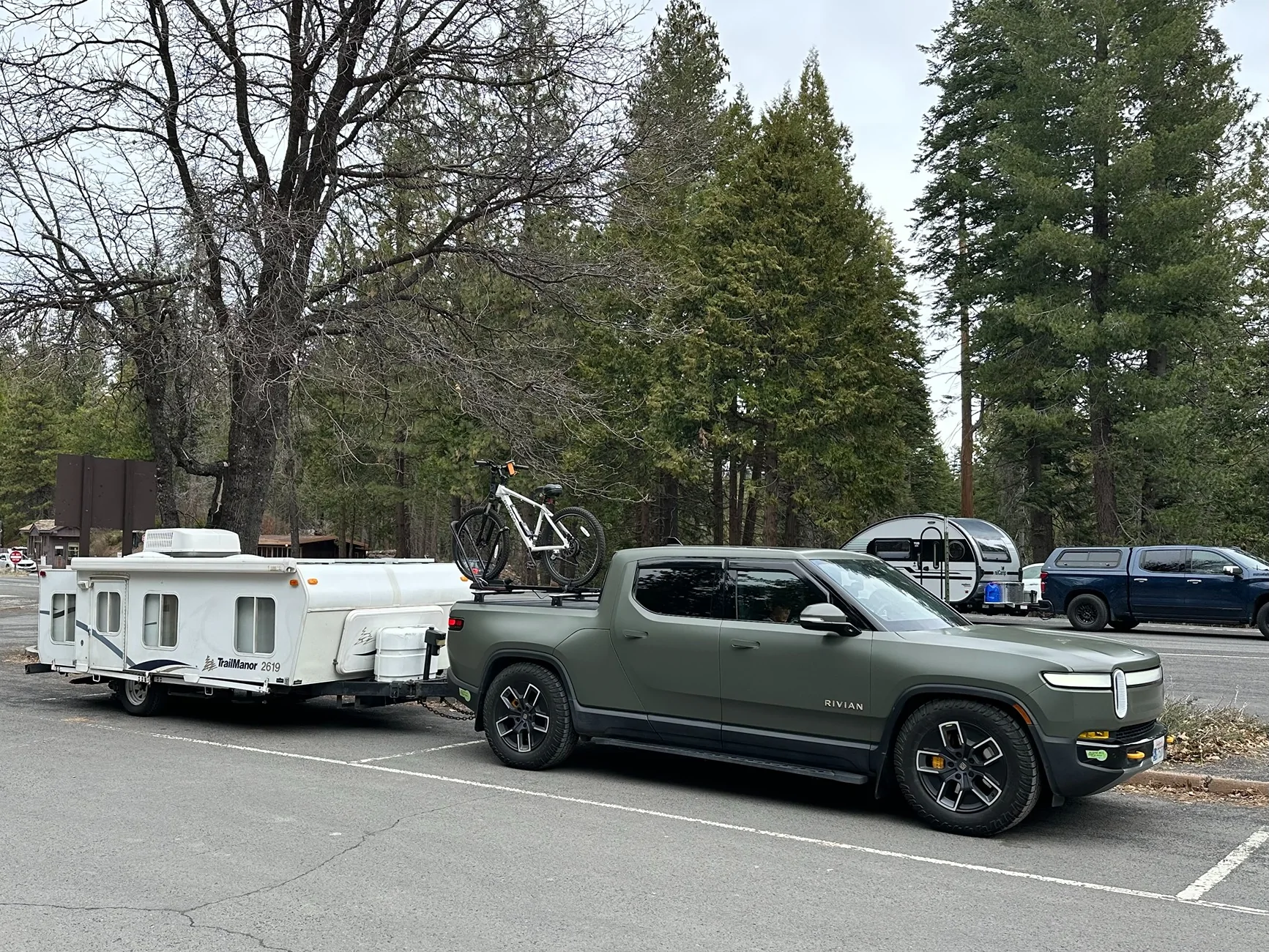
It’s been 1 year since we bought our TrailManor trailer and have traveled 5,000 miles with it on 10 trips. From the San Jose area, we have traveled to Ukiah, Hensley Lake, Pismo Beach, Pinnacles NP, Yosemite NP, Santa Barbara, Joshua Tree NP, Lake Oroville, Porterville (Sequoia & Kings Canyon NP), and Susanville (Lassen NP).

Manufacture specs say the TrailManor is under 2,700 Lbs. The truck sensors fluctuate between 4,500 to 5,000 Lbs. I have averaged 1.35 mi/kWh on my launch edition, large battery pack, with 20” AT tires.

The furthest I’ve driven between charges was 153 miles using 79% of the battery. Shortest trip was to Pinnacles NP, traveling 83 miles each way. Longest trip was to Joshua Tree NP, traveling 475 miles each way. The only place I had to drop the trailer to charge was at Groveland RAN, on the way to/from Yosemite. All the other RANs had a trailer stall and there was enough space to maneuver around at the Tesla SC’s and EVgo. Here is a chart of each trip:


TripMileskWhMi/kWh
Ukiah325.36223.081.46
Hensley Lake298.95229.031.31
Pismo Beach409.46297.621.38
Pinnacles NP165.53148.441.12
Yosemite NP357.01267.171.34
Santa Barbara697.78502.871.39
Joshua Tree NP951.37715.921.33
Lake Oroville405.93302.61.34
Porterville490.02352.861.39
Susanville712.32516.241.38


Rivian R1T R1S Towing + Efficiency: Please post your experience! IMG_9462 1
Rivian R1T R1S Towing + Efficiency: Please post your experience! IMG_6057
Rivian R1T R1S Towing + Efficiency: Please post your experience! IMG_5585
 
Last edited:

Tarkus

Well-Known Member
First Name
Robert
Joined
Oct 29, 2022
Threads
0
Messages
293
Reaction score
539
Location
Texas
Vehicles
'06 Lincoln Mark LT
Occupation
Outdoor/Indoor E911 Wireless Engineer
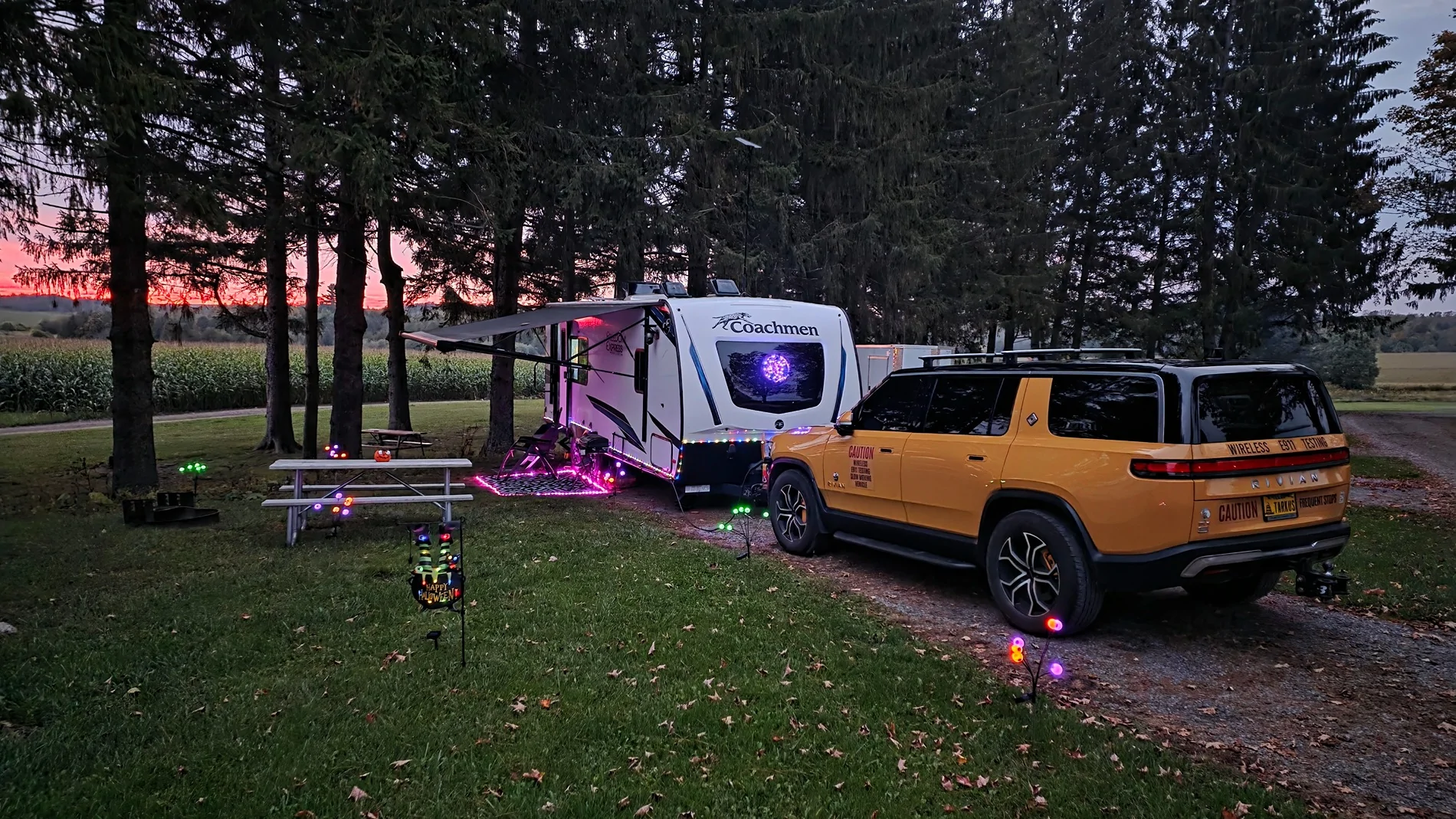
I've been towing my 2024 Coachman Ultralite 246RKS (7,000lbs) for over 6,000 miles during that past 12 months & I'm averaging around 0.88 to 0.93 on the interstates at 60-63 mph.
Rivian R1T R1S Towing + Efficiency: Please post your experience! 20250927_190756


Happy Halloween fellow Rivian's!
 

schlosrat

Well-Known Member
First Name
Steve
Joined
Jun 23, 2024
Threads
6
Messages
191
Reaction score
179
Location
Vancouver, WA
Vehicles
2024 R1T Dual Large
Occupation
Engineer
Aging Wheels has some compelling data that shows our towing efficiency is driven by aerodynamics (CD, cross-sectional area, and velocity), with weight having a negligible impact.

I'm looking at getting a small-ish travel trailer, so I've been datamining posts on this thread and the rest of the forum to see if I can estimate what I might expect. The trouble is, this thread is fairly old, and so there are a lot of posts where people neglect to mention what their rig is (Thank you, Google Image search!). Some posts also neglect to mention what their speed was. Those that do mention speed often just toss up a screenshot from their vehicle giving the average speed, but that's not really effective, since drag goes with the square of velocity, and so the time you spend at lower speeds has much less impact than time spent driving faster.

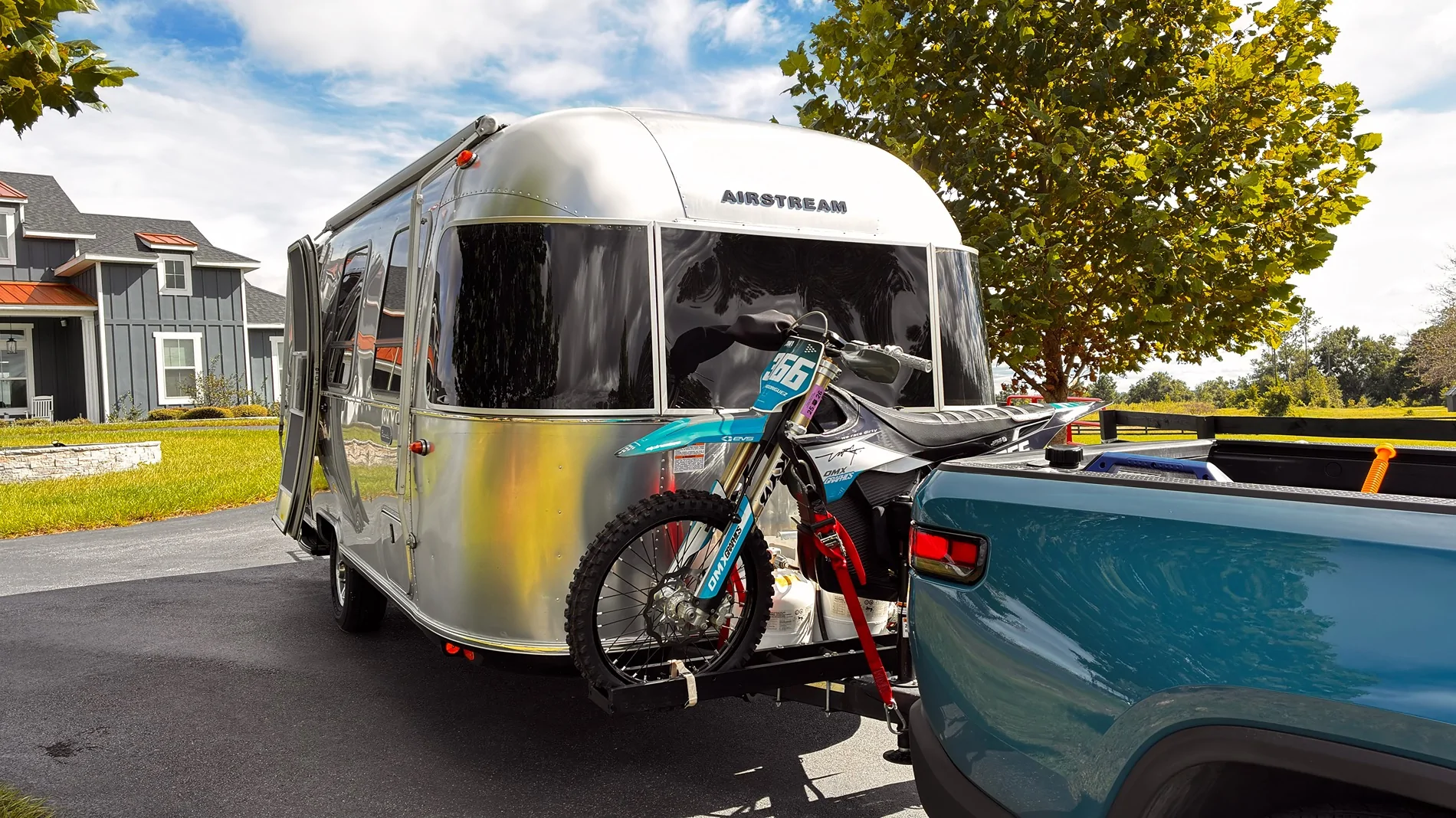
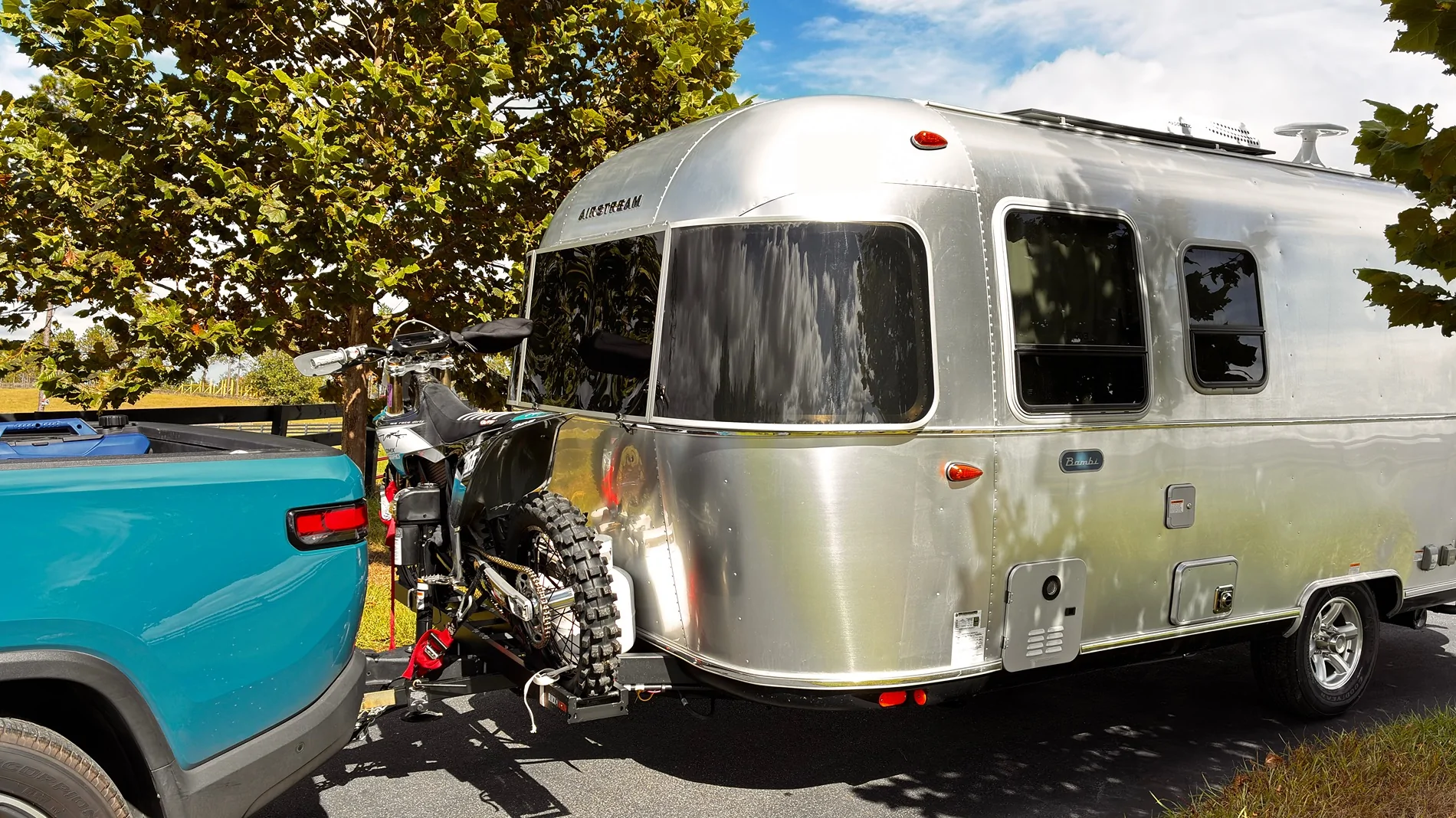
Looking at the data that can be gleaned from past posts, it's clear that smaller trailers do generally give better results, though there are some outlier data points, such as @Captblue's post above. It's unclear to me how an Airstream Bambi traveling at 45 - 60 mph can get 1.67 mi/kWh. @Captblue's previous post reporting 1.2 mi/kWh seems much more in line with the rest of the data, given the relatively large cross-sectional area of that rig, but if he says he got 1.67, then he did. Impressive!


MikeWilliams_R1T

Well-Known Member
First Name
MICHAEL
Joined
May 7, 2024
Threads
9
Messages
270
Reaction score
359
Location
Knoxville, TN
Vehicles
R1T, Chevy Bolt, Toyota Rav4
Occupation
Government Sales
I can tell you speed absolutely is a major factor in towing efficiency. When towing a giant box (regardless of it being 1000 or 9000 lbs) if you are going faster, the added drag gets you.
My experience is under 45mph, I am well into 1.3 ish miles/kwh. By the time I’m over 65, .8 or .9 at best.
Rivian R1T R1S Towing + Efficiency: Please post your experience! IMG_1362
 

Sponsored

antimatter

Well-Known Member
First Name
Lloyd
Joined
Dec 27, 2024
Threads
4
Messages
109
Reaction score
153
Location
Minneapolis, MN
Vehicles
Honda Ridgeline, Honda CR-Z
Occupation
Chief Compliance Officer
Aging Wheels has some compelling data that shows our towing efficiency is driven by aerodynamics (CD, cross-sectional area, and velocity), with weight having a negligible impact.

I'm looking at getting a small-ish travel trailer, so I've been datamining posts on this thread and the rest of the forum to see if I can estimate what I might expect. The trouble is, this thread is fairly old, and so there are a lot of posts where people neglect to mention what their rig is (Thank you, Google Image search!). Some posts also neglect to mention what their speed was. Those that do mention speed often just toss up a screenshot from their vehicle giving the average speed, but that's not really effective, since drag goes with the square of velocity, and so the time you spend at lower speeds has much less impact than time spent driving faster.

Looking at the data that can be gleaned from past posts, it's clear that smaller trailers do generally give better results, though there are some outlier data points, such as @Captblue's post above. It's unclear to me how an Airstream Bambi traveling at 45 - 60 mph can get 1.67 mi/kWh. @Captblue's previous post reporting 1.2 mi/kWh seems much more in line with the rest of the data, given the relatively large cross-sectional area of that rig, but if he says he got 1.67, then he did. Impressive!

As you pointed out, there are so many variables that it's hard to make a consistent travel plans unless you have a lot of data about your own RV's towing characteristics. For me, personally, towing my InTech Flyer Explore (mid-sized square box) I can sometimes achieve as high as 1.4 miles per kWh in ideal conditions, but if I plan my route using 1 mi/kWh I can generally avoid ending up in a sticky situation.

I've put a lot of thought into changing RVs to better accommodate EV towing, but haven't really found a solution that resonates with me OR my pocketbook. I'm not wild about canvas-walled pop-ups, even though I grew up camping in one, nor do the various hard-sided campact campers excite me - I've had to set up during rain storms and that just seems like a recipe for frustration. What I want is for some RV manufacturer to start making a reasonably priced camper that is designed to have low drag but not require a ton of set-up when you arrive. Alas, the RV industry is driven by profit above all, and the major manufacturers will continue to churn out square box campers of dubious quality until enough folks stop buying them. Hopefully the charging infrastructure will continue to improve enough that there will be enough fast chargers so stopping every 100 miles becomes easier once you leave the Interstate highways. Until then, if you're strapped for time I'd advise either owning or renting a gas or diesel-powered truck to tow your RV. When I decided to buy my R1T I made a conscious decision to do the majority of my camping within 250-ish miles of my home, and that my travel times would increase to accomodate the scarcity of fast charging in the rural areas I prefer to camp in.

If you can deal with the drawbacks of compact campers you can probably get as much as 1.5-1.7 mi/kWh when towing at 65 mph or under. No matter what RV you pick, there's going to be a learning curve associated with towing with an EV that will inform your planning. Until charging becomes as ubiquitous as gasoline supplies, that's just the way it is.
 

VandalSibs

Well-Known Member
First Name
Andrew
Joined
Dec 27, 2023
Threads
15
Messages
1,377
Reaction score
2,383
Location
Eastern Washington State
Website
www.sibulskymusic.com
Vehicles
R1T Dual Motor Large Pack
Occupation
Composer, IT Service Desk Analyst
Clubs
 
Alas, the RV industry is driven by profit above all, and the major manufacturers will continue to churn out square box campers of dubious quality until enough folks stop buying them.
I would love to see someone make the equivalent of the Bowlus, but smaller & much, much more reasonably priced (16-20 feet long, and no need to make the panels out of metal - go for fiberglass!).
 

schlosrat

Well-Known Member
First Name
Steve
Joined
Jun 23, 2024
Threads
6
Messages
191
Reaction score
179
Location
Vancouver, WA
Vehicles
2024 R1T Dual Large
Occupation
Engineer
I can tell you speed absolutely is a major factor in towing efficiency. When towing a giant box (regardless of it being 1000 or 9000 lbs) if you are going faster, the added drag gets you.
My experience is under 45mph, I am well into 1.3 ish miles/kwh. By the time I’m over 65, .8 or .9 at best.
IMG_1362.webp
Yep, the force due to drag depends on the square of velocity. It also depends on the density of the fluid (air) you're moving through, so colder weather not only reduces range due to effects on battery chemistry, but it also increases drag somewhat. Fortunately, the density of air doesn't swing around wildly like our velocity does. For sea level, it's about 1.18 kg/m^3 on a hot day and 1.29 kg/m^3 if it's freezing outside. Velocity is the much more important factor, and one we can control.

The drag equation is this:

D = Cd * A * (p * V^2)/2

Where
D = force due to drag
A = Cross-sectional area in the direction of motion (this encompasses both the trailer and the vehicle)
Cd = Coefficient of drag for your vehicle + trailer combo
p = density of fluid
V = velocity

In practice, Cd is determined empirically, though it can be estimated computationally if you've got good models and the right SW. If you wanted to get really fancy about it all, you could do some careful driving on flat roads using cruise control both with and without your trailer, and you'd be able to estimate the actual Cd for your rig alone and your rig + trailer. You would need to record energy consumption, speed, and air temp, and you'd need to work out an estimate for the total cross-sectional area of the vehicle alone and the vehicle + trailer. You could do this at any speed you like; it wouldn't have to be at highway speeds, since we have the equation.

This is where my data mining exercise falls apart... Most people sharing info haven't included the air temp, and many don't give a good number for speed, or just give a range. A few don't give their efficiency numbers but instead refer to percent battery usage over distance, where we have to guess their battery capacity. And, of course, I'm using a really crude estimate for cross-sectional area based on the width and height of the trailer alone. Still, it's a fun exercise.

https://www1.grc.nasa.gov/beginners...t=Drag Coefficient,times the reference area A.
 

MikeWilliams_R1T

Well-Known Member
First Name
MICHAEL
Joined
May 7, 2024
Threads
9
Messages
270
Reaction score
359
Location
Knoxville, TN
Vehicles
R1T, Chevy Bolt, Toyota Rav4
Occupation
Government Sales
Yep, the force due to drag depends on the square of velocity. It also depends on the density of the fluid (air) you're moving through, so colder weather not only reduces range due to effects on battery chemistry, but it also increases drag somewhat. Fortunately, the density of air doesn't swing around wildly like our velocity does. For sea level, it's about 1.18 kg/m^3 on a hot day and 1.29 kg/m^3 if it's freezing outside. Velocity is the much more important factor, and one we can control.

The drag equation is this:

D = Cd * A * (p * V^2)/2

Where
D = force due to drag
A = Cross-sectional area in the direction of motion (this encompasses both the trailer and the vehicle)
Cd = Coefficient of drag for your vehicle + trailer combo
p = density of fluid
V = velocity

In practice, Cd is determined empirically, though it can be estimated computationally if you've got good models and the right SW. If you wanted to get really fancy about it all, you could do some careful driving on flat roads using cruise control both with and without your trailer, and you'd be able to estimate the actual Cd for your rig alone and your rig + trailer. You would need to record energy consumption, speed, and air temp, and you'd need to work out an estimate for the total cross-sectional area of the vehicle alone and the vehicle + trailer. You could do this at any speed you like; it wouldn't have to be at highway speeds, since we have the equation.

This is where my data mining exercise falls apart... Most people sharing info haven't included the air temp, and many don't give a good number for speed, or just give a range. A few don't give their efficiency numbers but instead refer to percent battery usage over distance, where we have to guess their battery capacity. And, of course, I'm using a really crude estimate for cross-sectional area based on the width and height of the trailer alone. Still, it's a fun exercise.

https://www1.grc.nasa.gov/beginners-guide-to-aeronautics/drag-equation/#:~:text=Drag Coefficient,times the reference area A.
It may be hard to collect all of the data you are looking for... even with an Electrafi subscription, and it polling data every 8-9 seconds, I noticed it is missing some data like outside air temp but I suppose you could fill in weather data from the area to get that and barometer data.
 

Attachments

schlosrat

Well-Known Member
First Name
Steve
Joined
Jun 23, 2024
Threads
6
Messages
191
Reaction score
179
Location
Vancouver, WA
Vehicles
2024 R1T Dual Large
Occupation
Engineer
It may be hard to collect all of the data you are looking for... even with an Electrafi subscription, and it polling data every 8-9 seconds, I noticed it is missing some data like outside air temp but I suppose you could fill in weather data from the area to get that and barometer data.
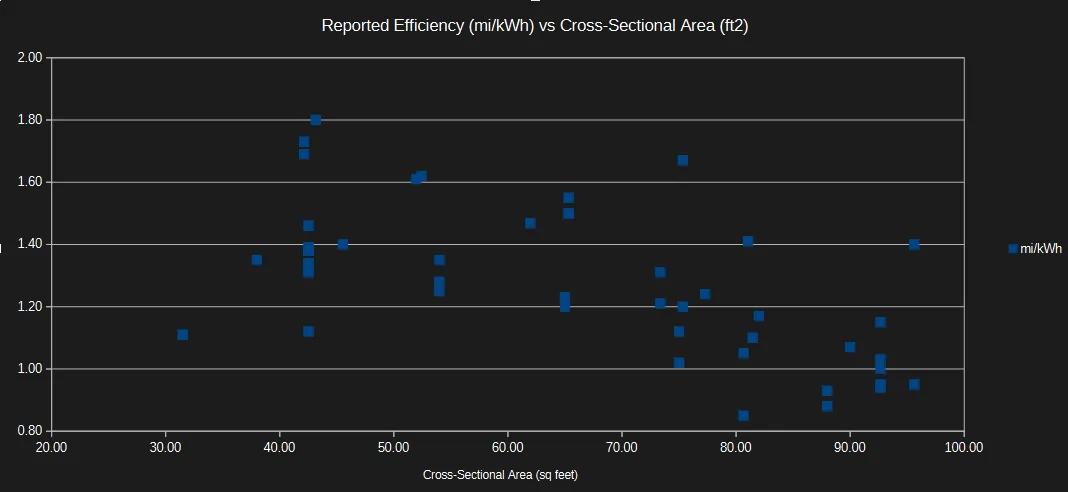
It's pretty much impossible to do it with just the information typically posted on this forum, but we can at least get a plot of efficiency vs approximate cross-sectional area of trailer.

Rivian R1T R1S Towing + Efficiency: Please post your experience! 1760546876474-bl


There are some outliers here, like kevinhanff's report for a 6x12 U-haul enclosed trailer with only 1.11 mi/kWh. I show one of those as being 6' wide by 5.25' tall (data from U-Haul), so it's only 31.5 sq ft. It is a box, so Cd can be approximated like a cube (1.05), but still, there are other box-like trailers with much better results, such as DeanB1452's Trailmanor 2619, which gets numbers in the 1.35 range, and it's got about 42.5 sq ft in area. In both cases, the trailers are small and mostly hide behind the truck, although the Trailmanor is wider than an R1T.

I interpret the vertical scatter here as being related to speed foremost, and Cd secondarily, but we can see that the data could be fit with a straight line running from 1.6-ish at 42 sq ft down to 0.94-ish at about 93 sq ft.

Rivian R1T R1S Towing + Efficiency: Please post your experience! 1760546800079-2s
Sponsored


Top