Sponsored

Wall charger vs. 14-50 plug in.

ftmeyer50

Member
First Name
frank
Joined
Oct 5, 2024
Threads
5
Messages
12
Reaction score
5
Location
Bozeman, MT
Vehicles
Rivian R1T 2025 Dual Motor
I know you get faster charger times with a wall charger.. 25 miles/hour vs. 19mph but are there any other reasons to spend the money on a wall charger vs. simply plugging in with the portable connector? I have a ‘25 R1T max pack. And i have a 50 amp with 14-50 outlet.
Sponsored
 

mudito

Well-Known Member
First Name
Aldo
Joined
Jul 30, 2024
Threads
18
Messages
1,011
Reaction score
1,414
Location
Texas
Vehicles
Rivian R1T
In my personal case, living in Texas with a "Free nights" from 8pm to 6am electricity plan, those 8 extra Amps (48A vs 40A on the portable charger) helps to ensure I can fully top-off during my free nights in case is needed.

But having the fixed adapter in the wall and the portable always sitting in my Frunk, is probably the biggest reason. I did my own hard-wiring so no extra expenses for me, and also I bought a brand-new open-box Rivian Wall Charger for $380 which was a great deal :)

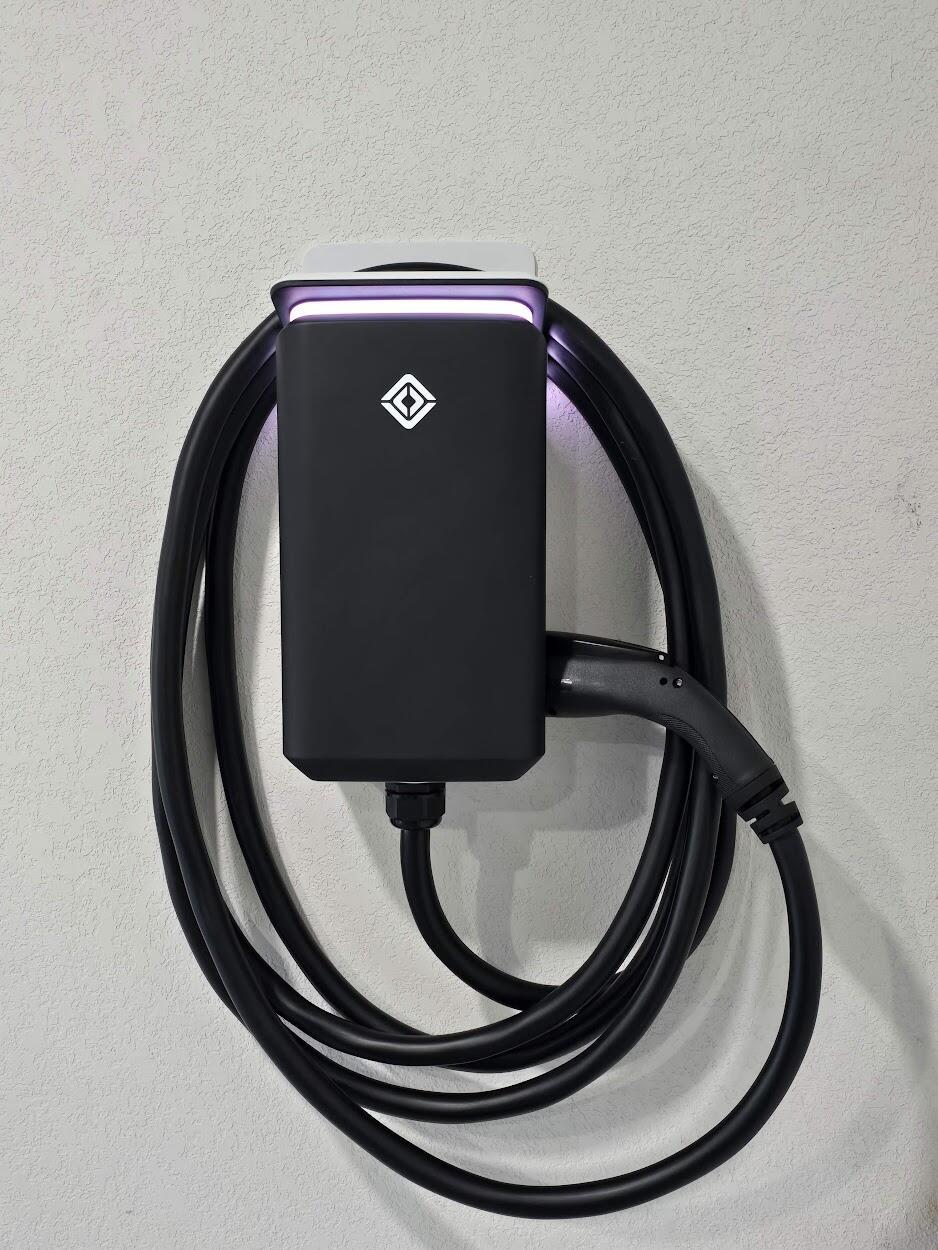
Now this sits flush in my garage right next to where I park my R1T


Rivian R1T R1S Wall charger vs. 14-50 plug in. 1728327370286-j5
 

shamoo

Well-Known Member
Joined
Jan 3, 2022
Threads
6
Messages
683
Reaction score
954
Location
SoCal
Vehicles
Rivian R1S, Porsche 911 GT3
Occupation
Cybersecurity
Personally, I don't see a benefit for purchasing a wall charger.

I get ~14mi/hr on my 14-50 which is enough for (so far) 100% of my use cases in the last year and a half I've had my R1S.

I have solar and I live in Southern California where power is quite expensive, but charging after 9pm is good enough for me. Coincidentally the lowest I've ran the car was down to 9% and that was this past weekend. Charged back up to 80% by the time I needed to use the vehicle by the next morning. Even if not, it would have been enough to do the errand planned (not more than 10 miles total).

Again, just personally unless you just want a cool wall charger (and it is cool, and there's no problem with that), I can't see a use case where you need that much charging power on a daily basis. Are you burning through 200+ miles a day all the time? Even if you do it once a week, the following day you don't need that much.
 
Last edited:

Tim-in-CA

Well-Known Member
Joined
Sep 30, 2021
Threads
46
Messages
1,795
Reaction score
3,434
Location
So Cal
Vehicles
Gen 1 R1S, Lucid Air, T-Bird
You want to be sure that you have a high quality grade 14-50 outlet installed and avoid unplugging / replugging the charger into the outlet as they are not designed for many insertion / removal cycles. I'd still get a dedicated charger that you can mount on the wall. I use Wallbox Pulsar Plus (2 units) for both of my vehicles
 

SANZC02

Well-Known Member
First Name
Bob
Joined
Feb 11, 2021
Threads
50
Messages
7,439
Reaction score
12,736
Location
California
Vehicles
Tesla Model S, LE - R1S
Occupation
Retired
The portable charger provided with Rivian is only a 32 amp max charger.

you can get plug in chargers like the Emporia that can get 40 amps. I have one of these at my other place using a 14/50 plug.

The benefit to buying a dedicated wall charger is those 14/50 outlets are not designed for high plug/unplug cycles and can start arcing over time.
 

Sponsored

tps5352

Well-Known Member
Joined
Dec 26, 2020
Threads
22
Messages
235
Reaction score
285
Location
California Central Valley
Vehicles
2026 Tesla Model X All-Wheel Drive (5-seater)
I know you get faster charger times with a wall charger.. 25 miles/hour vs. 19mph but are there any other reasons to spend the money on a wall charger vs. simply plugging in with the portable connector? I have a ‘25 R1T max pack. And i have a 50 amp with 14-50 outlet.
The choice between a NEMA 14-50 (or other 240-volt) wall receptacle/outlet versus a good hard-wired wall charger/connector is an old debate, much discussed by electric-car users over the years. Some key factors include:
  1. Charging power and speed.
  2. (Total) Cost.
  3. Safety
  4. Convenience.
  5. Need for Professional Installation.
  6. Weather-resistance.
I. Charging Power and Speed

You already know this, but for other readers: A NEMA 14-50 receptacle can charge a vehicle with up to 40-amps of power. (That's assuming that the house circuit is properly wired for 50 amps and the connecting cable to the car can handle up to 40 amps. Many portable/mobile charging cables can't handle that much power.)

In comparison, many good wall chargers can charge at up to 48 amps of power; so that is somewhat faster. If an owner needs that added charging speed, the wall charger is the better choice.

II. Cost

It is (understandably) assumed by most people that wall-charger installations are much more expensive than wall-outlet setups. And it is, of course, true that the price of a good wall charger is considerably more than that of a simple 240-volt wall receptacle. But there are a number of additional factors that can reduce the total price difference between the two charging options. Here are some:
  • For safety reasons, a much more expensive GIS-type circuit breaker is often required by code for a wall outlet setup. Name-brand wall chargers may not require the extra cost of a GIS-type breaker.

  • If a completely new 240-volt circuit must be installed, the cost of labor for installation should be similar whether a wall outlet or a wall charger is going to be used. (Depending on circumstances, it may actually require slightly less physical labor to install a wall charger.)

  • If a wall receptacle/outlet is installed to charge at 40-amps (using a 50-amp house circuit), then an additional portable charging cable also rated at 40 amps must be purchased. Many portable charging cables (from Rivian, Tesla, others) can only charge to 32-amps. Purchase of a good-quality 40-amp cable (of sufficient length) can be pricey.

  • Even if a wall outlet will only be used to charge at 32-amps (or less), experts still recommend that a (separately-purchased) dedicated portable connecting cable be left plugged into the outlet (to avoid wear-and-tear on the outlet).

  • In contrast, most wall chargers come complete with a long, built-in connector cable (rated at up to 48-amps). So no expensive, additional connecting cable need be purchased.

  • If a NEMA 14-50 wall receptacle is to be used, experts strongly recommend that only the best quality (and definitely more expensive) Hubbell 9450a or Bryant 9450fr receptacles be installed.

  • Savvy shoppers may find good deals on name-brand equipment. (My favorite is Craig's List, which can now be easily used to search for bargains all over North America.) So with proper cautions taken, Rivian (or other) wall chargers may be found new or lightly-used at bargain prices.
I once put together a crude cost-analysis breakdown comparing these two charging options (see Chart #3 here). While a good quality wall connector is of course initially more expensive than a simple wall outlet, when total price is considered it is often within the same ball park for both options. I acknowledge that Rivian wall chargers are (currently) pretty expensive. But there are other good-quality, hard-wired wall chargers/connectors available for less. And Rivian equipment may be found online at discount prices. Ultimately, any added cost of a wall charger may be worth it to some drivers when increased safety and convenience are factored in.

III. Safety and IV. Convenience

I believe that most unbiased reviewers conclude that properly installed, good-quality wall chargers are generally safer and more convenient than wall outlets. Most new drivers have not really handled a NEMA 14-50 plug. They are big and unwieldy, and it would not be impossible for a finger to slip and touch an exposed contact (say on a damp day). A 240-volt, 50-amp shock is nothing to take lightly. Once properly installed, a wall charger is fully enclosed and the chance of receiving a shock is virtually zero. You just plug into the car and you're set. (No need to plug anything into the wall.) The better ones include built-in GIS circuitry, I believe.

V. Need for Professional Installation

Some drivers believe that wall outlets will allow them to save money by avoiding professional installation. In truth, that is not true. Since 2008 and earlier, there have been numerous reports online of damage and small fires allegedly due to 240-volt wall outlets used to charge electric cars.

I believe that this is often due to the fact that inexpensive wall outlets--which may use cheap wire connectors that can be difficult to tighten adequately--can (over time) loosen their connections (due to repeated cycles of heating/cooling) and eventually experience electrical arcing with resulting damage.

So, if anything, one can conclude that 240-volt wall outlets for car charging should definitely be installed professionally (adding to the total price of wall outlet installation).

VI. Weather Resistance

Good quality wall chargers, designed as they are within self-contained enclosures, are usually considered to be more weather resistant and therefore better choices for outdoor installations. NEMA 14-50 receptacles can, of course, be put inside custom or retail weatherproof enclosures with covers, but that just requires more cost and effort. (And when the cover is opened during a charging event, it still may expose the outlet to wind-blown moisture.)
 
Last edited:
OP
OP

ftmeyer50

Member
First Name
frank
Joined
Oct 5, 2024
Threads
5
Messages
12
Reaction score
5
Location
Bozeman, MT
Vehicles
Rivian R1T 2025 Dual Motor
Thanks for taking the time to go over issues i hadn’t even thought about! One more question. We are building a new house and the electrician already wired the spot where we would put the wall charger in the wall with a 60amp breaker. So at this point it’s either finish it with a hardwired wall charger or put in a 14-50 (would that even work?) i am going to go with the wall charger for the safety considerations.
 

PeterSK

Well-Known Member
Site Sponsor
First Name
Peter
Joined
Nov 22, 2022
Threads
8
Messages
369
Reaction score
387
Location
Cambridge, MA
Vehicles
2023 FG/FE R1S, 2021 Model Y
Occupation
Retired / board director
Clubs
 
At a shared family cabin in the woods I had a local contractor install a NEMA 14-50 outlet when I got my first EV (Model S) in 2013. Over the years a number of family members bought Model 3s and Ys, so we had more occasions of having to move the plug from one car to another when two or more Teslas were there at once, and the 32A speed became a bit limiting.

So last year after getting my R1S I had a Tesla Universal Wall Connector installed. It’s safer (no plugging/unplugging a 240v plug), faster (though limited to 40A because the buried cable from the house is only rated for 50A, not 60A), and has a longer cord that helps with sharing. Charges both Teslas and other EVs, and it’s nice when packing the car to not have to grab and pack the charger as well - or to have to dig out the charger from beneath luggage etc upon arriving with a low charge. Definitely worth it.
 

beatle

Well-Known Member
Joined
Jun 20, 2024
Threads
17
Messages
1,148
Reaction score
1,565
Location
Springfield, VA
Vehicles
'23 R1T PDM Max, '97/'25 Miatas, '19 Monkey
Occupation
IT
Clubs
 
Thanks for taking the time to go over issues i hadn’t even thought about! One more question. We are building a new house and the electrician already wired the spot where we would put the wall charger in the wall with a 60amp breaker. So at this point it’s either finish it with a hardwired wall charger or put in a 14-50 (would that even work?) i am going to go with the wall charger for the safety considerations.
You'll need to see if he ran 3 conductors + ground for the 14-50. If he put in a 60A breaker he may have predicted a hardwired EVSE that only needs 2 conductors. Technically if you're just plugging in an EVSE you don't need a neutral, but a 14-50 needs one for code. You could install a 6-50 receptacle which has no neutral, but you'd then need a 6-50 to 14-50 adapter to plug in your Rivian MC, or you'd need a mobile EVSE that supports a 6-50 natively like a Tesla UMC.

You'll also want to swap out the breaker for a 50A for a 14-50, and make sure it's a GFCI breaker if your local code requires it (most do these days).

Hard wired is a good choice. It used to be a lot less expensive to run a 14-50R, but that was before wiring costs went up, hard wired EVSE prices went down, and before a pricey GFCI breaker was needed in most locations.

You'll also be able to get 48A out of a hardwired setup. Not really necessary, but a nice little bonus.
 

Sponsored

2Cybers

Member
Joined
Jul 31, 2024
Threads
0
Messages
7
Reaction score
2
Location
North Georgia
Vehicles
Tesla Model S
Occupation
Retired
I know you get faster charger times with a wall charger.. 25 miles/hour vs. 19mph but are there any other reasons to spend the money on a wall charger vs. simply plugging in with the portable connector? I have a ‘25 R1T max pack. And i have a 50 amp with 14-50 outlet.
First off -- it appears you are not aware a NEMA 14-50 outlet on only legal/approved for charging at 40 amps. The Electric codes say continuous current draws are limited to 80% of the nominal amount/fused current.

If you go with a NEMA 14-50 and you do not plan on leaving the cable essentially all the time plugged in, do not get your outlet from the likes of Home Depot. There are two grades of outlets. If you plan on taking the cable with your travels, be sure to get the commercial grade plug.

I am aware of several Tesla owners who have destroyed their mobile charging cables with non commercial grade plugs.
 

beatle

Well-Known Member
Joined
Jun 20, 2024
Threads
17
Messages
1,148
Reaction score
1,565
Location
Springfield, VA
Vehicles
'23 R1T PDM Max, '97/'25 Miatas, '19 Monkey
Occupation
IT
Clubs
 
Even if you're not going to unplug your EVSE regularly, I'd still get a commercial/industrial/EV rated receptacle. I melted my cheapo receptacle even though I could count on one hand the number of times I unplugged it.
 

moosetags

Well-Known Member
First Name
SuEllyn & Brian
Joined
Dec 25, 2021
Threads
110
Messages
1,940
Reaction score
3,219
Location
Santa Rosa Beach, Florida
Vehicles
2023 R1T; 2020 Chevy Duramax; 1956 Ford Tbird
Occupation
Retired
Clubs
 
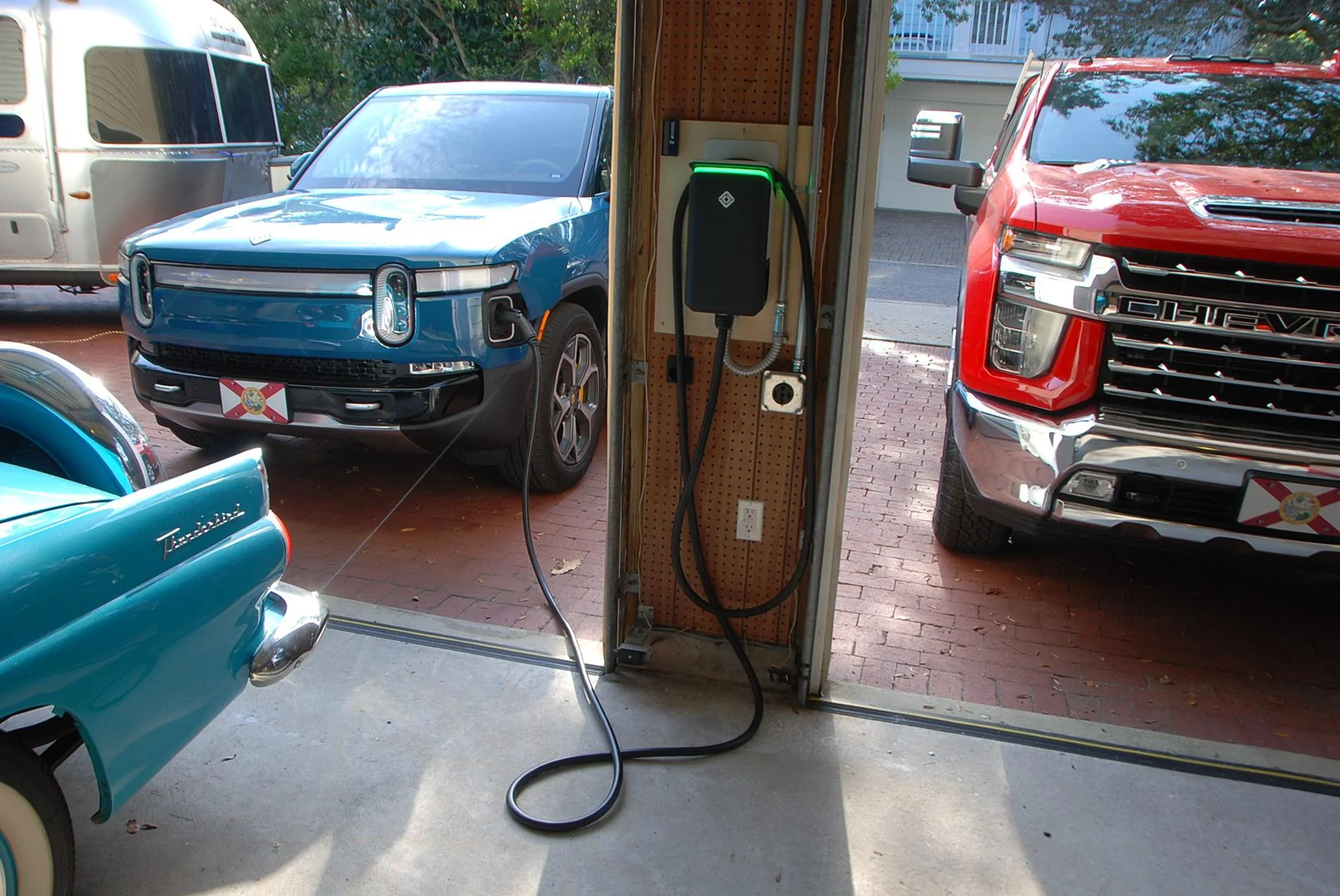
Being a "Tim, the Tool Man kind of guy", we have both, we have both a Rivian Wall Charger (60 amp circuit) and a 14-50 outlet (50 amp circuit). Being that we have two sons with EV's, this has come in handy. We are also considering adding a Silverado EV to the fleet next year.

Brian

Rivian R1T R1S Wall charger vs. 14-50 plug in. DSC_0050
 

mudito

Well-Known Member
First Name
Aldo
Joined
Jul 30, 2024
Threads
18
Messages
1,011
Reaction score
1,414
Location
Texas
Vehicles
Rivian R1T
Thanks for taking the time to go over issues i hadn’t even thought about! One more question. We are building a new house and the electrician already wired the spot where we would put the wall charger in the wall with a 60amp breaker. So at this point it’s either finish it with a hardwired wall charger or put in a 14-50 (would that even work?) i am going to go with the wall charger for the safety considerations.
Make sure your electrician installs the right (or even a bit oversized) gauge-wired. I've seen a few going with 32A capable wire but then installing 40 or 48A chargers. That's a recipe for fire :) And yes, some would do that. So be careful!
 

iamnid

Well-Known Member
Joined
Aug 10, 2023
Threads
7
Messages
626
Reaction score
782
Location
California
Vehicles
Mercedes EQE, Rivian R1S
Thanks for taking the time to go over issues i hadn’t even thought about! One more question. We are building a new house and the electrician already wired the spot where we would put the wall charger in the wall with a 60amp breaker. So at this point it’s either finish it with a hardwired wall charger or put in a 14-50 (would that even work?) i am going to go with the wall charger for the safety considerations.
Based on it being new construction and wired for and with a 60 amp breaker, definitely go for the wall charger. 32 amps vs. 48 amps. It's 1.5 times faster to charge your vehicle. There is ZERO reason to limit yourself if it's new construction and you have the appropriate wiring. Sure, you can probably get by fine with either but it's better to charge at 11.5kw vs. 7.6kw.

Here's a comparison of charging 80% of each of the three battery packs:

Standard = 92.5kwh battery: 9.7 hours on 32 amps vs. 6.2 hours
Large = 109.4 kwh battery: 11.5 hours on 32 amps vs. 7.6 hours
Max =141.5 kwh battery: 14.9 hours on 32 amps vs. 9.8 hours

**The battery figures are for Gen 2 found from googling pack size.

These figures are just charging 80% of the battery. They'd be longer if doing a full charge. So yes, the difference is significant. Come home late one night with a very low charge and you won't hit 80% the next morning on the larger packs with 32 Amps.
Sponsored


Top