

Sponsored

Charging Speed. Not disappointed.

SeaGeo

Well-Known Member
First Name
Brice
Joined
Jan 12, 2021
Threads
50
Messages
5,673
Reaction score
10,212
Location
Seattle
Vehicles
Xc60 T8
Occupation
Engineer
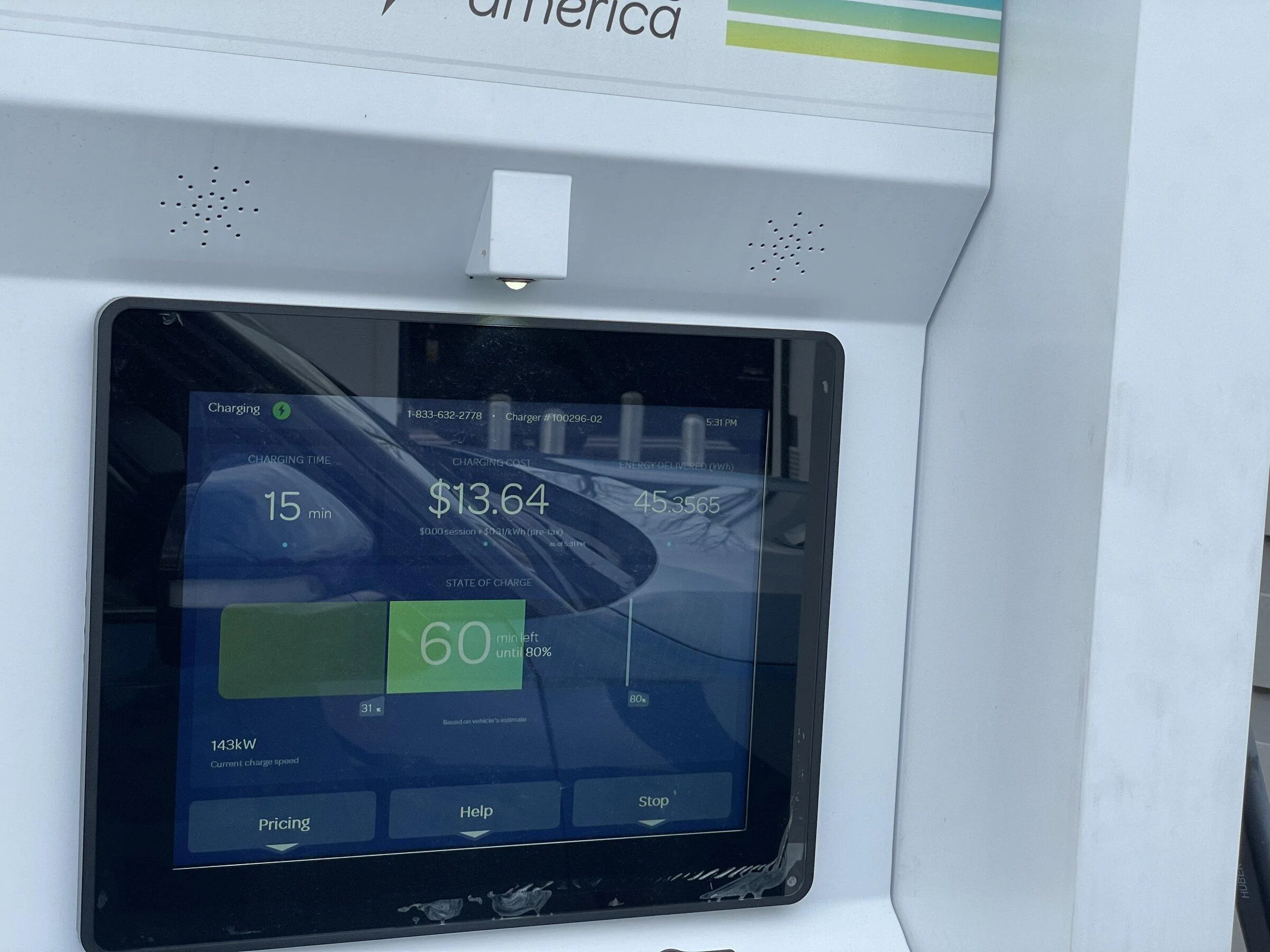
My R1T showed a steady 197kW (flickering around that number, I think I saw 200+ for a few blinks but it wasn't sustained, so it's not really relevant and could just be software in that instrument readout.)

According to Kyle / OoW the steps were arbitrary (not related to temp) and the battery temp management was the initial dip-recovery at 25% then the zig-zig steps down.

For now, I think we can conclude Rivian will go to a heat pump for the Max Pack with LFP and hopefully more than 180kWh, and the software will have fleshed out pre-conditioning, etc.
The steps above about 60% are arbitrary to mimic linearly dropping the current to nearly 0 at 100%. The steps below that appear to be thermal related. See his theoretical curve.

If you watch his video you can see the voltage maxes out above about 60% at about 450A. Which is consistent with what they submitted to the EPA.
Sponsored
 

SeaGeo

Well-Known Member
First Name
Brice
Joined
Jan 12, 2021
Threads
50
Messages
5,673
Reaction score
10,212
Location
Seattle
Vehicles
Xc60 T8
Occupation
Engineer
ARE YOU NOT ENTERTAINED?!

FE4A4074-5ACA-49AD-8D6D-032DAEAA7124.jpeg
You said you're heading back to CA soon too right? Any chance you'll be taking the same interstate through AZ Kyle took? I'd be curious if the problem on those has been resolved (maybe EA pushed a software update...).
 

zefram47

Well-Known Member
First Name
Aaron
Joined
Feb 6, 2022
Threads
18
Messages
2,751
Reaction score
4,515
Location
Denver, CO
Vehicles
Rivian R1T, Alfa Romeo 4C
Occupation
Software Engineer
For now, I think we can conclude Rivian will go to a heat pump for the Max Pack with LFP and hopefully more than 180kWh, and the software will have fleshed out pre-conditioning, etc.
There is literally no chance the max pack will be LFP because that tech is much lower energy density than the NCA or NCM they are currently using in the large pack. All Rivian has announced is that the standard pack will be LFP. That said, I fully expect that max pack will probably be the first 800V R1s released because charging 180 kWh at only up to 200 kW would be painful. The Hummer EV supposedly charges at 300-350 kW with its near 200 kWh pack and I'm sure Rivian is looking at their now known competition as well.
 

SeaGeo

Well-Known Member
First Name
Brice
Joined
Jan 12, 2021
Threads
50
Messages
5,673
Reaction score
10,212
Location
Seattle
Vehicles
Xc60 T8
Occupation
Engineer
There is literally no chance the max pack will be LFP because that tech is much lower energy density than the NCA or NCM they are currently using in the large pack. All Rivian has announced is that the standard pack will be LFP. That said, I fully expect that max pack will probably be the first 800V R1s released because charging 180 kWh at only up to 200 kW would be painful. The Hummer EV supposedly charges at 300-350 kW with its near 200 kWh pack and I'm sure Rivian is looking at their now known competition as well.
Totally agree. I wonder if that's part of the reason they delayed it.
 

ajdelange

Well-Known Member
First Name
A. J.
Joined
Aug 1, 2019
Threads
9
Messages
2,883
Reaction score
2,319
Location
Virginia/Quebec
Vehicles
Tesla XLR+2019, Lexus, Landcruiser, R1T
Occupation
EE Retired
Welcome back. The topic at hand is a large number of EA stations (though not all) are not giving out more than about 350A. Even when they should be capable of 500A.

Cause: unknown. Could never EA. Could be how Rivian and Mercedes are communicating with a specific series of chargers.
Thanks.

There are many things that could explain why less than 500A has been observed at these 350kW stations the most likely of which is that the trucks have not be asking for voltages that would push 500A. Of course EA could also be limiting what the chargers will produce as they ramp up to full capability in increments.
 

Sponsored

SeaGeo

Well-Known Member
First Name
Brice
Joined
Jan 12, 2021
Threads
50
Messages
5,673
Reaction score
10,212
Location
Seattle
Vehicles
Xc60 T8
Occupation
Engineer
Cell constrained, as suggested by the change to LFP on the small pack.
I know that's part of it. But I wouldn't be surprised if they realize a 180kwh pack at ~200kw peak just isn't what it needs to be, and if they're close to 800v elsewhere it was worth pausing the max pack to be their first 800v pack.

And LFP will most likely not be in the max pack.
 

zipzag

Well-Known Member
Joined
Nov 15, 2021
Threads
15
Messages
1,088
Reaction score
983
Location
Chicago
Vehicles
Model Y
I know that's part of it. But I wouldn't be surprised if they realize a 180kwh pack at ~200kw peak just isn't what it needs to be, and if they're close to 800v elsewhere it was worth pausing the max pack to be their first 800v pack.

And LFP will most likely not be in the max pack.
It's more likely they would support ~300kw@ 400v than 800v IMO. Wire size in the current trucks indicate if these vehicles can handle higher power than 200kw at 400v. Rivian should be able to charge at 300kw for awhile just considering the larger packs.

Too bad there is no Rivian teardown. 200kw for an expensive vehicle released essentially in 2022 seems too conservative to be the final number. The charge curve after 50% does not seem to fit an expensive vehicle.

The charge rate and curve is adequate for interstate travel. Running between 10%-60% from charger to charger works great. But for people really needing the max pack to travel away from chargers the current rate and charge curve is far from ideal.
 

SeaGeo

Well-Known Member
First Name
Brice
Joined
Jan 12, 2021
Threads
50
Messages
5,673
Reaction score
10,212
Location
Seattle
Vehicles
Xc60 T8
Occupation
Engineer
It's more likely they would support ~300kw@ 400v than 800v IMO. Wire size in the current trucks indicate if these vehicles can handle higher power than 200kw at 400v. Rivian should be able to charge at 300kw for awhile just considering the larger packs.

Too bad there is no Rivian teardown. 200kw for an expensive vehicle released essentially in 2022 seems too conservative to be the final number. The charge curve after 50% does not seem to fit an expensive vehicle.

The charge rate and curve is adequate for interstate travel. Running between 10%-60% from charger to charger works great. But for people really needing the max pack to travel away from chargers the current rate and charge curve is far from ideal.
So you think RAN, which the leaked specs were for a standard CCS 500A limit, will not follow the CCS connector standard and exceed 500A huh?

It's possible. They'd be looking at a custom connector or not adhering to the standard though.

And I totally agree that the charging curve is conservative for the size of the battery. But that's also limited by the CCS connector standard for charging limit. (Well, it will be, they're pulling 450A right now at max, with the limit of 500A).
 

emoore

Well-Known Member
Joined
Nov 29, 2020
Threads
4
Messages
3,815
Reaction score
4,240
Location
Colorado
Vehicles
2022 R1T
I don’t think the CCS standard can provide the 750A to get to 300KW charging at 400V.
 

Sponsored

zefram47

Well-Known Member
First Name
Aaron
Joined
Feb 6, 2022
Threads
18
Messages
2,751
Reaction score
4,515
Location
Denver, CO
Vehicles
Rivian R1T, Alfa Romeo 4C
Occupation
Software Engineer
It's more likely they would support ~300kw@ 400v than 800v IMO. Wire size in the current trucks indicate if these vehicles can handle higher power than 200kw at 400v. Rivian should be able to charge at 300kw for awhile just considering the larger packs.
You'd need over 770A to get 350 kW at 450V...never gonna happen. This is why 800V is used...to keep wire gauge down for one thing.
 

zipzag

Well-Known Member
Joined
Nov 15, 2021
Threads
15
Messages
1,088
Reaction score
983
Location
Chicago
Vehicles
Model Y
You'd need over 770A to get 350 kW at 450V...never gonna happen. This is why 800V is used...to keep wire gauge down for one thing.
While I don't carefully track 400V EVs, it does seem that 250kw is the current limit. Although I'm unsure if Plaid is going higher. The wire gauge from the chargeport would be an easy way to determine Rivians intention.

Rivian charge curve isn't good for such a big battery. With the completeness of so much of the vehicle I didn't expect the apparent crudeness of thermal management in the battery pack (based mostly on Kyles charging video).

Preconditioning will help a lot. There are few situations a situation where the driver would want a substantial fast charge without advanced planning.
 

electrictaco

Well-Known Member
Joined
Apr 2, 2021
Threads
0
Messages
267
Reaction score
468
Location
California
Vehicles
R1S
While I don't carefully track 400V EVs, it does seem that 250kw is the current limit. Although I'm unsure if Plaid is going higher. The wire gauge from the chargeport would be an easy way to determine Rivians intention.

Rivian charge curve isn't good for such a big battery. With the completeness of so much of the vehicle I didn't expect the apparent crudeness of thermal management in the battery pack (based mostly on Kyles charging video).

Preconditioning will help a lot. There are few situations a situation where the driver would want a substantial fast charge without advanced planning.
200kW is the nominal limit of a 400V vehicle on a 500A charger. In reality, you can see vehicles with charging above and below this based on amperage limits (most chargers won't actually let you pull their peak amps) or higher pack voltages (Rivian has a 450V pack).

Tesla is in their own world because they don't follow CCS and have their own proprietary charging. Tesla Superchargers go up to 625A I believe, allowing a 400V car to pull 250kW. But this is not allowed under CCS standards, thus the migration to 800V to get better charging. Added benefits are cheaper wiring and lower thermal loads on the cables.

With a 180kWh battery on the way, 800V is realistically the only way forward for Rivian. The expectation for EVs will be 18-25 min charging to 80% on 350kW chargers. 45 min to do the same curve will be a dealbreaker for many in 2 years.
 

zipzag

Well-Known Member
Joined
Nov 15, 2021
Threads
15
Messages
1,088
Reaction score
983
Location
Chicago
Vehicles
Model Y
200kW is the nominal limit of a 400V vehicle on a 500A charger. In reality, you can see vehicles with charging above and below this based on amperage limits (most chargers won't actually let you pull their peak amps) or higher pack voltages (Rivian has a 450V pack).

Tesla is in their own world because they don't follow CCS and have their own proprietary charging. Tesla Superchargers go up to 625A I believe, allowing a 400V car to pull 250kW. But this is not allowed under CCS standards, thus the migration to 800V to get better charging. Added benefits are cheaper wiring and lower thermal loads on the cables.

With a 180kWh battery on the way, 800V is realistically the only way forward for Rivian. The expectation for EVs will be 18-25 min charging to 80% on 350kW chargers. 45 min to do the same curve will be a dealbreaker for many in 2 years.
I do keep forgetting that CCS1 is not supercharger. I've never found the max charge rate to be highly useful on Tesla. But maintaing a charge rate above 50kw to 90% is useful to not spend 2 hours charging in a Rivian.

I do think the high charge rate is useful for people who don't charge at home. But I doubt there are many Rivian owners in that category.
 

ajdelange

Well-Known Member
First Name
A. J.
Joined
Aug 1, 2019
Threads
9
Messages
2,883
Reaction score
2,319
Location
Virginia/Quebec
Vehicles
Tesla XLR+2019, Lexus, Landcruiser, R1T
Occupation
EE Retired
200kW is the nominal limit of a 400V vehicle on a 500A charger.
So I'll say it again. EA and Tesla are both members of CHaRin and so adhere, to at least to some extent, to the CHaRin standards the applicable one here being HPC350. The HPC350 envelope is bounded by a maximum voltage of 920V and a maximum current of 500A. A compliant station must be able to provide any voltage/current combination between those limits that results in less than or equal to 350kW (i.e. there is 'bite' missing from the 920V x 500 A corner of the box). Moving up the 500A boundary line 350 kW is reached at 700 V. If the vehicle, assuming it has a 400V battery pack, asks the charger for 700V if that battery pack has an impedance of (700 - 400)/500 = 0.6Ω, then the charger will push 500 A through it and it will charge at 350 kW, less, of course, the 150 kW dissipated in the battery impedance. So it isn't likely that the actual vehicle load line is going to slope at 0.6Ω or that the vehicle will ask for 700V if it does. Understanding what is really happening depends on knowing that load line which of course we don't.

Don't forget that Rivian filed a patent in which the 400V pack would be split into two halves connected in parallel for driving and series for charging. This results in battery load lines which begin (at the low current end of the envelope) at around 800V and which have double the slope of parrallel configuration load lines meaning that their high current ends easily apprach the 350 kW boundary in the upper right hand corner of the diagram;
Sponsored

 
Last edited:


Top