Sponsored

MotorTrend trip charging strategy comparison

NC-Rivian

Well-Known Member
First Name
Greg
Joined
Jul 31, 2022
Threads
33
Messages
374
Reaction score
654
Location
Hendersonville, NC
Vehicles
LA Silver R1T; Blue R1S
Occupation
Sales

Mathme

Well-Known Member
First Name
Matt
Joined
Jul 25, 2022
Threads
3
Messages
1,378
Reaction score
1,812
Location
Los Altos, CA
Vehicles
R1T: El Cap, OC, 20AT, Off road package
Occupation
High Tech
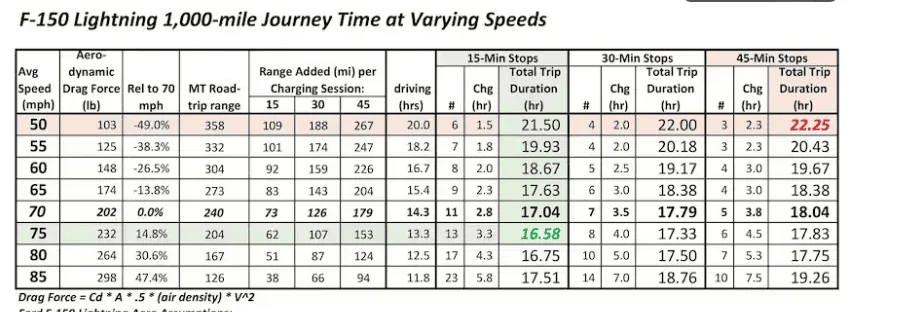
Key word there is theoretical. At a speed of 70 mph that's 11 15-minute charging stops on that 1000 mile trip vs, five stops when it's a 45-minute charge. All to save exactly one hour.

I think I'd give up that hour of my life so I could bypass the frustration involved in finding those additional six non-functional/throttled EA chargers along the route.

Rivian R1T R1S MotorTrend trip charging strategy comparison Screenshot 2023-08-23 at 8.42.45 AM
 

usofrob

Well-Known Member
First Name
Robert
Joined
Apr 9, 2022
Threads
5
Messages
671
Reaction score
583
Location
Michigan
Vehicles
Tesla 3, lotus Elise
Occupation
MBSE
I like they that started this, but it seems a little incomplete.

First, it looks like they assume all the energy used is based on aerodynamic drag, and that it will increase exactly as theoretically would with a more simple shape. For example, Out of Spec did a test with (I think a Rivian) showing the measured energy used difference at 60, 70 and 80 mph. I remember it being about 20% more for each 10 mph.

Second, they don't seem to account for time to get to the charger and start it up. If you assume 5 minutes per stop, that would shift things around a lot.

Also, I didn't see how they calculated the range added, what % charge were they using?
 

docwhiz

Well-Known Member
First Name
Mark
Joined
May 22, 2023
Threads
5
Messages
668
Reaction score
618
Location
Lake Tahoe, California
Vehicles
Tesla Model S LR (2022), Land Rover Discovery 2
Occupation
Retired
I like they that started this, but it seems a little incomplete.

First, it looks like they assume all the energy used is based on aerodynamic drag, and that it will increase exactly as theoretically would with a more simple shape. For example, Out of Spec did a test with (I think a Rivian) showing the measured energy used difference at 60, 70 and 80 mph. I remember it being about 20% more for each 10 mph.

Second, they don't seem to account for time to get to the charger and start it up. If you assume 5 minutes per stop, that would shift things around a lot.

Also, I didn't see how they calculated the range added, what % charge were they using?
Would have been better if they had measured actual efficiency at speeds rather than theoretical.
Another factor is social. I've found traveling in a EV is more relaxing due to frequent short rest stops.
 

Sponsored

usofrob

Well-Known Member
First Name
Robert
Joined
Apr 9, 2022
Threads
5
Messages
671
Reaction score
583
Location
Michigan
Vehicles
Tesla 3, lotus Elise
Occupation
MBSE
Would have been better if they had measured actual efficiency at speeds rather than theoretical.
Another factor is social. I've found traveling in a EV is more relaxing due to frequent short rest stops.
I agree. I have had a Tesla for a few years now. And I noticed that we stop for longer, but arrive more rested. We usually take time to get a meal, or maybe at least a short walk around the area.
 

Buck

Member
First Name
Buck
Joined
Jun 1, 2020
Threads
2
Messages
15
Reaction score
21
Location
Asheville, NC
Vehicles
R1T Limestone/Forest Edge
Occupation
Welder
Clubs
 
I've done a lot of thinking and testing on this subject. 31,000 miles currently on my R1T with about half of that being long distance interstate trips. TL;DR the faster you drive, the faster your trip goes.

The article is uselessly theoretical. In the real world we can't choose to stop and charge at precise intervals. We have to use the chargers that are available. Also not taken into account is the time it takes to detour from your route to find the charger, plug in, and start charging. Third, efficiency at a given speed is highly variable. Yes in general faster = less efficient, but there are so many other factors affecting efficiency that it's almost impossible to plan a trip based on a given theoretical efficiency number at X speed. Traffic speed and density, elevation change, temperature, and wind speed greatly affect efficiency at highway speeds. Lastly, and most importantly IMO, charging speeds are wildly variable. Most stations other than RAN are usually outputting less than advertised, and the charge curve achievable by the station and vehicle is often unpredictable. With any math I've ever done, as long as you're charging over 50kW and will have enough range to get to the next charging station, driving as fast is possible yields higher average speeds on a road trip even if that means you have to stay at the charger longer.

Anecdotally, during my recent 6000 mile cross country road trip I travelled in parallel with several other R1Ts for hundreds of miles at a time. I set my cruise control at 85mph whenever conditions allow. The other Rivians I would pass were travelling much slower - more efficiently (apprx. 70-75mph). Twice it worked out where I would pass a R1T, stop to charge, the other truck would catch up to me at the same charging station, leave before me, then later I would pass them again on the highway. With this sort of leap frogging my average speed was clearly faster than the slower/more efficient trucks, again even though I was stuck at the charger for a longer time. In both cases I was also on a less efficient tire setup (20" AT vs 21" AS) and I was hauling a motorcycle in the bed of the truck vs an empty bed/closed tonneau. I had every efficiency disadvantage, but still managed to travel much faster on average.

My current priorities for maximum road trip speed are:
  1. Choose the fastest charge stations. Check plugshare, etc. to confirm high speed operation.
  2. When possible, choose charging intervals that keep charging sessions at the highest speeds (target 0 - 70% SOC)
  3. Drive as fast as reasonably possible as long as you will have enough range to get to the next charger.
 
Last edited:

emoore

Well-Known Member
Joined
Nov 29, 2020
Threads
4
Messages
3,815
Reaction score
4,240
Location
Colorado
Vehicles
2022 R1T
Would have been better if they had measured actual efficiency at speeds rather than theoretical.
Another factor is social. I've found traveling in a EV is more relaxing due to frequent short rest stops.
Totally agree. Also once you road trip in an EV the range anxiety tends to go away. I was worried on my first long road trip so I typically charged more frequently from 50%-85%. But on the way back I felt a lot more comfortable going from 20%-70% and it was quicker.
 

Cosmacelf

Well-Known Member
Joined
Nov 11, 2020
Threads
20
Messages
442
Reaction score
530
Location
San Diego, CA
Vehicles
Rivian R1S, Tesla Model X
Occupation
Software
The real world experience is that you drive as fast as possible, resulting in lower SOC, which allows you to charge the fastest on high powered fast chargers. All you need to know is that fast DC chargers can give you 300 miles or range in an hour. As long as you don’t drive faster than 300 mph, that’s the best strategy then.
 

RexRemus

Well-Known Member
First Name
Chuck
Joined
Sep 27, 2021
Threads
42
Messages
759
Reaction score
1,345
Location
Chicago, IL
Vehicles
2023 R1S
Clubs
 
The real world experience is that you drive as fast as possible, resulting in lower SOC, which allows you to charge the fastest on high powered fast chargers. All you need to know is that fast DC chargers can give you 300 miles or range in an hour. As long as you don’t drive faster than 300 mph, that’s the best strategy then.
Sigh... fine...

<pushes top-fuel dragster back into garage>
 

Sponsored

usofrob

Well-Known Member
First Name
Robert
Joined
Apr 9, 2022
Threads
5
Messages
671
Reaction score
583
Location
Michigan
Vehicles
Tesla 3, lotus Elise
Occupation
MBSE
I need to update my comment from before, they did actually run a test at every 5 mph and plotted it on the graph against their theoretical and they didn't match, and chose the theoretical values instead for some reason. The real world values clearly show less range at lower speeds and better range at higher speeds than the theoretical calculation. This makes sense to me because not all losses are aerodynamic, some are static or linearly relating to speed.

Still in reality it's as summarized by others that it's better to go as fast as you can and arrive with a low state of charge, charge until you have enough range to make it to the next charger that's still within the like 50-70% range of the vehicle.

I do wonder at what point that breaks down. Like if the Ford could travel at 150 mph, would it still be an advantage to do that? When charging a Tesla, it gives you an estimated charging rate in miles per hour. To do that it uses the estimate of it's supposed efficiency to calculate the amount of energy to go a mile, then use that to calculate the miles/hour. But as we all know, that rate efficiency is only true if you're going slow (not freeway speed). I've never sustained over 100mph in my Tesla to see what it's efficiency is, but it could be like 3x the rated efficiency. So, when charging at a Supercharger, it'd only be worth going that fast if you stopped charging when the charger gives out at a rate of 300 miles per hour. But actually higher than that, because of the added time it takes to get to the charger and start charging.
 

Buck

Member
First Name
Buck
Joined
Jun 1, 2020
Threads
2
Messages
15
Reaction score
21
Location
Asheville, NC
Vehicles
R1T Limestone/Forest Edge
Occupation
Welder
Clubs
 
I need to update my comment from before, they did actually run a test at every 5 mph and plotted it on the graph against their theoretical and they didn't match, and chose the theoretical values instead for some reason. The real world values clearly show less range at lower speeds and better range at higher speeds than the theoretical calculation. This makes sense to me because not all losses are aerodynamic, some are static or linearly relating to speed.

Still in reality it's as summarized by others that it's better to go as fast as you can and arrive with a low state of charge, charge until you have enough range to make it to the next charger that's still within the like 50-70% range of the vehicle.

I do wonder at what point that breaks down. Like if the Ford could travel at 150 mph, would it still be an advantage to do that? When charging a Tesla, it gives you an estimated charging rate in miles per hour. To do that it uses the estimate of it's supposed efficiency to calculate the amount of energy to go a mile, then use that to calculate the miles/hour. But as we all know, that rate efficiency is only true if you're going slow (not freeway speed). I've never sustained over 100mph in my Tesla to see what it's efficiency is, but it could be like 3x the rated efficiency. So, when charging at a Supercharger, it'd only be worth going that fast if you stopped charging when the charger gives out at a rate of 300 miles per hour. But actually higher than that, because of the added time it takes to get to the charger and start charging.
Realistically I think it begins to break down if you're using level 2 charging, especially as you dip below 11kW; e.g. when the last leg of your mileage for one day of a multi day trip ends at a hotel with a 6kW charger.

Otherwise, as DCFC and EV efficiency improves it will practically never be true that higher speeds have diminishing returns for overall average trip speed. I'd estimate deep triple digit speed before it's a real issue. Maybe in some kind of auto racing application.
 

sub

Well-Known Member
Joined
Jul 23, 2021
Threads
34
Messages
1,873
Reaction score
3,306
Location
USA
Vehicles
Rivian R1S, Tesla Model 3
Garbage story/analysis. It doesn't seem like they took into account any of the overhead involved in a charge stop. A 15 minute charge does not take 15 minutes.

Best case scenario, you have 5 minutes driving to the charger(and finding it), and another 5 minutes to get back on the road after charging. So the 2 15-minute charges actually take 50 minutes. While 1 30-minute stop only takes 40 minutes. Hang around for another minute or two and you will end up with more charge in less time with one stop.

And that is the best case scenario. Often the charger is more than 5 minutes out of the way. And you are going to at least occasionally have to wait for an occupied charger to free up or to have to call the support line to have them fix the charger.

More realistically, they should assume at least 30 minutes of overhead per stop. 15 minutes of charging takes 45 minutes and 30 minutes of charging takes an hour.

Plug that into the equation and I would be shocked if it suggests you make numerous, short, charging stops.
 

SANZC02

Well-Known Member
First Name
Bob
Joined
Feb 11, 2021
Threads
50
Messages
7,424
Reaction score
12,716
Location
California
Vehicles
Tesla Model S, LE - R1S
Occupation
Retired
This chart seems pretty close to what I found on a 5100 mile trip. Was pretty much staying around 70 except where speeds were higher. Was doing 75 in 75 and found 78 to be better where speeds were 80. My miles per kW was decent around 2.25 on 22s for the trip. Easily was able to get to chargers with plenty of reserve charging to 70-80%. I was seeing decent speed charging until around 72-73% so would stop just at the drop off if range was not needed.

There was 1 section on I-10 in western Texas where I pulled in and there was a Ford lightening charging. Talked to him and he was heading to SoCal. For the next few stations we saw each other, he left about 15 minutes before me, next stop he left about 5 minutes before me, next stop I left before him but never saw him again.


Top