
Sponsored

Charging your R1T 70 or 85%

SeaGeo

Well-Known Member
First Name
Brice
Joined
Jan 12, 2021
Threads
50
Messages
5,673
Reaction score
10,212
Location
Seattle
Vehicles
Xc60 T8
Occupation
Engineer
Why wouldn’t you? You paid for it, right? It’s not like that upper 30% requires additional $$$.
As a volunteer for local Search and Rescue, I’m on call 24/7/365. We may get a call and have to drive 50+ miles one way. I almost always charge 70% anytime I can plug in. On the weekends (starting Thursday night) I charge to 85% because I know I drive more on the weekends. I have only charged to 100% twice.
Your behavior is exactly what I described. You're charging to 70% daily and when you're more likely to drive further you're cheng to 85%. So why aren't you charging to 85% every day?
Sponsored


ElGuapo

Well-Known Member
Joined
Jul 10, 2023
Threads
3
Messages
249
Reaction score
291
Location
Maryland
Vehicles
R1S - April 2021 preorder
My "ask" is Rivian try to provide better guidance on what will truly negatively impact battery life. Obviously, charging to 100% (and leaving it there for a bit) is bad to do over and over. Same with fast charging a ton. However, my sense (from owning three Teslas) is it should not matter whether you choose to charge to 70% or 90% daily. Regardless of whether you "need" it or not.

That said, the battery tech is different in Teslas and Rivians.
 

Prime

Well-Known Member
Joined
Jul 18, 2022
Threads
11
Messages
1,168
Reaction score
1,173
Location
SoCali
Vehicles
Tesla MY(P), Rivian R1T
I go right in the middle and charge to 80% everyday and if I know I'll be driving longer a specific day 90%.
 

RivAW

Well-Known Member
First Name
Alex
Joined
Mar 9, 2023
Threads
1
Messages
871
Reaction score
850
Location
MA
Vehicles
R1T, Glacier White, Black Mountain, Black AT 20s,
Clubs
 
Why would you charge it to 85% unless you're driving more than about 190 miles a day? I just don't understand the desire of charging to 85 or 100% unless you actually need it.
Well, for one, it does not actually degrade the battery any more than charging to a lower level. Also, not everyone has a reliably equal amount of daily driving and its generally a good idea to have extra SOC in case something unexpected comes up (since Rivian's charge relatively slowly [at home]). My daily commute is ~60 miles RT, but who knows what might come up on a given day with plans, diversions, kids etc.....Not to mention to potential emergency circumstance...better to have the extra SOC and not need it than find yourself really needing it but not having it...
 

MidnightRivian

Well-Known Member
Joined
Jun 21, 2021
Threads
98
Messages
2,296
Reaction score
3,671
Location
USA
Vehicles
Rivian R1S
Clubs
 
I’m not here trying to save the cells for the next guy.

If I can get a new battery in 8 years, why am I trying to baby my current one.


Daily I charge between 85-93 and on the weekends I go to 100.

I never know when I want to go on a spontaneous road trip or use the vehicle to camp in or as a power source.

I believe in ABC - Always Be Charging and I personally believe in using 100% of what I paid for.

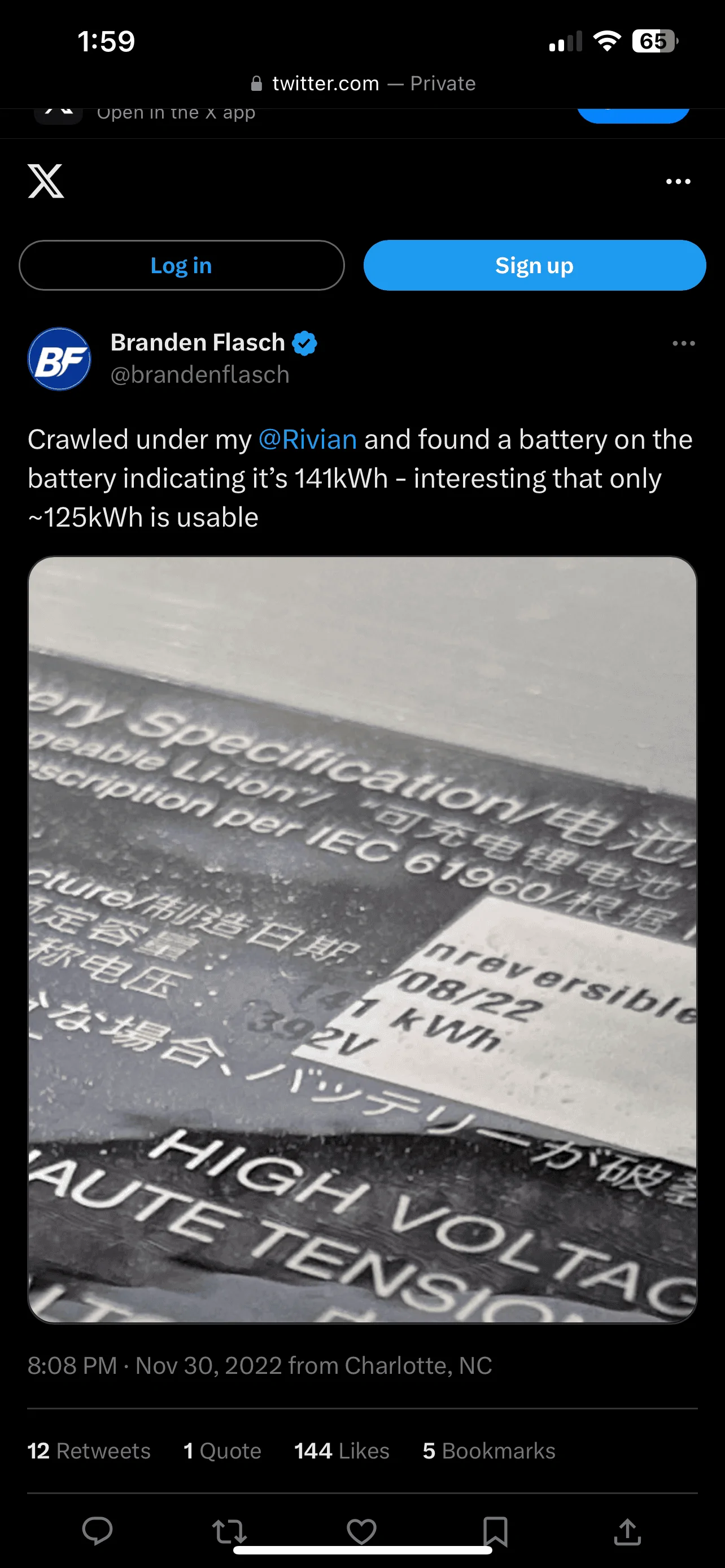
I believe our battery is 14 kWh but we only have access to 127 kWH and they’ll slowly release the buffer to account for degradation.

I hope you use and enjoy the hell out of your Rivian.

Let RJ and the shareholders worry about the cost to replace your battery. I say this as an active trader / shareholder.


Don’t try to save your car for the next guy.

https://www.batterydesign.net/rivian-r1t/

Rivian R1T R1S Charging your R1T 70 or 85% IMG_2600
 
Last edited:

Sponsored

RivAW

Well-Known Member
First Name
Alex
Joined
Mar 9, 2023
Threads
1
Messages
871
Reaction score
850
Location
MA
Vehicles
R1T, Glacier White, Black Mountain, Black AT 20s,
Clubs
 
Do you charge to 70 or 85?

the warranty is 70% charge retainment for 8 years or 175K.

Why do I care if 85% will be deteriorating the battery more moderately? if within 8 years the truck can’t hold 70% charge Rivian will give me new battery.

Do I have to charge to 70 every time to utilize the warranty.

I would like to charge to 80 and not 85%. I think 80 is a good balance. Get a bit more in mileage and battery deteriorate just a little bit more.
Thoughts ?
There is no actual science suggesting that charging to any specific percentage will degrade the battery faster (except that you the battery doesn't like to be at extremes....so charge to 100% only if you need it and don't let the vehicle sit at that state of charge for an extended time). You will never notice a difference in battery health charging to 85 (or 90) versus charging to 70. Finally, you are misunderstanding the language of the warranty. The warranty means that the battery health (max state of charge) cannot degrade more than 30% in that time/mileage (regardless of how often or how much you charge it), without having to be replaced by the manufacturer.
 

moosetags

Well-Known Member
First Name
SuEllyn & Brian
Joined
Dec 25, 2021
Threads
110
Messages
1,940
Reaction score
3,219
Location
Santa Rosa Beach, Florida
Vehicles
2023 R1T; 2020 Chevy Duramax; 1956 Ford Tbird
Occupation
Retired
Clubs
 
When we drove Opal (our R1T) back to Florida from the Factory in Normal (900 miles), we charged her to 100% each night at the campground. Since she has been home, we charge her to 75% and use that charge until we get down to 30% before we charge her again. We are hoping that this keeps her in good battery health.

Brian
 

SeaGeo

Well-Known Member
First Name
Brice
Joined
Jan 12, 2021
Threads
50
Messages
5,673
Reaction score
10,212
Location
Seattle
Vehicles
Xc60 T8
Occupation
Engineer
Well, for one, it does not actually degrade the battery any more than charging to a lower level. Also, not everyone has a reliably equal amount of daily driving and its generally a good idea to have extra SOC in case something unexpected comes up (since Rivian's charge relatively slowly [at home]). My daily commute is ~60 miles RT, but who knows what might come up on a given day with plans, diversions, kids etc.....Not to mention to potential emergency circumstance...better to have the extra SOC and not need it than find yourself really needing it but not having it...
Well, for one, your statement that it doesn't degrade it "any" is in conflict with what's implied by RIvian's settings, and is also in conflict with some quotes from Professor Dahn. Is the impact large? No, but it's still there.

Even with your 60 mile commute you have an 80 mile buffer at 70%. So you have over a 100% buffer on your daily commute. Adding another 42 miles (70% to 85%) solves your range anxiety but an 80 mile buffer doesn't? Why not charge to 100% and get yet another 42 miles of buffer just in case?

Obviously feel free to charge more to calm any range anxiety, but the likelihood of needing to drive an unplanned an extra 80 miles in a day is usually quite small for the vast majority of people.

Here's a link summarizing a discussion from Jeff Dahn. Annoyingly the video the linked to in the post below is now private on YouTube.


The key takeaways of this video are:
1) Jeff's advice in the video only applies to high nickel batteries in long range vehicles! Not LFP standard range vehicles.
2) High temperatures kill batteries. If you go on a holiday/vacation during the summer, leave your vehicle at a low SOC (state of charge). For example: At or below 30% SOC
3) Cycle within a narrow SOC range. For example: 40-60% rather than 10-80%. The cathode expands and contracts in a wider SOC range, which causes it to break apart.
4) On that note: The lower the narrower the SOC range, the better. That means charging frequently.
5) Avoid charging the vehicle above 75% SOC. Above 75% side reactions start occuring that cause degradation. This also reduces the volume expansion issues mentioned in 3).
6) Taking all variables into account, operating between 45-70% SOC and storage at ~30% is ideal. 7) Occasional high SOC and wide SOC range are okay! For example, the occasional roadtrip.
8) With good thermal management hardware and battery managment software, supercharging should have minimal negative effect on cycle life. Watch the video if you'd like more specifics! https://youtu.be/mN91pS1hSSQ It's worth watching because Jeff Dahn is one of the fathers of the Lithium Ion battery and his lab is partnered with Tesla.
 
Last edited:

shap

Well-Known Member
Joined
Nov 18, 2021
Threads
16
Messages
870
Reaction score
765
Location
Austin,TX
Vehicles
BMW 45e, R1T
Clubs
 
My "ask" is Rivian try to provide better guidance on what will truly negatively impact battery life. Obviously, charging to 100% (and leaving it there for a bit) is bad to do over and over. Same with fast charging a ton. However, my sense (from owning three Teslas) is it should not matter whether you choose to charge to 70% or 90% daily. Regardless of whether you "need" it or not.

That said, the battery tech is different in Teslas and Rivians.
Is it the same NMC battery chemistry for Tesla and Rivian (except LPF batteries for RWD Model 3 and RWD Model Y standard range)?
 

ElGuapo

Well-Known Member
Joined
Jul 10, 2023
Threads
3
Messages
249
Reaction score
291
Location
Maryland
Vehicles
R1S - April 2021 preorder
Is it the same NMC battery chemistry for Tesla and Rivian (except LPF batteries for RWD Model 3 and RWD Model Y standard range)?
Rivian now uses LFP batteries as well. However, they are not identical to Tesla (or Ford or GM) batteries. As well, equally important, the software managing the batteries is different (e.g. heating/cooling batteries, when/how battery regen works, etc.). My only point was not to say one is better than the other, just to say they're different.

I agree staying in a range (pun intended) of, say 30-70% in general is likely best. That said, we don't know.

If Rivian is like Tesla, they will do everything they can to avoid replacing batteries - even if degradation is legitimate. My Model Y is a 2021, supercharged once, very rarely charged to 100% and itsn't driven hard and has 303 miles of range at 100% now (I tested it) versus 330 in June 2021. 10% seems a lot over two years as I had 12% over six years for my X. But Tesla says it's fine...
 

Sponsored

shap

Well-Known Member
Joined
Nov 18, 2021
Threads
16
Messages
870
Reaction score
765
Location
Austin,TX
Vehicles
BMW 45e, R1T
Clubs
 
Rivian now uses LFP batteries as well. However, they are not identical to Tesla (or Ford or GM) batteries. As well, equally important, the software managing the batteries is different (e.g. heating/cooling batteries, when/how battery regen works, etc.). My only point was not to say one is better than the other, just to say they're different.

I agree staying in a range (pun intended) of, say 30-70% in general is likely best. That said, we don't know.

If Rivian is like Tesla, they will do everything they can to avoid replacing batteries - even if degradation is legitimate. My Model Y is a 2021, supercharged once, very rarely charged to 100% and itsn't driven hard and has 303 miles of range at 100% now (I tested it) versus 330 in June 2021. 10% seems a lot over two years as I had 12% over six years for my X. But Tesla says it's fine...
Rivian is planning to use LFP, but not using it for now. NMC is used in R1T and R1S (at least for now).

As for your battery degradation in Tesla - you may need to open a service menu and see kWh capacity and not how many miles you can drive. Miles will vary based on the software calculations and version.

Said that it is kind of "normal" to lose up to 8-10% in the first year, and afterward degradation should become very slow. But companies are not stupid to warrant only 70% of capacity :)
 

Oldsmobile_Mike

Well-Known Member
First Name
Mike
Joined
Mar 24, 2022
Threads
62
Messages
2,421
Reaction score
3,905
Location
Manassas Park, VA
Vehicles
FG/FE R1T recv'd 3/31/2023
Occupation
I build stuff
Clubs
 
Personally charge to 85% every three days or so. Guess in 10 years we can revisit this discussion to see which of the many charging strategies worked out the best for folks. ?
 

dleepnw

Well-Known Member
Joined
May 13, 2021
Threads
148
Messages
3,021
Reaction score
3,423
Location
WA
Vehicles
Rivian, Toyota, Lexus
Clubs
 
im sure Rivians warranty is based off good science and learnings from Tesla to minimize cost for them, so i doubt many of us are going to exceed the warranty limits. so its likely whether we charge to 70% or 100% it probably wont matter before 8 years or 175k miles

so charge away!
 

trez63

Well-Known Member
Joined
Mar 7, 2022
Threads
46
Messages
377
Reaction score
707
Location
SoCal
Vehicles
R1T, Gladiator, Porsche GT4, and a bunch of bikes
Clubs
 
Why would you charge it to 85% unless you're driving more than about 190 miles a day? I just don't understand the desire of charging to 85 or 100% unless you actually need it.
Is it really that hard to understand that some people have a more unpredictable range requirement than you due to the nature of their work or the dynamics of their life?
 

sub

Well-Known Member
Joined
Jul 23, 2021
Threads
34
Messages
1,873
Reaction score
3,306
Location
USA
Vehicles
Rivian R1S, Tesla Model 3
Do you charge to 70 or 85?

the warranty is 70% charge retainment for 8 years or 175K.

Why do I care if 85% will be deteriorating the battery more moderately? if within 8 years the truck can’t hold 70% charge Rivian will give me new battery.

Do I have to charge to 70 every time to utilize the warranty.

I would like to charge to 80 and not 85%. I think 80 is a good balance. Get a bit more in mileage and battery deteriorate just a little bit more.
Thoughts ?
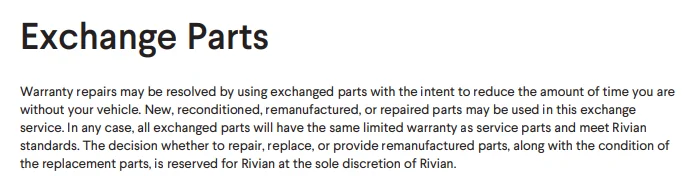
There is not a warranty concern. Charging to 100% every day is not going to void the warranty. However, the warranty specifically permits Rivian to install used parts when they perform the repair. So when you do drop below 70% and Rivian does replace your battery, all they have to do is push you back above 70%. The "replacement" might only push you back up to 75%.

Rivian R1T R1S Charging your R1T 70 or 85% 1690831509787


The reason to be nice to your battery is to minimize degradation, because you would rather not ever see anything close to 30% degradation. The numbers below are completely made up - but the desire to be in bucket #2 rather than bucket #1 is the reason to be nice to the battery.

Hypothetical Scenario #1:

Charge to 100% every day and perhaps after a few years you have 25% degradation. You can continue to charge to 100% confident that it can't get much worse, but charging to 100% is only 300*.75 = 225 miles of range.

Or Hypothetical Scenario 2:

Your daily charge is 70%. After a few years you have 5% degradation. Your daily 70% charge has nearly as much range as the guy in #1's 100% charge, and when you charge to 100% for your annual road trip, you have 300*.95 = 285 miles of range.

There is no guarantee that being nice to the battery will land you in scenario #2, and if you actually need more range than you get with 70% charge then you should charge more and not feel at all guilty. But if you don't actually need the extra range on your typical day, why increase the chances of landing in #1?
Sponsored


Top