
Sponsored

Rivian doesn't cost less to drive on long trips

rhumbliner

Well-Known Member
First Name
thomas
Joined
Nov 8, 2020
Threads
12
Messages
335
Reaction score
527
Location
Bend
Vehicles
R1T & Model X
Occupation
Retired
OT, but have you tried getting in and out of R1T yet? In standard ride height,
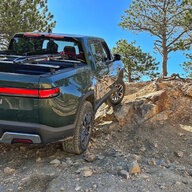
Are you using Kneel Mode? We use it all the time but, in addition, I installed running boards to make it even easier on my wife.
Sponsored


zefram47

Well-Known Member
First Name
Aaron
Joined
Feb 6, 2022
Threads
18
Messages
2,749
Reaction score
4,511
Location
Denver, CO
Vehicles
Rivian R1T, Alfa Romeo 4C
Occupation
Software Engineer
...significantly fewer brake fluid changes...

Side note, but changing brake fluid has very little to do with brake use and everything to do with moisture accumulating in the brake fluid since it's not a closed system. That usually a time component, shorter in more humid areas and maybe a bit longer in dry climates. Folks that tow or live in the mountains and actually use their brakes more or risk boiling the fluid would want to change it more frequently (less so due to regen vs always using friction brakes, etc). But generally DOT 4 is said to be a 2 year replacement frequency. On something like my track car it needs to be done annually or after a couple track days. Maybe you meant fewer brake pad changes?

Reason behind this is brake fluid is rated for a dry and wet boiling point where the wet boiling point is often dramatically lower. So brake fluid that has accumulated a lot of moisture will boil / overheat much earlier than a dry fluid. Maybe not important for a single emergency stop situation, but it would be during repeated braking events descending a mountain pass, while towing, etc. I'd also suspect that the recently released regen assist will find folks unintentionally using brakes a lot more than they have been, but time will tell on that one.
 

CTRedCanyon

Well-Known Member
First Name
Matt
Joined
Oct 24, 2023
Threads
6
Messages
161
Reaction score
488
Location
Connecticut
Vehicles
Rivian R1S, Tesla Model S, Kia Telluride
Occupation
Self Employed IT
Clubs
 
Don't forget that your first and last 250+ miles can be charged at home if you time it right. Which means on a 1000 mile road trip you could potentially do half the charging at your home rate for much less. There's no half price gas. Plus you have an SUV or truck that can do 0-60 in 3 seconds flat. Compare to those gas vehicles like a Ram TRX - 15 MPG on premium.
 

Bob Steele

Member
First Name
Bob
Joined
Nov 27, 2023
Threads
0
Messages
16
Reaction score
6
Location
Bon Air, VA
Vehicles
R1T, Porsche Taycan, 2022 Defender, 2020 Defender
Occupation
Architect
I regularly drive my 2023 R1T on highway trips between 500 - 750 miles RT. Here in the Mid-Atlantic, the cost at RAN and EA chargers typically runs $0.36. Averaging 2.3 KwH/HR, I average about $0.16/mile. Our charging rates through Dominion Energy are very low - in the $0.03 - $0.05 range. Our total residential off peak rate is closer to $0.09, but I only include the uncharge for EV powering, not our base residential costs. Thus, my cost is as little as $0.03/mile. While I did not purchase my Rivian to save on my ICE fuel bills, I am pained each time I read in the press that it cost about the same to power an EV as an ICE. To boot, between my Taycan and R1T, I have put close to 30K on the odometer and yet to incur any maintenance or repair bills. The 5 ICE vehicles in my driveway can't say that.
 
Last edited:

elfordon

Well-Known Member
First Name
Elfordon
Joined
Sep 1, 2021
Threads
9
Messages
98
Reaction score
152
Location
IL
Vehicles
Chevy Bolt, Large Charge Marge (Max Pack R1T)
Occupation
retired
Clubs
 
...because the grid can't support it all.

From: https://advocacy.consumerreports.org/research/blog-can-the-grid-handle-evs-yes/

"Electrifying the entire US light-duty vehicle fleet by 2050 will require less than 1% growth per year in overall electricity generation. Furthermore, complying with the EPA’s latest GHG standards for light duty vehicles will create only a 6% increase in electricity demand by the end of 2032. So, the answer is yes—the grid can absolutely handle all those EVs."
 

Sponsored

Rividiculous

Well-Known Member
First Name
Eric
Joined
Nov 23, 2023
Threads
11
Messages
565
Reaction score
1,094
Location
New York City
Vehicles
2025 R1S, 2006 3 series
I think that part of the “problem” here is that EVs and charging is so new to many of us (including me—I’m still waiting on my R1S). There is enough competition among gas stations to drive prices down—there’s less opportunity for inefficient stations or for price gouging.

With charging stations, it seems like pricing is more variable and even includes different methodologies. And given the scarcity of chargers in some places, there are opportunities for price gouging.

I suspect that with time, charging pricing will become more standardized and more transparent. (And charging will become more dependable, faster, and generally easier.) Also, we consumers will get better at charging when demand is lower, reducing costs (and CO2 emissions).

It might take a while and a lot of growing pains, but we should get there. One can hope, at least!
 

Tahoe Man

Banned
Well-Known Member
Joined
Aug 12, 2022
Threads
1
Messages
561
Reaction score
498
Location
Tahoe
Vehicles
Chevy Volt
I don't get this. Enlighten me, you spend 70,80,90k for a vehicle but you're worried about spending 70, 80, 90 bucks on gas or electric for a road trip??? Really?
 

Riviot

Well-Known Member
Joined
Mar 29, 2021
Threads
121
Messages
6,430
Reaction score
10,804
Location
Kitsap, WA
Vehicles
R1T
Clubs
 
It's only that way because we depend on importing oil instead of doing it all here. We could easily be energy independent and never depend on OPEC and South America ever again. If gas prices were solely based on the evil oil companies demands, why didn't they just raise prices to $4-5 gal under the previous administration? Burdensome regulations and importation of oil are why gas prices are high, even after depleting our strategic petroleum reserve.

Obvious political yawyawing aside, even with domestic supplies of all petroleum types (sweet, sour, heavy, light, etc) meeting domestic demand, global economics win out and prices will spike here because they get more money exporting to countries who want it more (see: southeast Asia).

Lower supply (anywhere, it's a global market), demand remains constant, prices rise. Macro-economics 101. Why do you think OPEC has been dropping production? Same money selling less product, extending overall value of their supply.
 

Deacon

Well-Known Member
First Name
Ernie
Joined
Aug 25, 2021
Threads
8
Messages
317
Reaction score
382
Location
North Carolina
Vehicles
Subaru Forester, Rivian R1T
Occupation
Retired
Clubs
 
Right, paying ~0.12/kWh, but this is western Washington which is pretty cheap. Although, I do agree with the OP, if you are tied to DC fast charging, the economics don’t look that great.
I pay .12/kWh at home and generally about .34 for EA fast chargers. On long road trips I try and stay in hotels with free charging - that give me 200-300 free miles.
 

Windblade

Well-Known Member
First Name
Tom
Joined
Mar 20, 2023
Threads
1
Messages
46
Reaction score
23
Location
Solvang, CA
Vehicles
R1S
Occupation
Manager
We spend a lot of time going to/from hockey games & tournaments from middle Tennessee (e.g., to Chicago, Atlanta, Raleigh, Columbia SC, etc.). Stopping at fast charge locations has been more than manageable. Often, we get charging for free at the hotels and rinks, while home charging is $0.14 per kwh. Lack of oil changes, etc., is a bonus. Tires are wearing reasonably well with plenty of tread at 25k miles to lasts another 3k or so. Currently, a ton of snow and a VERY steep hill with snow on it to climb to get into our property but done without any issue because of the vehicle weight. So far, so good.

On the cost side, $2k for tires every 28k miles should be factored into the equation vs. similar cost for a large ICE SUV.
 

Sponsored

BigSkies

Well-Known Member
First Name
Brian
Joined
Sep 4, 2021
Threads
17
Messages
1,231
Reaction score
2,646
Location
Denver
Vehicles
R1T, Model Y
Clubs
 
Piling on what other have said, DCFC can be as expensive as gasoline, but is usually less in practice. Factors:

1. The first ~300 miles of your trip is charged at residential rates and the last ~250 miles is charged at residential rates. Let's just say 500 miles ish. That's 25% of a 2,000 mile road trip at residential rates.
2. Hotels will commonly give you free L2 charging overnight. That's ~70kWh/day free on a 6.6kW charger.
3. Many cities you're visiting will have L2 chargers available at various spots. Using them when available will get you electricity only slightly marked up over residential rates.
4. $0.5/kWh is on the higher end, even for California. When visiting LA over the holidays, I paid everywhere from $0.15 to $0.50 per kWh for charging. Most were in the low $0.3/kWh range after paying for the EA pass.

On my 2,500 mile road trip, I paid somewhere in the neighborhood of $0.15-$0.20 per mile. I didn't track it precisely. But I could do it cheaper next time, as I ended up over-using a $0.50/kWh charger when I later found a $0.16/kWh charger just a mile away.
 

gregtay

Well-Known Member
First Name
Greg
Joined
May 24, 2023
Threads
6
Messages
212
Reaction score
301
Location
Redmond, WA -> Scottsdale AZ
Vehicles
'23 R1S LS/OC, '21 Escalade, '13 RS5 Cab
I don't remember anything on Rivian's literature that stated "buy a Rivian because it is cheaper to drive". If that was the reason for purchasing an 80-100k truck/SUV.. then I think you purchased the wrong vehicle.
 

IGR

Well-Known Member
Joined
Jul 7, 2023
Threads
8
Messages
360
Reaction score
506
Location
SoCal
Vehicles
Rivian R1S
Occupation
I make things
Clubs
 
Now that I've observed the vehicle on longer trips I'm realizing that there isn't much difference in cost per mile vs our V8 powered 2007 Lexus GX470 here in CA.

GX: $5 per gal / 20mpg= .25 per mile
R1S: $.50 per kw dcfc / 2 mi per kwh = .25 per mile

What's everyone else seeing? Home charging costs about half as much so it's like a 40mpg SUV in that case. Although it's classified as 75mpge, you have to fill it with $8-$16 per gal "gas."
I agree with your statement, and that's just what we have to live with in California lol.
But personally the reason I got Rivian is the same as when I was getting fast toys with big v8's, its about smiles per gallon or rather per kwh in this case ;)
 

Scoiatael

Well-Known Member
Joined
Sep 20, 2021
Threads
49
Messages
1,162
Reaction score
1,816
Location
Southern CA
Vehicles
2025 R1S, 2024 Mach E
Pretty sure R1T is cheaper to drive than a comparable truck. My F150 used to get around 11 mpg on the freeway. Plus with gas usually $2 more per gallon on major routes, if I were driving on Highway 5 from Southern CA to Northern CA, there would be a big price difference.
 
OP
OP
HaveBlue

HaveBlue

Well-Known Member
Joined
Nov 22, 2022
Threads
41
Messages
2,926
Reaction score
2,234
Location
91107
Vehicles
R1S DMP Max, Lifted GX470, APR Audi A7, BMW 325Ci
Clubs
 
The Rivian costs about the same as most new premium SUVs. The gap feels closer than when the Model S came out competing with premium sedans. Feels like the Model 3 was competing against the Prius and of course was a nicer car in loads of ways. I think the lesson from this thread is that we don't get many price options with gas but there's the opportunity to save some depending on the source of power. I think I assumed that it would take a long time before the cost would be the same as a gas guzzler and in certain cases, we are there already. So Ca Edison already has .66/kwh residential peak rates and off peak in .30-.45! I feel sorry for those people.
Sponsored


Top