

DaveA
Well-Known Member
I'm 32 months in if I go by my truck's build date. ?Hmmm, I’m 27 months in on a gen1 with dual batteries. Am I living on borrowed time?
Sponsored
I'm 32 months in if I go by my truck's build date. ?Hmmm, I’m 27 months in on a gen1 with dual batteries. Am I living on borrowed time?
To actually answer your question, you'd need to pull them out, and charge/load test them individually.Hmmm, I’m 27 months in on a gen1 with dual batteries. Am I living on borrowed time?

I'm 32 months in if I go by my truck's build date. ?
That’s the now classic problem. No advanced warning. It would be great to load test them but getting them out without bricking the truck seems problematic. A problem waiting on a solution.To actually answer your question, you'd need to pull them out, and charge/load test them individually.
That's the only way to know. You could have batteries that are still 90% capable, or ones that are about to fail. No way to know without testing.
I deal with a lot of lead acid UPS batteries. A Lot. Charge/discharge cycles, ambient temperature, quality of manufacture, it all matters. Unfortunately, unless you load test them, they can report good voltage until the moment they fail. I don't know what sort of load testing the truck does on them internally to check health. It could be great, it could be horrible.
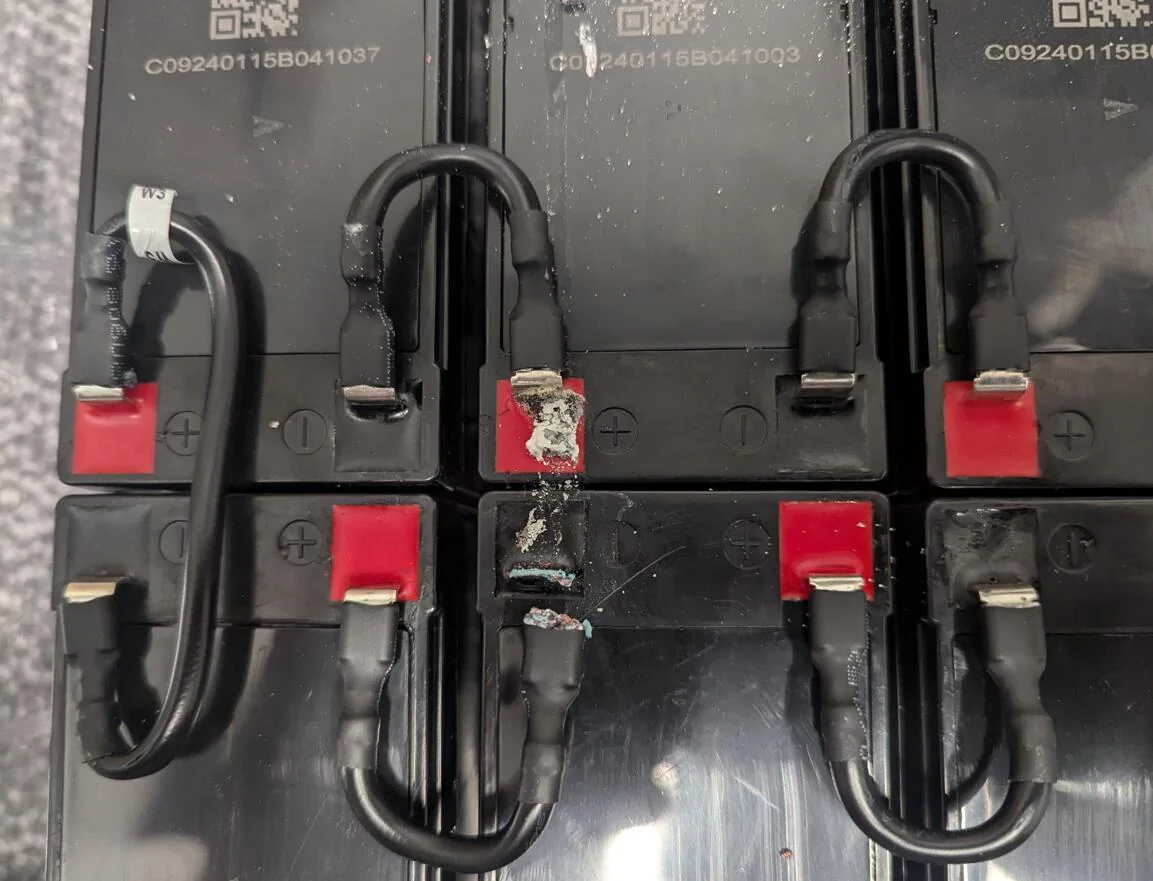
I just had to replace a UPS battery pack because it was working fine one day, and failed the next.
Turns out one of the SLA batteries in it had a small leak that led to corrosion of one of the battery tabs. It worked fine until the corrosion was enough to eat through the tab completely. Thats how these things go sometimes.

There is a common negative binding post for both 12V batts in the Gen 1 vehicles, they don't ground out at different spots on the chassis.That’s the now classic problem. No advanced warning. It would be great to load test them but getting them out without bricking the truck seems problematic. A problem waiting on a solution.
I was stranded this morning with zero warnings. I’ve had it for only seven months.I contacted Rivian regarding these batteries. They stated they last about 3 to 5 years. Once they start going bad, you'll get an initial warning. The system will last about a week with that warning. There after you're likely to be stranded after a 2nd warning.
I'm still trying to think of a place to both store and charge a 12v jump device that's accessible from outside the vehicle with no power.I was stranded this morning with zero warnings. I’ve had it for only seven months.
 .
.
I've also got a 3A battery tender with an OBD connector. My question is.......since my R1T has two 12v batteries, will plugging in the battery tender keep BOTH 12v batteries happy and charged OR will it only keep ONE of the two batteries happy???My current hedge is to have a 3A battery tender with OBD connector that I use to condition and charge the battery overnight periodically and before a long trip or camping, to minimize the maximal inconvenience of bricking while traveling or offroad. I figure if the battery tender successfully charges and conditions the battery it is unlikely to die imminently - plus as others have pointed out conditioning the battery can minimize vampire drain which can be stressful when off grid. The rear pigtails are really intended to be used to jump the dead battery using an ICE with jumper cables as the amperage requirement is high (30A) and for more than a few seconds. In other words, a standard jump pack (ie most NOCOs) will NOT work from the rear pigtails. You can use a high amperage jump pack (JNC 660 is popular) but it may not charge enough the few minutes it takes to start all the electronics in a dead vehicle. Even if you are successful waking the car up with the rear pigtails, it only gives you access to the doors/charging door/frunk so still doesn't guarantee drivability. I have considered storing a high output battery (ie Ecoflow or Ego Power Station) in the frunk with the plug in battery charger/conditioner, which would allow me to charge the battery directly (which requires storing or having the appropriate Torx screwdrivers in the hitch to access the frunk) but I irrationally can't quite bring myself to spending the money on a large battery pack when the vehicle I'm driving has 128kWh and shouldn't really need an additional kWh.
I am unable to find an answer for this and I am lucky enough to have the 1 battery/1 capacitor setup. I would guess that the OBD port gets power from only 1 battery, especially given that the rear pigtails also only charge 1 battery. Remember that using the OBD port is merely convenience. You can always access both batteries in the frunk fairly easily and can charge each separately with your tender if you want to be sure both are okay. Directions here for accessing the second battery: https://rivian.com/support/article/r1-tow-operator-guideI've also got a 3A battery tender with an OBD connector. My question is.......since my R1T has two 12v batteries, will plugging in the battery tender keep BOTH 12v batteries happy and charged OR will it only keep ONE of the two batteries happy???

Rivian contacted you out of the blue, or did you log a service request first?Rivian contacted me about a week ago and I'm actually having a proactive mobile service call next week to replace my 12v batteries. I'll have to ask the service tech whether both or only one of the batteries would be maintained. I (like you) suspect it is only one of the two. I may have to pick up a second battery tender so that I can maintain both batteries at the same time.
Rivian contacted me out of the blue. I suspect that they are trying to stay ahead of things now that they're aware of the 12v problem. I have a 2022 R1T...it is one of the ones that had TWO 12v batteries instead of just one. I think they made the change to one battery sometime early in 2023.Rivian contacted you out of the blue, or did you log a service request first?
The Rivian has a low capacity 12V battery (or 2 depending upon the model) and the large capacity high voltage battery. The high voltage battery has a battery maintainer built into it so in theory it is constantly monitoring the 12V battery and charging when needed. As the 12V battery starts to fail (which can happen for a variety of reasons including wear, faulty manufacturing, shorts, etc), the high voltage battery needs to wake up more often and charge up the battery. In some cases, you can see this with increased vampire drain, because when the high voltage battery wakes up to charge the 12V battery, there is a lot of electrical overhead that also starts up when this happens. In fact, this is why some people put their 12V battery on a battery tender to make sure that the 12V is optimally charged, which in some cases dramatically reduced the need for the high voltage battery system to wake up and charge the 12V battery. Some have kept their Rivians in long term storage attached to a battery tender to keep the 12V battery fully charged and they see little to no vampire drain. I think it is nearly impossible for the 12V battery to fail during a drive because the high voltage system is already running and charging the 12V battery. It's when you stop the vehicle and the high voltage system goes to sleep where the risk lies. If the 12V battery doesn't have enough juice to fire up the high voltage system (which can take 30amps at up to a minute or more) that's when bricking can occur. Certainly if you leave the USB ports on or seat belt plugged in you will get high voltage battery drain because the car is not going to sleep. 12V batteries in an EV have a completely different purpose and requirements than an ICE. I'm surprised that better batteries technology that can better tolerate high amperage discharge for a longer period isn't used but on the other head, lead acid batteries are very solidly proven and typically reliable technology. For me, the only real benefit to driving around with an EcoFlow or comparable battery would be in situations where bricking the 12V system would be a nightmare (ie primitive camping and long road trips). Otherwise I will always carry a battery tender in the front truck because I would otherwise typically be close to AC power. The other advantage (for me) in having a portable battery while camping is to use that battery for camping power needs to save electrons for travel. Rivians currently are not very efficient when you are using an electrical outlet (remember that they are powering a pretty hungry computer system even when charging the 12V battery).If our batteries in our 2024 R1S G1 fail, can this happen in the middle of the drive or once the car is “Awake” this is unlikely? I’m trying to understand, what do the 12V batteries power - just the on board electronics or also any accessories plugged into the USB-C ports? I’m trying to figure out if avoiding use of the USB-C ports with any higher voltage accessories (MacBook / vacuum cleaner) and driving around with my EcoFlow would have any benefit. My refrigerator / freezer is powered by the 120V outlet, so this would have no relevance to the 12V batteries, correct?


